Line Scan Lens Selection: Image Circle Math for 4K, 8K and 16K Sensors
Home - Lens Selection Guides - Line Scan Lens Selection: Image Circle Math for 4K, 8K and 16K Sensors
Reading Time: 7 min ( Word Count: 1,669 )
8192 × 5 µm = 40.96 mm. That is the line you must cover. A 2/3″ FA lens (11.00 mm diagonal) does not cover it. An 8K camera with a 29 mm image circle is a 5K camera with dark pixels on both ends. Line scan lens selection starts with that product: pixels times pitch, then a circle large enough to seat the chip with alignment margin.
Key Takeaways
Required image circle ≥ sensor line length = pixel count × pixel pitch. Add seating margin. Never use the area-scan format name.
8K at 5 µm is 40.96 mm. Lensmind EK4032A / EK5028A publish a 46 mm circle for that class. 16K at 3.5 µm is 57.344 mm.
Basler racer examples: 8K × 3.5 µm is 28.7 mm; 12K × 3.5 µm is 43.0 mm. Same “8K” label, different glass.
Mount follows circle: C-mount for short 2K/4K lines, M42 / M58 / M72 as the line grows. Thread fit is not coverage.
Use line scan on webs, foils, electrodes, and cylinders in continuous motion. Use area scan on discrete, fixtured parts.
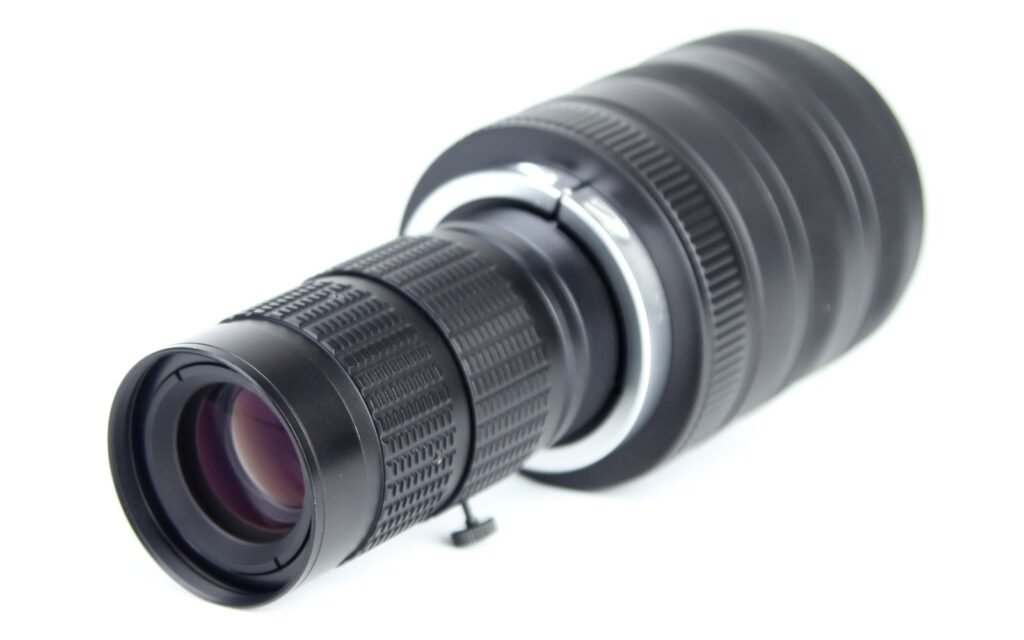
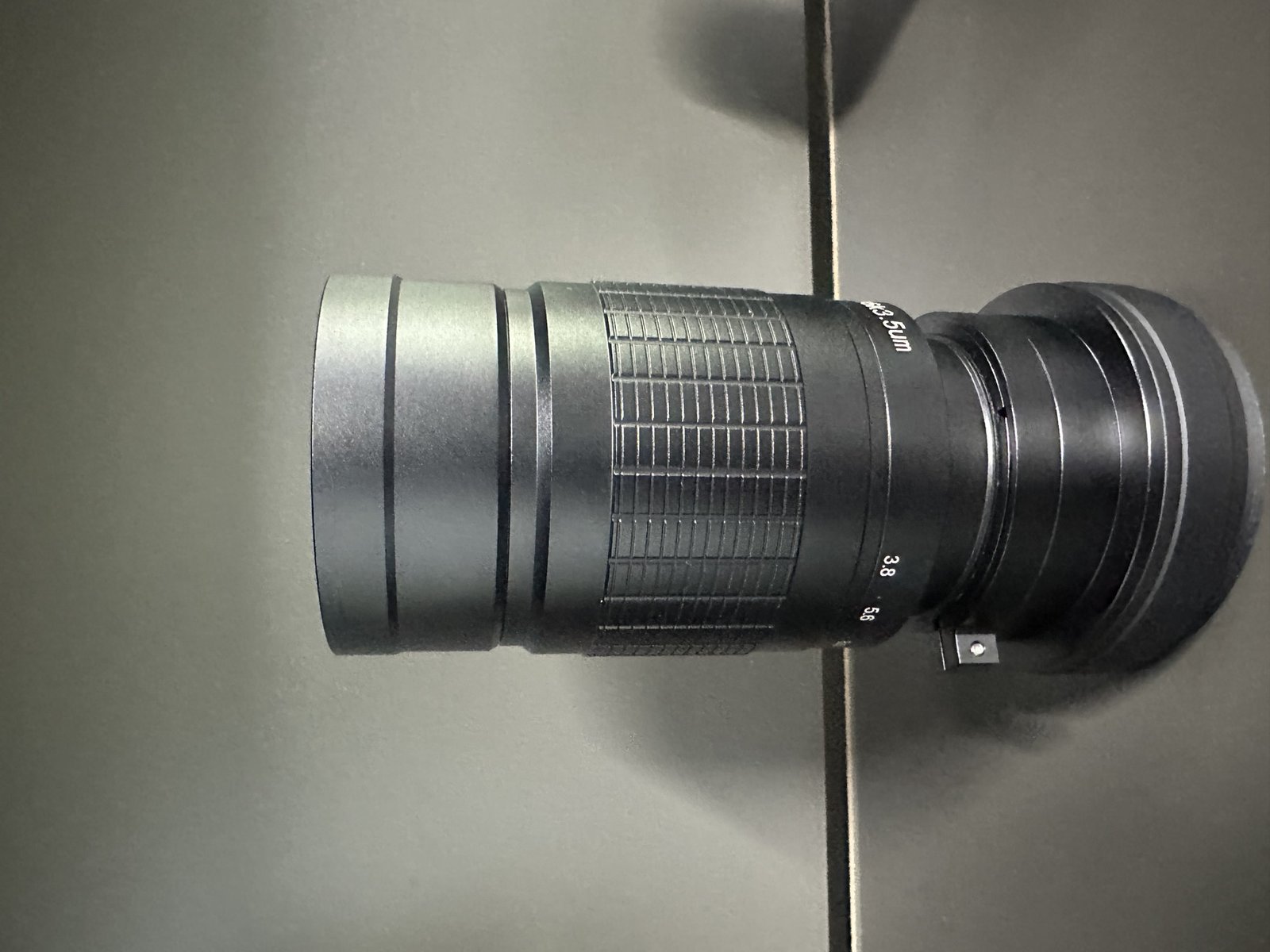
Lensmind’s line-scan family is listed as 40 models across 13 families, including a 40 mm F4.0 16K class at 3.5 µm.
The rest of this page is the metrology-lead checklist: compute the line, pick the circle, pick the mount, then confirm MTF at the edge of that circle. The five inputs in the machine vision lens selection guide still apply. On a web, “field of view” is the cross-web width, and “working distance” is the standoff to the roller.
Line Length Is the Spec, Not Megapixels
An area-scan format (2/3″, 1″, 1.1″) is a rectangle. A line-scan sensor is a stick. The number that sizes the lens is the stick length, not a vidicon-era inch label. Compute it from the datasheet:
Line length (mm) = pixel count × pixel pitch (mm)
8192 × 0.005 mm = 40.96 mm. 16384 × 0.0035 mm = 57.344 mm. Those two cameras can both be sold as “high-resolution line scan.” They do not take the same lens. If the drawing lists only “8K,” stop and ask for pitch.
Image Circle Math for 4K, 8K, and 16K
Basler’s racer 2 line ships 8K and 16K models; older racer Camera Link sheets already published the lengths that trip buyers. A 4K × 7 µm line is 28.7 mm. An 8K × 3.5 µm line is also 28.7 mm. A 6K × 7 µm line and a 12K × 3.5 µm line are both 43.0 mm. Pixel count without pitch is a marketing label.
Class
Pixels × pitch
Line (mm)
Circle you actually need
4K / 7 µm
4096 × 7 µm
28.67
≥ ~30 mm with margin
8K / 3.5 µm
8192 × 3.5 µm
28.67
Same length as 4K/7 µm
8K / 5 µm
8192 × 5 µm
40.96
EK 46 mm class
12K / 3.5 µm
12288 × 3.5 µm
43.01
M58 / M72 territory
16K / 3.5 µm
16384 × 3.5 µm
57.34
Large-format / M72
The circle must be at least the line, plus margin for seating tolerance and rotation. A 40.96 mm line in a 41.0 mm circle will vignette as soon as the chip is not perfectly centred. That is why the EK 8K 5 µm pair is specified at 46 mm, not 41 mm.
Line Scan Versus Area Scan
Choose line scan when the object moves continuously and uniformly: electrode foil, glass, print, paper, cylinders. The second axis of the image is time (encoder ticks × line rate), not a second row of pixels. Choose area scan when the part sits still in a nest.
Tiling six area-scan cameras across a 400 mm web is a lighting and stitching project. One 8K or 16K line with the right circle is an optics project. If the web speed is not stable, line scan will shear. If the part is a connector in a pallet, area-scan FA glass is cheaper than a 16K line you will never fill.
Mounts: C, M42, M58, and M72
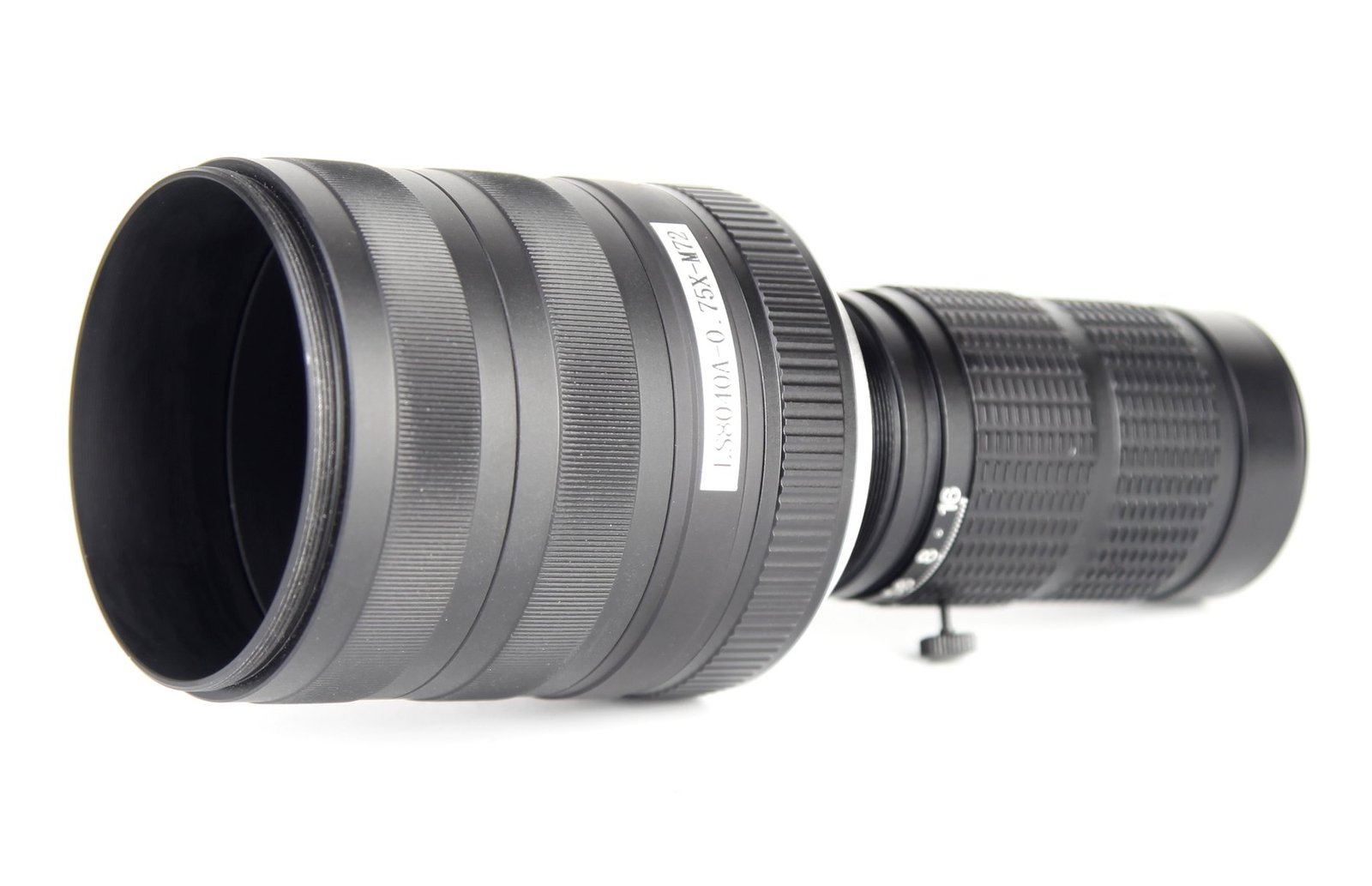
C-mount (17.526 mm flange, 1″-32 UN) is fine for short lines that actually fit a ~16 mm circle. It is not a 16K mount. As the line grows, camera makers move to M42, M58, and M72 so the throat can pass a 40–60 mm circle. The EK series is offered in M42, M58, and M72-F. LMJJ-LS8040A sits in that large-mount class for 12K bodies.
An adapter that changes the thread does not enlarge the image circle. If the camera is M72 because the sensor is 57 mm long, a C-mount FA lens on a ring is still an 11 mm optic. Match mount to circle, then confirm flange and rear protrusion on the camera drawing.
Edge MTF and Illumination
The defect you care about is often at the edge of the web, which is the edge of the sensor. A datasheet MTF quoted on-axis is a brochure. Ask for the curve at the full line height. Relative illumination that falls off at the ends looks like a process defect to an uncorrected algorithm.
High line rate shortens exposure. Aperture, illuminator, and sensor sensitivity have to be budgeted together. Stopping down to hide field curvature will starve a 100 kHz line. Line-scan lighting is usually a focused bar or a rod lens along the web, not a ring light meant for a square FOV.
40 line-scan models across 13 families, including EK 8K 5 µm glass at 46 mm image circle and a 40 mm F4.0 16K class. Send pixel count, pitch, mount, and web width. First-pass feasibility is 48 hours.
The live line scan lens family is listed as 40 models in 13 families. Two 8K 5 µm catalog SKUs are named in the public spec set: EK4032A and EK5028A, both at a 46 mm image circle, with M42 / M58 / M72-F options. That 46 mm circle is the 40.96 mm line plus alignment margin.
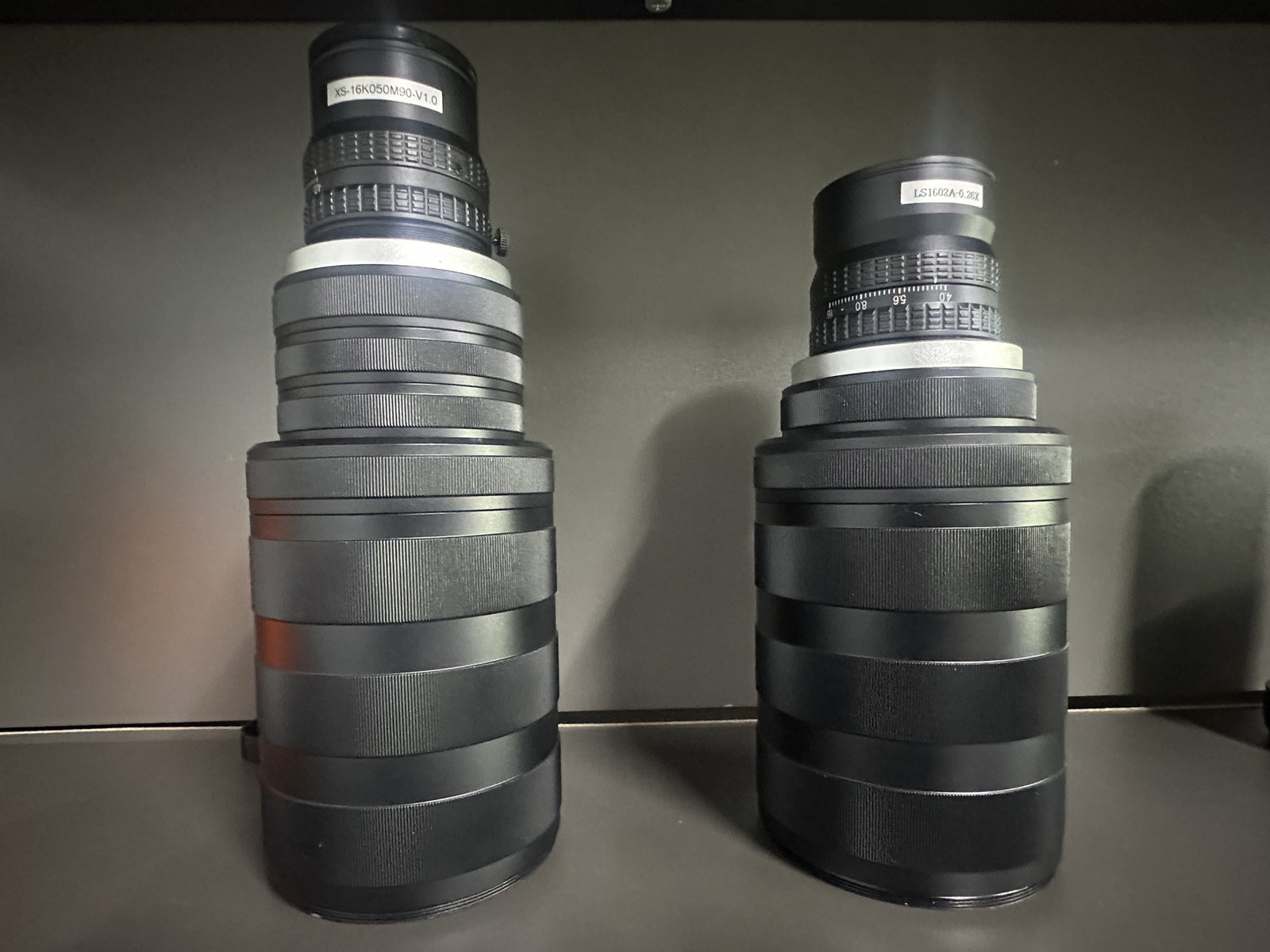
16K is quoted against the sensor, because 57 mm-class lines leave the C-mount world entirely. The factory line includes a 40 mm F4.0 16K-class optic at 3.5 µm resolution (English poster in the media set), plus LS1602A / XS-16K050M90 bodies. Do not drop a 2/3″ FA lens on an adapter and hope the corners “are only used for navigation.”
Worked Example: Electrode Web at 8K
Illustrative path: an 8192 × 5 µm camera, 400 mm cross-web field, 300 mm standoff, M72 body, looking for coating skips on electrode foil. Line length = 40.96 mm. Circle must be ≥ 46 mm class. Magnification β’ = 40.96 / 400 = 0.1024. A 40 mm EFL at 300 mm object distance is in the right neighbourhood once principal planes are checked on the drawing; the thin-lens estimate is a start, not a PO.
If the camera had been 8192 × 3.5 µm, the line would be 28.67 mm and a smaller circle could work — but sampling on the web would be finer only if the same 400 mm still maps onto those 8192 pixels. Pitch and field are a pair. Changing one without the other is how 8K projects ship 5K images.
What We Check Before a Line-Scan RFQ
Send the sensor datasheet, not a camera marketing name. First-pass feasibility is 48 hours. Prototype to mass production is 60 working days. Repeat orders are 30 days. Payment is 50% advance and 50% before shipment. Every production batch ships with test documentation covering the agreed parameters — typically MTF, distortion, BFL, DOF — plus batch number and a pass/fail judgment.
Pixels × pitch: the only honest line length.
Mount and flange: C / M42 / M58 / M72, and rear clearance.
Web: width, speed, encoder, illuminator type and wavelength.
Standoff: object to front vertex, mechanical envelope above the roller.
Edge spec: MTF and relative illumination at the last millimetre of the line, not only on-axis.
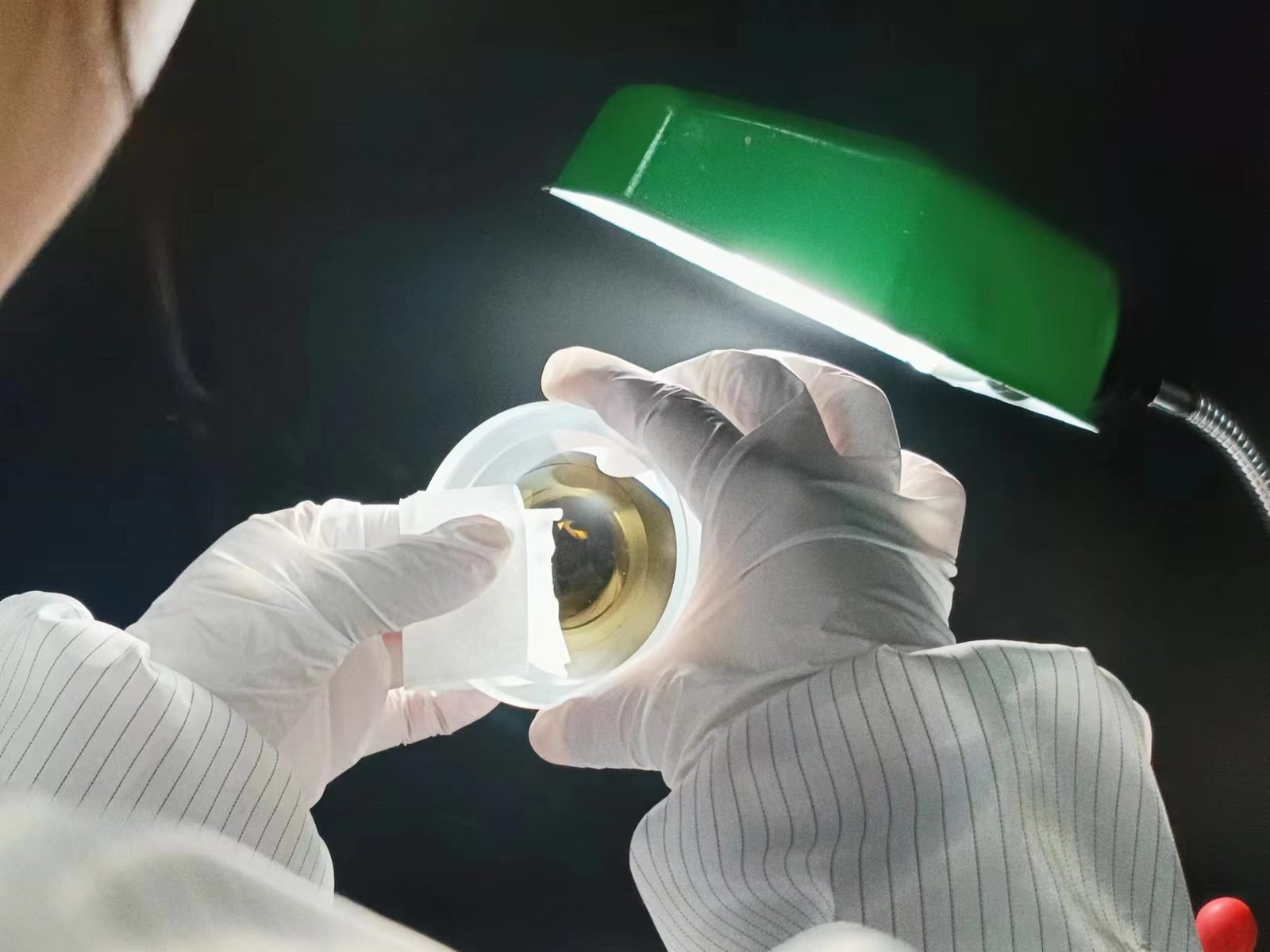
The Hangzhou plant runs Class 10,000 assembly cells and ISO 9001 certified in 2024. If the math says a 2/3″ FA lens covers 11 mm of a 41 mm chip, that is the end of the FA conversation.
Conclusion
Line-scan glass is sized by millimetres of silicon, not by a K-number. Multiply pixels by pitch, add seating margin, then pick a circle and a mount that can pass that circle. 8K at 5 µm is 40.96 mm. 16K at 3.5 µm is 57.344 mm. Those two facts prevent most failed first samples.
Key takeaways
Line length = pixels × pitch. Format names from area-scan do not apply.
EK4032A / EK5028A cover the 8K 5 µm class at 46 mm. 16K 3.5 µm needs a ~57 mm line and a large mount.
C-mount is not a 16K interface. M42 / M58 / M72 exist because the throat must pass the circle.
Ask for MTF at the end of the line. The defect is usually there.
If you already have pixel count, pitch, mount, and web width, send those four. The Hangzhou desk will map them onto the 40-model family or tell you the job is still area-scan. First-pass feasibility is 48 hours. You want a circle that covers the silicon you paid for.
Written by the Lensmind Optics team — Hangzhou factory (Lin’an) and Zhongshan office, company registered 2019, ISO 9001 certified 2024. Founder on this site: Baker Zhao.
Frequently Asked Questions
How do I calculate the image circle for a line scan sensor?
Multiply pixel count by pixel pitch. 8192 × 5 µm = 40.96 mm. Specify a circle larger than that line, such as the EK 46 mm class, so seating tolerance does not vignette the ends.
Is 8K always a 41 mm line?
No. 8K × 3.5 µm is 28.67 mm. 8K × 5 µm is 40.96 mm. 8K × 7 µm is 57.34 mm. Pitch decides the glass.
Can I use a C-mount FA lens on an 8K line scan camera?
Only if the line is short enough for that image circle. A 2/3″ FA lens covers about 11 mm. A 41 mm 8K line will be dark at both ends.
When should I choose line scan over area scan?
When the part moves continuously: webs, foils, panels, cylinders. Discrete fixtured parts belong on area-scan FA or telecentric glass.
Which mount do I need for 16K?
A 16K × 3.5 µm line is 57.34 mm. That length needs a large, stable mount such as M72, not C-mount. Confirm flange and rear clearance on the camera drawing.
Do you offer 16K line scan lenses?
Yes. The family includes 4K / 8K / 16K coverage and a 40 mm F4.0 16K-class optic at 3.5 µm. 16K is quoted against your sensor datasheet.
Baker Zhao
Founder, Lensmind Optics
Baker Zhao is the founder of Lensmind Optics, with 26 years of experience in the optical industry — including Vice President of Sales at Sunny Optical (Zhongshan) and earlier roles at Foxconn, LG and Sintai Optical. He leads Lensmind with a mission to help customers find reliable, application-specific optical solutions from development to volume production.
A short-working-distance large-FOV feasibility input pack is the maker-ready file that states part size, stand-off, pixel budget, and which image costs the buyer will...
Turning a 50 micrometre defect at 200 millimetres into a lens commitment means locking pixel pitch, image height, and a verification target before anyone...