A quotation you can compare with another quotation is built from triples, not sentences. Every performance claim must carry three parts: a named metric, the condition it applies to, and a pass or fail limit with a stated statistical basis. When one factory answers your custom lens RFQ with numbers at named image heights and the other answers in adjectives, the second bid is not automatically worse, but it is not yet comparable. Treat the adjective bid as incomplete rather than disqualified. Convert each adjective into a metric, a condition and a criterion with a written follow-up, put batch data and revision-controlled documents into the contract, and tie the same matrix to first article release. This article gives you the review checklist, the follow-up questions and the contract clauses.
If this is close to your build but not exact, custom optics design at Lensmind is how we turn a spec sheet into a production design.
Why a numeric bid and an adjective bid are not yet comparable
The trouble with this pair of bids is asymmetry, not honesty. The difference between quantitative and qualitative lens performance specifications is the difference between two kinds of answers. A number, such as a distortion limit at a named image height, answers the question of what you will measure and what happens if it fails. A phrase, such as “excellent edge correction,” describes a feeling about a design. The numeric factory has answered your question; the adjective factory has described its product. Until both answer the same question at the same field points, wavelengths and apertures, no fair ranking exists.
Do not assume the numeric bid is automatically the better one, either. A factory that quotes numbers at chosen image heights may have skipped the corners, quoted a monochromatic value where you need a polychromatic one, or reported best focus adjusted separately at every field, which quietly inflates off-axis numbers. Standard optical engineering practice separates three claims that buyers often mix together: predicted nominal performance from the ideal design, predicted toleranced performance after manufacturing variation, and accepted delivered performance that a production unit must demonstrate (optical engineering references treat this separation as basic discipline). One factory may be quoting the first while the other quotes the third, and the first always looks better on paper.
Before you score anything, confirm that both bids carry the minimum set of custom lens RFQ quotation requirements: the exact part identity and the drawing or specification revision they priced; performance data as numbers at defined conditions; the statistical basis of every number; an acceptance test plan with equipment, sample size and pass or fail rules; the document package that ships with each lot; environmental limits; and commercial terms split into unit price, tooling, lead time and validity. Anything missing from either bid is a gap to close, not a style difference.
The metric, condition and criterion triple
Force every performance line in both quotations into the same three-part shape. The metric names what is measured. The condition fixes where and how it is measured. The criterion states the limit, who guarantees it, and on what share of units. If a line cannot be written in this form, it is not yet a specification; it is marketing.
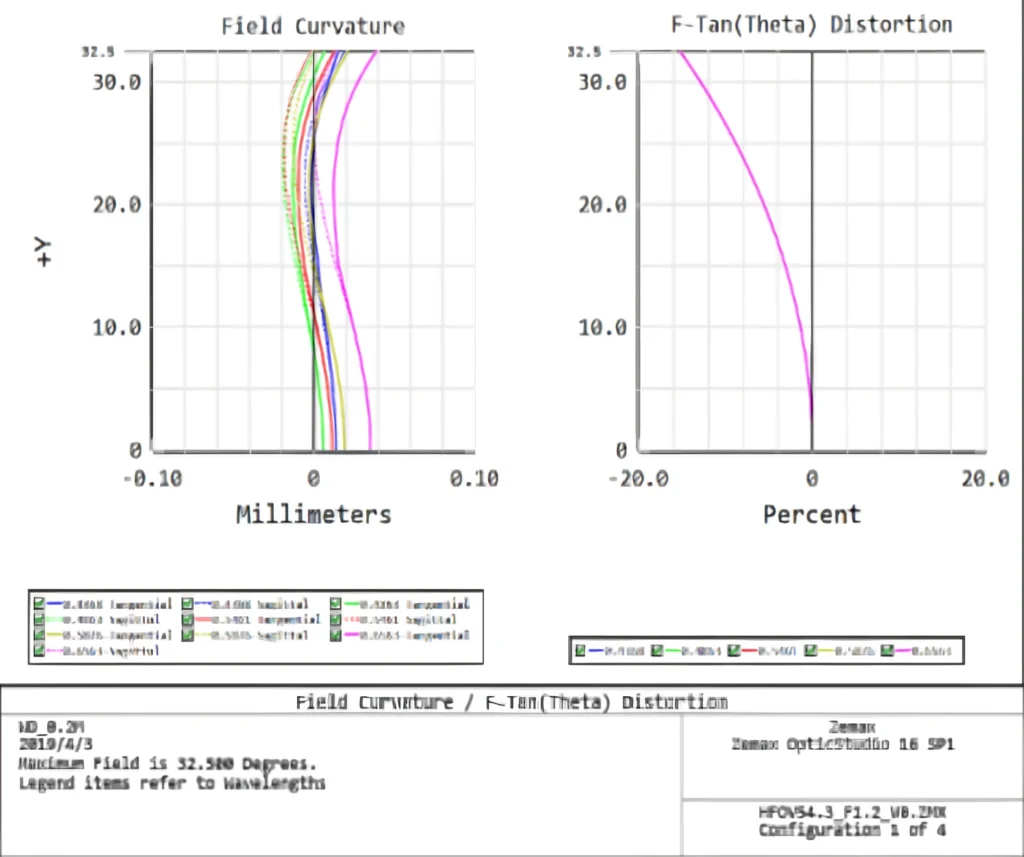
On the metric side, the working list for most machine vision and custom imaging projects is short: MTF as contrast percentage at named spatial frequencies, reported separately for tangential and sagittal orientations; distortion as a percentage with its definition stated, because TV distortion and f-theta distortion are different numbers for the same lens; relative illumination as a percentage at each field position, stating whether vignetting is included; back focal length with its tolerance and reference wavelength; lateral chromatic aberration in micrometers or pixels; and focus shift across the field. These are the key performance indicators for custom optical lenses that a quotation must translate into values.
The condition column is where most comparisons silently break. How to specify lens performance at different image heights: name the heights in millimeters from the optical axis and tie them to your active sensor area, typically on-axis and then fractions of the full image height such as 0.3, 0.7 and 1.0. MTF specifications for custom lenses mean nothing without those heights, the wavelength band and its weighting, the f-number, the object distance, and the focus rule. The focus rule deserves special attention: one common image plane shared by all field points is a harder and more honest condition than best focus found separately at each field, and a supplier who does not state which rule was used has not stated a condition at all. Fix as well whether each value applies to the lens alone or to the lens with your window, filter and sensor attached.
The criterion column decides what you can enforce. Each number must be labelled as a nominal design prediction, a toleranced prediction from a tolerance or Monte Carlo analysis, or guaranteed measured performance, together with the share of production units expected to meet it and whether the limit is worst case or statistical. Only guaranteed delivered performance should become your acceptance criterion; the other two are design evidence. When both factories fill the same rows, the adjective problem dissolves on its own: a blank cell or a sentence without a number is recorded as no numerical evidence supplied, and the two bids finally sit side by side.
A follow-up template for the adjective quotation
Giving the adjective factory a structured chance to convert is both fair and diagnostic. Send both bidders the same compliance matrix, one row per requirement, and treat any refusal to fill it as evidence in its own right. The following questions work as a ready-to-send follow-up for a quotation that answered in adjectives, and they double as the core of an RFQ template for custom optical lenses on your next project:
- Restate each adjective as a metric. “Sharp toward the corners” becomes MTF at named spatial frequencies, at named image heights in millimeters, tangential and sagittal.
- State the wavelengths. Is each value monochromatic or polychromatic, over which band, and with what spectral weighting?
- State the aperture and object distance. Full aperture or stopped down, at which f-number and conjugate?
- State the focus rule. One common image plane for all fields, or best focus per field with the search method disclosed?
- State the basis. Is each number nominal design, toleranced prediction, or measured, and if measured, on how many units?
- State the criterion. Which values do you guarantee as pass or fail for every delivered unit, and which are typical?
- State the test. Which instrument measures each parameter, what is the calibration reference, and will you deliver raw numerical data rather than plots alone?
- Fill the same matrix cells as the other bidder. A blank cell counts as not offered, not as compliance.
Send the questions with a deadline and record the response in the matrix. A factory that converts its adjectives into numbers at your field points is telling you it has the metrology to back them. A factory that answers with more adjectives has also answered something; you now hold evidence instead of wording. Our guide on how to source custom optics from an OEM factory covers how to structure the RFQ itself so that much of this conversion is never needed in the first place.
Batch data and revision-controlled documents belong in the contract
Comparing bids at quotation stage is wasted effort if the winning bid is allowed to drift after the order. Tolerancing in custom lens quotations only stays honest when the documents and the data are locked. Put these clauses into the purchase order, not the cover email:
- Binding values. Only quantified values identified as guaranteed and accepted in the purchase order are binding. Values described as typical, expected, nominal or design target are not acceptance criteria unless explicitly incorporated.
- Batch data. Every production batch ships with test documentation covering the agreed family parameters, typically MTF, distortion, back focal length and depth of field, together with the batch number, test conditions, inspection coverage and an explicit pass or fail judgment.
- Revision control. Datasheets, drawings and coating specifications carry revision numbers, and changes to glass, coating, prescription, process or test method require written approval before they take effect.
- Tooling custody. State who owns the tooling and the design outputs, and how long tooling is stored between orders.
- Confidentiality sequencing. The NDA is signed before drawings move, so the matrix can carry prescription-level detail wherever the supplier agrees to it.
Buyers often ask how to tell whether a factory can honor the batch data clause before the first order arrives. Look at what a factory already does by default rather than on request. At Lensmind Optics, batch reports are the default: every production batch ships with documentation of the agreed family parameters plus the batch number, test conditions, inspection coverage and an explicit pass or fail judgment. That documentation is produced by in-house metrology that includes Trioptics centration measurement with OptiSurf, a laser Fizeau interferometer and a UV spectrophotometer, with 1 µm-class active alignment and Class 10,000 cleanroom assembly behind it, under an ISO 9001 quality system certified in 2024. Our FA machine vision line, models such as FA3505W and FA5020W, holds distortion below 0.05 percent with batch consistency demonstrated above ten thousand units, and the written commercial spine of a custom quotation looks like this: feasibility first pass within 48 hours, prototype to mass production in 60 working days, and tooling stored free for five years between orders. A supplier that puts specifics like these in the quotation is showing the same reflex the matrix demands.
Tie the matrix to first article release
The quotation matrix should not die after award. Carry it, row for row, into the first article inspection. The first article units are measured against exactly the cells both bidders filled: same image heights, same wavelengths, same aperture, same focus rule, with serial numbers recorded and raw numerical data delivered, not only plots. Approval of the first article then freezes the specifications for custom lens manufacturing: the design revision, the process and the test method are locked, and a golden sample is retained and agreed as the physical reference.
From that point on, every production batch, including repeat orders that carry a 30-day written commitment, reports against the frozen state, and the batch documentation clause takes over with the same parameters, the same conditions and an explicit pass or fail judgment. If a first article misses a cell, the rework, replacement and concession path defined in the quotation applies, with inspection and shipping responsibilities already assigned. Before you reach this stage, verify that the metrology promised in the quotation actually exists on the floor by walking the lab with our factory audit checklist for an optics OEM, and reserve the right to witness acceptance tests or send samples to a third-party laboratory.
A refusal anywhere in this chain is data. A factory that will not sign the matrix, will not define its focus rule, or will not commit to batch documentation is asking you to buy adjectives at production volume.
Scoring the two bids without changing the rules midway
Once both quotations sit in the same matrix, scoring becomes arithmetic instead of rhetoric. Freeze the field points, wavelengths, apertures and focus rules before prices are opened, then compare filled cells against blanks, guaranteed values against typical ones, measured evidence against design predictions, and deviations priced with their cost and schedule effects rather than buried in footnotes. That is the practical answer to how to compare custom lens quotations, and it also settles what data is needed to compare custom lens quotes on any future project: identity and revision, numbers at conditions, statistical basis, a test plan, a batch data commitment, and commercial terms stated with the same specificity.
The adjective factory may yet win. Some suppliers answer in prose because nobody ever forced them into rows; once converted, their numbers can beat the numeric bidder, who may have been quoting favorable field points and hoping you would not notice the missing corners. You are not disqualifying anyone. You are making both bids answerable, cell by cell, from quotation to first article to the batch reports that arrive with the cartons.