Decide from the two ends of the height band, not from the average parcel. Put a representative code at the lowest and the highest position your conveyor can produce, then ask one question: at the aperture you actually plan to run, does one lens still deliver enough pixels per module and enough decode margin at both positions? If yes, a single deep-depth lens is the simpler and cheaper build. If either end falls short on focus, pixel count, or light, a second station will beat any amount of stopping down, because stopping down always bills you back in exposure time and diffraction. Treat usable depth range as measured data tied to your sensor, aperture, and code size, demand it in the batch test report, and the one-lens-versus-two decision can be made on paper before you buy anything.
If you are comparing suppliers for this kind of optic, the Lensmind machine vision lens catalog is the hub for our standard models and custom options.
Measure the Band the Way the Camera Sees It
Parcel height is not code distance. The optics only respond to the distance from the front of the lens to the label plane, so convert the height band into a near code distance and a far code distance. Include label tilt, belt sag, pallet bounce, and the fact that a tall carton passing under a tilted camera changes its distance again across the field of view. Write both numbers down in millimeters, measured from the same datum the lens maker uses, and carry them into every conversation that follows.
A wide band fails at its ends first, and it fails in three different ways. At the far end, magnification drops, so the smallest module of your code loses pixels; a commonly cited planning floor for machine-readable codes sits around two to three pixels per module, and poor print quality pushes that floor higher. At the near end, the code grows, its perspective shifts enough to bother decoders that locate finder patterns geometrically, and a large label can walk out of the frame entirely. Between the ends, defocus blur spreads the module edges, and blur plus falling contrast, not optical sharpness alone, is what actually stops a decode.
Run the screening arithmetic before you compare products: the maker’s usable depth envelope at your working aperture has to cover the far code distance minus the near code distance, with margin left over for vibration, bounce, and mounting tolerance. An envelope that merely equals the band gives you zero margin, and zero margin on paper turns into misses on the line. The same logic behind our depth of field specification guide applies here, and it settles this architecture question before any hardware is ordered.
When One Deep-Depth Lens Carries the Whole Band
One station wins when the band fits inside the envelope with room to spare at both ends. Deep depth of field barcode reading on a conveyor is mostly a light management problem. Stopping the iris down stretches depth of field, but every stop costs light, and lost light either lengthens the exposure, which invites motion blur at belt speed, or forces a stronger strobe. Past a certain f-number, diffraction softens the smallest modules faster than the extra depth helps, so the maker should state the usable aperture ceiling rather than just quoting the smallest number on the iris ring.

The operational benefits are easy to underrate. A single camera means one bracket, one trigger, one calibration record, no duplicate-read logic, and no station-to-station agreement to recheck after something gets bumped during maintenance. For a line already running close to its takt time, that simplicity is real money.
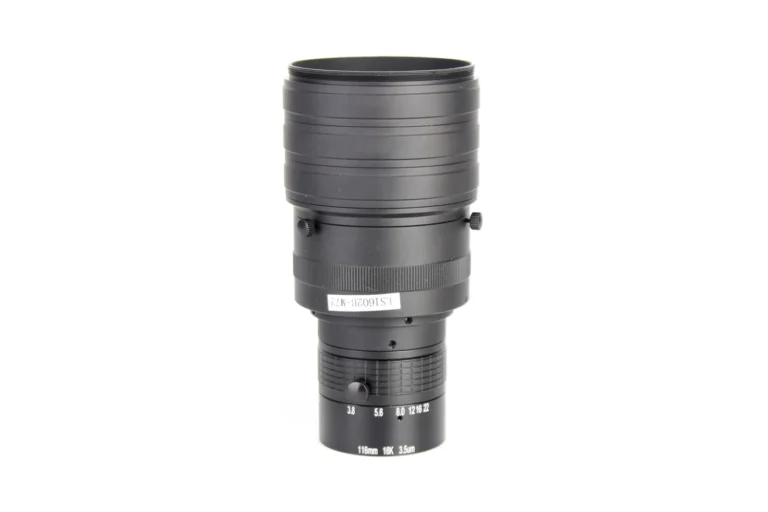
On the hardware side, this is the job the FA C-mount family is built for. The Lensmind FA line covers 2/3 inch through 1.1 inch sensor formats, holds distortion below 0.05 percent with 10K+ batch consistency, and includes models from the FA2520W to the FA7520W so an integrator can trade field of view against working distance instead of forcing one focal length to do everything. A macro branch of the same family handles close-distance gauging when a station must sit near the belt.
Know what a deep-depth lens does not fix. It cannot recover a label that faces away from the camera, and it does nothing for glare off shrink wrap or curvature on a soft poly bag. Fixed focus also freezes the geometry at commissioning: if the belt height or the carton mix changes materially, the envelope decision has to be repeated, not assumed.
When a Second Station Earns Its Cost
Add a station for one of three reasons, and be honest about which one applies. First, split the band: aim one camera at the near zone and one at the far zone, each focused and lit for its own sub-band, so both operate near best focus instead of one lens straddling the whole span. Second, change the view: a second head at a different angle catches labels the first camera cannot see, which solves an orientation problem at the same time as the height problem. Third, buy redundancy: two looks per parcel raise the first-pass read rate without asking more of either lens.
The bill is bigger than a second camera. You are adding a light, wiring, triggering, synchronization, mounting space, calibration work, and software that merges two streams and suppresses duplicate reads of the same barcode. In the single camera versus multiple cameras debate for barcode scanning on a conveyor, the honest comparison is installed cost and lifetime maintenance against read-rate margin, not component prices.
Conveyor speed changes the depth of field requirement in a way datasheets rarely show. A fast belt commits your exposure budget before you ever touch the iris, and once exposure is fixed, any light lost to stopping down has to come back from the strobe. When the aperture the full band demands would push lighting beyond what the tunnel can deliver, the second station is usually the cheaper exit, because it lets each camera run a friendlier aperture over a shorter span.
A middle path exists for embedded readers: a focus-tunable lens. Electrowetting liquid lenses such as the Lensmind ZWA series shift focus in about 20 ms with no moving parts, which can be fast enough to chase parcel heights between triggers when a reader head rides close over the belt; our barcode and logistics M12 lenses article covers that configuration in detail. For wide C-mount fields above a sorting line, treat the liquid lens as a design conversation rather than a drop-in swap, because the depth each station can prove still rests on the same data.
The Usable Depth Range Data to Demand From the Maker
Do not accept a bare line such as depth of field, 200 to 600 mm. Depth of field is defined as the range over which the image stays acceptably sharp, and the word acceptably is where vendors hide. Usable depth range data for an industrial camera only means something when it arrives with five things attached.
- The datum. State whether distances run from the front of the lens, the mounting flange, or the sensor plane. On C-mount the flange sits 17.526 mm in front of the sensor, on CS-mount 12.5 mm, and the 5 mm adapter ring between them is exactly the kind of offset that turns a quoted band into a misfocused install.
- The aperture. The envelope must be quoted at the f-number you will actually run, together with the usable aperture ceiling where diffraction starts to cost module contrast.
- The criterion. Ask what acceptable means: an MTF percentage at a spatial frequency mapped to your smallest module, or better, a measured decode probability for your symbology and print grade.
- The field position. Envelopes quoted at image center flatter the lens. Corners degrade first, and parcel codes land everywhere in the frame.
- The conditions. Light level, exposure time, wavelength, and whether the target was static or moving when the numbers were taken.
This is batch paperwork as much as optics. Lensmind ships every production batch with test documentation covering the agreed family parameters, typically MTF, distortion, BFL, and DOF, together with the batch number, test conditions, inspection coverage, and an explicit pass/fail judgment, and those reports are default practice rather than a special request. When parcel heights vary, ask that the DOF line item be measured at your aperture and stated against your datum, so the number in the file is the number your bracket was machined around. That is the core of what to request from a lens supplier when heights vary: a conditional envelope tied to your build, not a slogan on a datasheet.
Ask for magnification and field of view at both limits as well. The band changes image scale, and the far end that decides pixels per module also decides how much belt width stays in frame at the near end, which is where wide fields quietly fail.
Write the Acceptance Test Into the Purchase Order
Paper decides the architecture; a trial confirms it. Specify a validation run on real or representative labels placed at the nearest, nominal, and farthest code positions, plus roughly 10 to 20 percent beyond each end, moving at line speed, with your worst print quality, shiny tape, and curved surfaces included. Require the maker or integrator to report reads per attempt, no-read rate, and failure modes over a sample large enough to mean something, not a handful of clean stills taken at the sweet spot.
Then compare the options on cost per point of first-pass read rate instead of on component price. One deep-depth lens with a stronger strobe competes against a second camera with its own light, wiring, and dedupe logic, and the read-rate curve from the trial shows which margin you actually need. The five inputs that drive that verdict, sensor format, working distance, field of view, resolution target, and environment, are the same inputs that drive any lens selection on the site, which is why they belong in the purchase order and not just in a proposal deck.
If a supplier will not state the envelope with a datum, an aperture, and a criterion, treat the silence as data of its own: the margin is probably not there, and a second station ordered now is cheaper than discovering the gap on a live line.