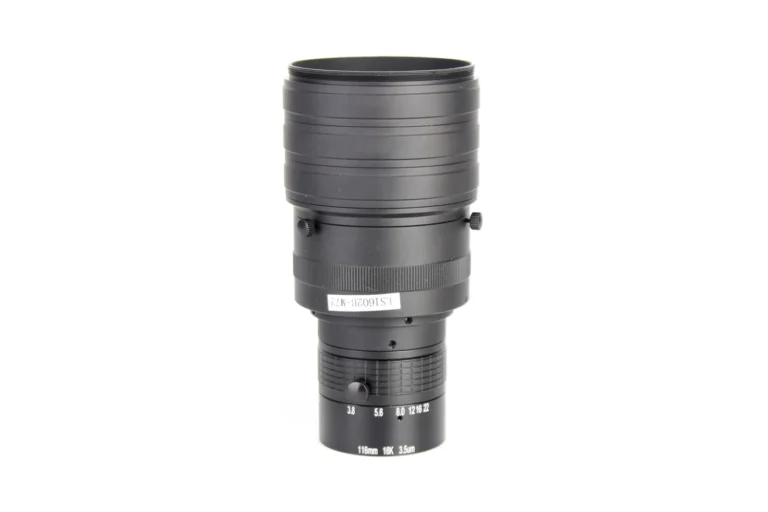
A 5 megapixel label on a lens box is a format claim, not a resolution guarantee, so put one question to the maker before you trust it: what modulation transfer value, in percent, does this lens hold at my sensor’s Nyquist frequency, measured on a production unit at my aperture and wavelength? That single number decides whether the lens matches your pixels or just the box. Compute it yourself first: divide one by twice the pixel pitch in millimeters, so a 3.45 micron pixel sits near 145 line pairs per millimeter. Then ask four things in writing: which pixel pitch the design was actually rated for, whether the curves are measured or simulated, what the batch test report covers, and what pass or fail judgment it records. If the reply repeats the megapixel count and adds nothing in line pairs, the label and your sensor were never matched.
If you are comparing suppliers for this kind of optic, the Lensmind machine vision lens catalog is the hub for our standard models and custom options.
Why a 5 Megapixel Label Sets No Resolution Target
Read the fine print on most machine vision lens boxes and the megapixel figure turns out to encode one thing: the sensor generation and format the marketing team aimed at. It promises, at best, that the image circle covers a 5 megapixel sensor of a given size. It does not promise contrast at the spatial frequency your pixels sample, and that is the number that decides sharpness. Two sensors can both carry 5 megapixels while their pixel pitches differ by nearly a factor of two, because the same pixel count spreads across different formats. The label cannot honor both.
Soft, on a production line, has a precise meaning: contrast has collapsed at the detail size your application cares about. Edges turn grey instead of black and white, printed codes stop snapping into focus, and measurement repeatability drifts before anything looks obviously blurry. This is the classic lens resolution versus sensor resolution mismatch. The sensor samples finer detail than the lens preserves, so the extra pixels record blur instead of information. What you need from the maker is resolution stated in line pairs per millimeter, at a named contrast level, at named positions across the field, because that is the currency your sensor actually spends. A megapixel figure is packaging; line pairs and contrast are physics.
Turn Your Sensor Into the One Number the Maker Must Answer
Open your camera datasheet and find the pixel pitch in microns. Divide one by twice that pitch in millimeters and you have the Nyquist frequency, the finest detail the sensor can record without confusion. A 3.45 micron pixel gives about 145 line pairs per millimeter. A 2.2 micron pixel gives about 227. Above that frequency the sensor no longer reports the scene faithfully, so any detail the lens fails to deliver at or below it is gone for good. This arithmetic takes two minutes and converts the vague question “does this lens match my 5 megapixel camera” into a sentence a lens designer can answer with data.
The request to send reads like this: confirm the modulation transfer value this lens achieves at 145 line pairs per millimeter, at image center and at 0.7 field, at my working aperture, under my lighting spectrum, at my working distance. Those conditions are the same five inputs a careful lens selection already uses: sensor format, working distance, field of view, resolution target, and environment. Megapixels describe how finely your sensor samples the world; the transfer value describes how much of that sampling survives the lens. When a maker answers in those units, you can compare lenses, batches, and quotations on equal terms. When a maker answers in megapixels, you have learned only which box yours came in.
Four Questions That Get Past the Label
Integrators searching for what to ask lens manufacturer contacts about lens resolution usually collect the same generic list. Here it is again, with the procurement teeth that make the answers binding.
First: which pixel pitch was this design rated for, and what is the smallest pixel it was optimized for? A 5 megapixel rating may have been defined years ago on larger pixels than yours. Ask for the rated pitch in microns and the image circle diameter in millimeters, then check the circle against your sensor diagonal with margin to spare.
Second: are the performance curves measured or simulated? If they are design curves, say so in the purchase documents and ask for measured data from production units. Insist on the conditions: center, half field, 0.7 field, and corner, with tangential and sagittal curves shown separately, at the f-number and wavelength band you will run. A curve taken wide open at visible wavelengths tells you little about a near infrared application.
Third: what does the batch test documentation cover, and does it carry an explicit pass or fail judgment? This is the question most buyers never think to ask, and it separates a manufacturer from an assembler. Every production batch from a serious maker ships with test documentation covering the agreed family parameters, typically modulation transfer, distortion, back focal length, and depth of field, together with the batch number, test conditions, inspection coverage, and a written pass or fail. Reports should arrive by default, not as a special favor you negotiate. Then go one step further and ask the maker to test that report against your numbers: your pixel pitch, your aperture, your image heights. On a distortion controlled FA line that holds geometry below 0.05 percent across batches of ten thousand or more, a written number like that is exactly what a report should be checked against.
Fourth: what happens when a unit misses? Ask whether failing units are re-graded, re-aligned, or scrapped, and whether closed-loop active alignment at the one micron class is available for the units that demand it. Ask how a returned unit is traced back to its batch number, because the report that matters is the one for the batch your serial number came from.
Read the Reply Like a Buyer, Not a Browser
The warning sign is a one-liner: “5 megapixel compatible,” with no line pairs, no contrast value, no field positions, and no test conditions. A serious reply names numbers at named image heights, states the aperture and wavelength they were taken at, and separates measured results from design predictions. Push for exactly that format in the quotation itself, so two competing bids can be compared line by line instead of label by label; the guide on what a lens quotation must contain walks through that structure. If the maker will not put a guaranteed minimum transfer value at your Nyquist frequency in writing, treat the missing signature as data.
Curves intimidate people who have never been shown how to read an MTF chart, and the hesitation is expensive, because the curves answer your pixel question directly: find your Nyquist frequency on the horizontal axis and read the contrast that remains. An hour with a good explainer buys you the ability to audit every lens quotation for the rest of your career. Design plots are useful evidence too, but know what you are holding. The field curvature and distortion plots below, for example, are simulated design output: they show how focus shift and geometry behave across the field, and they belong in the drawing package, but they are not a substitute for bench measurement on the units you will receive. Ask which curves in the package came off the production test bench and which came out of the design file, and get the answer in writing.

When the Paper Is Good but the Image Is Still Soft
Sometimes the maker answers everything correctly and the line still reads soft. Then the label was never the problem and the cell is. Check the mechanical stack before you blame the optics. A C-mount lens seats at 17.526 millimeters while a CS-mount camera expects 12.5, and the 5 millimeter adapter ring that converts between them is the single most common source of focus error on an integration bench. A loose or wrong-thickness adapter shifts the focal plane just enough to look like a bad lens. Vibration does the same thing over weeks. Refocus at your true working distance with the fixture at production temperature.
Then verify on your own bench. Shoot a lens sharpness test chart, or simply a slanted edge, at your working distance and aperture, and compare center and corner results against the batch report that shipped with your units. That is how to measure lens resolution without buying new instruments, and it closes the loop: your bench result should land near the report’s curve at your Nyquist frequency. If it does not, ask the maker for the test data of your specific batch, request a scheduled video factory tour, or book an on-site audit and watch the report being generated. What does a soft image mean at that point? It means someone’s numbers and someone’s hardware disagree, and the batch documentation is the referee. For a re-rated or custom variant, a feasibility first pass inside 48 hours tells you quickly whether the maker can match your pixels deliberately instead of by label.
The message to send the maker is one sentence long. Our pixel pitch is so many microns, our Nyquist frequency is roughly so many line pairs per millimeter, please confirm in writing the measured transfer value at that frequency, at center and 0.7 field, at our aperture and wavelength, and send the batch test report with the shipment. A maker who answers in numbers has matched your pixels. A maker who answers with the label has matched only the box.