A single-source lens quote is a commercial offer with no rival bid to test price, schedule or specification against. The missing bidder used to do three jobs: benchmark the price, discipline the specification and give the buyer a walk-away option. None of the three jobs disappears when only one factory answers. The work moves into documents. Terms on this site run 50% in advance and 50% before shipment, so half the money leaves before a single lens is measured. According to UCC Article 2, a buyer may reject goods failing in any respect to conform, which makes the written specification, not the price, the real product. The trade a single-source buyer makes in 2026 is simple: less price tension, more document tension, and a signature that should wait until the paper earns it.
What does a single-source lens quote leave unprotected?
The exposure in a single-source quote is a three-part gap: price, performance and exit. Price loses the benchmark first, because no second bidder reveals what the same drawing costs elsewhere. Performance loses the second reader, because the only description of the lens is the one the bidder wrote. Exit disappears quietly, because a buyer without an alternative cannot refuse a schedule slip without stopping a line.
One number shows why the performance gap matters. A distortion target of 0.05% can be met on paper by any supplier picking a friendly image height, because the metric alone never says where in the field the limit applies. According to ASME Y14.5, a dimension is incomplete without a tolerance and a datum reference. A lens metric is incomplete the same way.
Three documents close the three gaps in 2026: a four-column specification, a payment gate and a file-ownership clause. Each fits on a page, and each is cheap to grant before the purchase order exists.
Which four columns turn a lens quote into a specification?
The four-column specification is a table in which every requirement carries a metric, a condition, a criterion and a sampling rule. Each column removes one argument. The metric names the quantity and the unit, so nobody negotiates over adjectives. The condition fixes image height, wavelength, aperture, working distance and focus state. The criterion states the pass line and the measurement uncertainty allowed around the pass line. The sampling rule says how many pieces, drawn how, and judged by whom.
According to ISO 10110-7, a surface limit belongs on the drawing as an explicit callout rather than a verbal promise. Lens requirements deserve the same treatment. A quotation with 0.05% distortion and no condition column has handed the buyer a number nobody can enforce. Pair the table with the discipline of numbers at named image heights, and the single bid becomes reviewable in 2026 even without a rival.
What do the four columns look like when they are filled in?
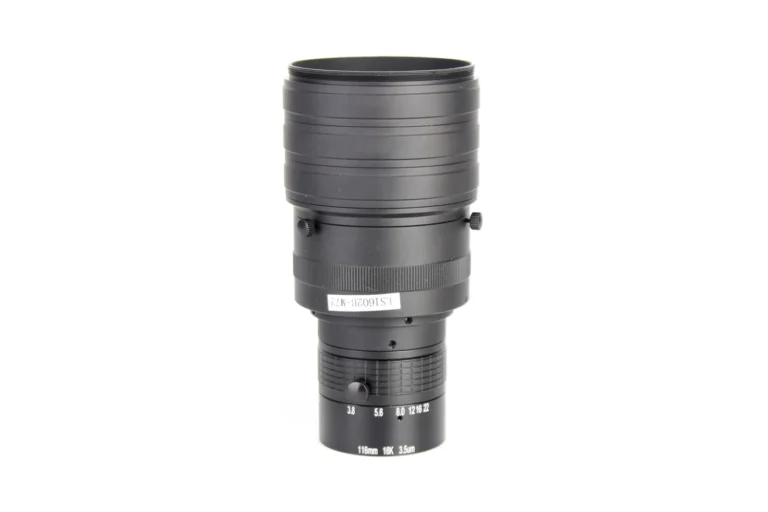
A filled-in specification line is a purchase-order entry, not a brochure claim, and the table below is the annex a 2026 purchase order should carry, filled in for a 2/3-inch FA C-mount lens where the distortion figure on this site is 0.05%. Read the sampling column as the part deciding who measures and how often. According to the NIST/SEMATECH e-Handbook, an acceptance sampling plan fixes the sample size and the acceptance number before inspection starts. An AQL of 1.0% defines a tolerable process average, and the figure is not a promise that every box is perfect.
| Column |
What the line contains |
The argument it ends |
| Metric |
quantity, unit and field position, for example distortion at 0.05% |
whether the number means anything |
| Condition |
sensor format, aperture, working distance, wavelength, focus state |
whose measurement counts |
| Criterion |
pass limit plus the uncertainty allowed around it |
what a failure actually is |
| Sampling |
pieces per batch, drawing method, named inspector |
how a dispute gets settled |
Where should the payment gate sit when there is no competing bid?
Why does the gate carry more weight without a rival bid?
A payment gate is a release of money tied to an accepted deliverable rather than to a calendar date. In a single-source order the gate carries more weight, because no second supplier absorbs a delay. Terms here run 50% in advance and 50% before shipment, and those terms leave room for one insertion: release the balance after the first article is measured against the four-column table and accepted in writing.
According to UCC Article 2 section 2-310, payment falls due when the buyer receives the goods unless the contract says otherwise, so silence hands the supplier the friendlier default. Move acceptance upstream in 2026 and the same 50% becomes a lever instead of a formality. Two conditions keep the gate fair: agree the measurement method before the first article runs, and define a rework window for a failed first article, so failure delays the order rather than cancelling the program.
What does a first article acceptance letter need to say?
An acceptance letter is a short written record naming the parts, the measured values, the specification revision and the decision. The document protects both sides, and a thin version creates the argument six months later. Include five items. Step 1: the specification revision letter and the date. Step 2: batch number or serial numbers of the accepted pieces. Step 3: each measured parameter with value, condition and pass or fail judgment. Step 4: any deviation accepted, with an expiry date. Step 5: the signature of the person entitled to accept on the buyer’s side.
For example, a first article passing distortion at 0.05% but leaving centering unmeasured is not an accepted article, and the letter should say so plainly. According to ISO 9001:2015 clause 8.6, release of product requires planned verification to be completed, and a signed letter is the cheapest evidence of completion in 2026. Keep the letter to one page, and treat the signature as the trigger for the 50% balance.
How do you freeze the revision before the drawing locks?
A revision freeze is a dated statement of which drawing, which specification and which process documents govern the order, signed by both sides. The clause costs nothing and gets skipped most often. Without a freeze, the specification keeps improving after the price is fixed, and each improvement lands on the buyer’s side of the ledger. Write three items into the clause: the revision letter of every controlled document, the point after which changes need a written change notice, and the rule that no change proceeds without a new price and a new first article.
According to ISO 9001:2015 clause 7.5.3, documented information must be controlled for revision and change. A supplier certified to ISO 9001 in 2024 already runs the machinery, so the clause points existing procedure at the order. Freeze 100% of the drawing set, not the optical sheet alone, and name the person who owns the freeze on each side.
Who owns the drawing, the tooling and the process records?
Tooling ownership is the clause deciding whether the program can move to a second supplier without starting over. Ownership in a lens program covers four things, not one: the optical drawing and the tolerance table, the mechanical drawing of the barrel, the fixtures and lapping tools built for the part, and the process records showing how the part was made. A clause covering only the drawing leaves the buyer with a paper trail and no way to build.
Custom tooling here is stored free for five years, which answers storage and not title. According to ISO 9001:2015 clause 8.4.3, the organization must tell external providers exactly what is being bought, including the documents defining the product. A 100% ownership clause signed before the first purchase order costs nothing in 2026 and saves the entire tooling budget later. Keep the schedule in the same package as the tooling ownership clauses.
What should the batch report carry when only one factory builds the lens?
A batch report is the evidence packet travelling with each shipment, stating what was measured, under which conditions, on how many pieces, with what result. In a single-source program the report replaces the comparison a second supplier would have provided, so completeness matters more than length. Every production batch here ships with test documentation covering the agreed family parameters, typically MTF, distortion, back focal length and depth of field, plus the batch number, test conditions, inspection coverage and an explicit pass or fail judgment.
For example, a 0.05% distortion limit means little unless the report names the image height and the aperture used for the measurement. In our production line, batch reports repeat the agreed family parameters, which is what makes the first article and the production shipment comparable. According to ISO 9001:2015 clause 8.7, nonconforming outputs need identification and control. Read the first report line by line in 2026, before the second shipment makes the format permanent.

How do you keep a second-source door open without insulting the supplier?
A second-source right is a written option to place a comparable order elsewhere, at a specification and a price basis fixed in advance. Suppliers accept the right when it reads as insurance rather than distrust. Three terms make the option real. The buyer may request one re-quote per year against the frozen drawing. The supplier must release the documents a competitor would need, which are the four-column table and the ownership records. The option survives a price increase beyond the index named in the contract.
According to UCC Article 2 section 2-609, a party may demand adequate assurance of performance when reasonable grounds for insecurity arise, which is the legal shape of the same idea. A re-quote against the same 0.05% distortion line the incumbent already meets is a light obligation in 2026, and the exercise proves the documents are usable. Pay the incumbent fairly, and keep the door unlocked through the document package a second source needs.
How do you check the price when there is no second price?
A should-cost check is an arithmetic reconstruction of what the lens ought to cost, built from the drawing instead of from the supplier’s spreadsheet. Four inputs carry the estimate: glass grade and quantity, machining hours for the barrel, coating runs and their yield, and metrology time per batch. Ask for the same four lines in the supplier’s breakdown and compare the differences, not the totals.
According to Incoterms 2020, the delivery term names the place where cost and risk transfer, so freight, insurance and duty belong in the comparison even when only one quote exists. The 50% advance is the amount at risk before any measurement happens, which is the figure a should-cost check actually protects in 2026. A quote nobody can decompose is not automatically expensive; the quote is simply unreadable, and an unreadable quote should not be signed.
What belongs on the signature checklist?
A signature checklist is the one-page list of conditions read aloud before the purchase order is signed. Five lines matter most. Step 1: the four-column specification with the revision letter. Step 2: the payment gate tied to first article acceptance. Step 3: the freeze date and the change notice window. Step 4: the ownership schedule, including tooling title and storage. Step 5: the batch report format agreed in advance.
According to UCC Article 2 section 2-602, a buyer must reject goods seasonably and identify the defect, so the checklist should also name who inspects incoming lenses and how fast a rejection reaches the supplier in writing. Half the order value moves at 50% advance, which is why the checklist belongs beside the payment approval rather than in a project folder. In 2026, sign the checklist first, then sign the quote.
Where does the protection package meet the rest of your program?
The protection package is a set of four documents a single-source lens order can carry without a second bidder: the four-column specification, the payment gate, the freeze and ownership clauses, and the batch report format. Together those documents do the work the missing bidder used to do, and each is cheap before signature. None of the four is exotic; each is ordinary quality practice pointed at a commercial gap.
A maker volunteering the package is telling the buyer how the program will run. In 2026 the practical test is short: ask for the 0.05% distortion line with its image height, the acceptance letter template and the tooling title paragraph. According to ISO 9001:2015 clause 8.2.3, requirements must be reviewed before a commitment is made, so the request is standard work rather than distrust. Start from custom optics, set the quality side against the quality agreement that goes beyond ISO 9001, and hold the supplier to the evidence a capability shortlist promised before the single bid arrived.