The Machine Vision Lens Selection Guide
Five inputs — sensor format, working distance, field of view, resolution target, environment — turned into a five-step method and a worked example from sensor to focal length.
Read the note →Four shelves — selection, technology, comparisons, and application notes — written by the engineers who design, align and test lenses on the Hangzhou line.
Sensor format, working distance, field of view, resolution and environment — turned into a focal length, an image circle check, and a honest “when not to buy the expensive option.”
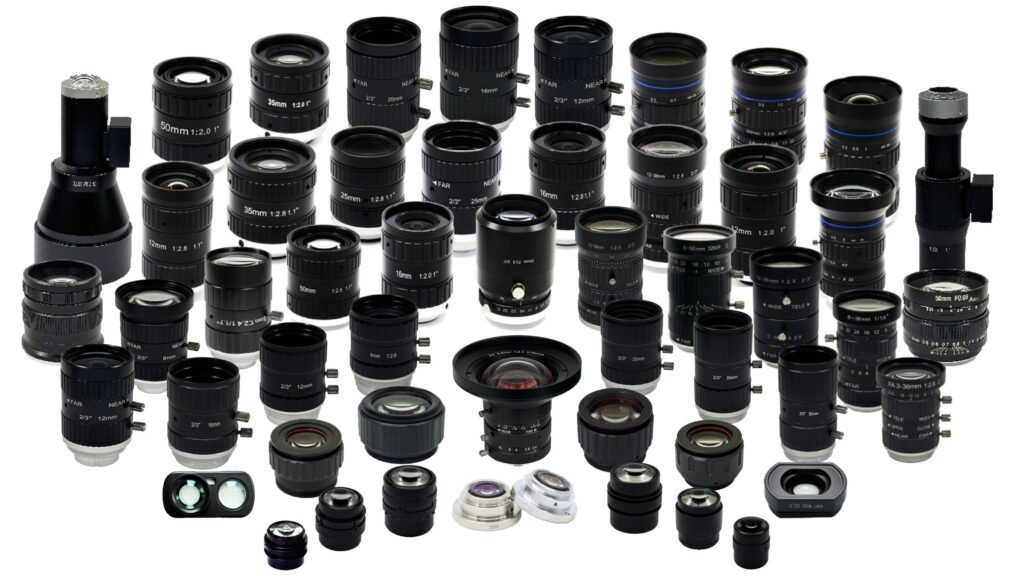
Five inputs — sensor format, working distance, field of view, resolution target, environment — turned into a five-step method and a worked example from sensor to focal length.
Read the note →H05–H16 series, FT/HT focus lock, and when a board camera should stay S-mount.
Read the note →When constant magnification is required — and when an FA lens is the better buy.
Read the note →Match image circle to line length so an 8K or 16K sensor is not vignetted.
Read the note →2/3 in to 1.1 in formats, distortion under 0.05%, and the macro family for close gauging.
Read the note →OV9734 / OV2740 / ES101 paired to sub-2 mm objectives.
Read the note →Waveband, material and FOV for industrial thermal stations — not home inspection cameras.
Read the note →The working formula, a numeric example, and the traps the formula does not catch.
Read the note →Wide FOV without handing metrology a distortion problem it cannot undo.
Read the note →Coverage, corner illumination, and why a 1/2 in lens fails on a 1.1 in sensor.
Read the note →Telecentric rays, electrowetting, MTF, distortion, flange distance and 1 μm active alignment — explained the way a metrology bench talks, not a brochure.

Telecentricity is a pupil at infinity, not a sharpness grade. Constant magnification versus depth, object-space vs bi-telecentric, and when an FA lens at under 0.05% distortion is the…
Read the note →Electrowetting focus in about 20 ms, ZWA series, and lifetime math for 24/7 lines.
Read the note →Working frequency, on-axis vs corner, and why a pretty curve can still fail inspection.
Read the note →How FA-line distortion is measured, reported, and why gauging cares.
Read the note →17.526 mm, the 1"-32 UN thread, and why back-focus errors look like a bad lens.
Read the note →How to specify DOF from aperture, magnification and pixel size — without guessing.
Read the note →Thread lock, FT/HT seats, and why board cameras lose focus on robots.
Read the note →When a VIS coating wastes IR illumination, and how M12 NIR/VIS options are specced.
Read the note →1 μm-class closed-loop alignment and why centration error silently kills MTF.
Read the note →Which telecentric family belongs on a gauge, a sensor, or both.
Read the note →C vs CS, M12 vs C-mount, line vs area scan, liquid vs VCM, telecentric vs FA. Side-by-side so you stop over-specifying.
17.526 mm vs ~12.5 mm, same thread, and when the adapter ring is the right fix.
Read the note →Board-level vibration vs accessory flexibility — a mount decision, not a brand decision.
Read the note →Webs and cylinders vs discrete parts, with resolution and throughput math.
Read the note →Fluid meniscus vs voice coil: speed, wear, aperture behavior, cycle life.
Read the note →When constant magnification pays, and when FA distortion under 0.05% is enough.
Read the note →Two words, two industries: NDT access vs medical/industrial modules.
Read the note →Triangulation vs stereo matching on specular metal and mixed surfaces.
Read the note →When a locked M12 is cheaper and more reliable than adding AF.
Read the note →FOV vs mapping: why metrology hates an uncorrected fisheye.
Read the note →When to tool, when to buy off the shelf, and the 60-working-day path.
Read the note →PCB, EV battery, food washdown, endoscope OEM, and how to send an RFQ that a Hangzhou factory can actually quote in 48 hours.
Factory proof, RFQ contents, NDA, tooling storage, and red flags.
Read the note →Solder glare, bridge detection, and which FA / telecentric family belongs on the lane.
Read the note →What to walk at Hangzhou: MTF bench, alignment, cleanroom, batch reports.
Read the note →Sensor, WD, FOV, distortion budget — the six fields that unlock a 48-hour first-pass.
Read the note →Sensor pairing, diameter, and sterilization constraints we will actually commit to.
Read the note →Tab welds, coating skips and seal pins on specular metal.
Read the note →IP67/IP68, washdown, and the housings that survive it.
Read the note →Embedded readers, mixed package heights, and FT/HT lock.
Read the note →60 working days prototype to MP, 30 days repeats, tooling stored 5 years.
Read the note →Where the rating matters — and where it is wasted budget.
Read the note →