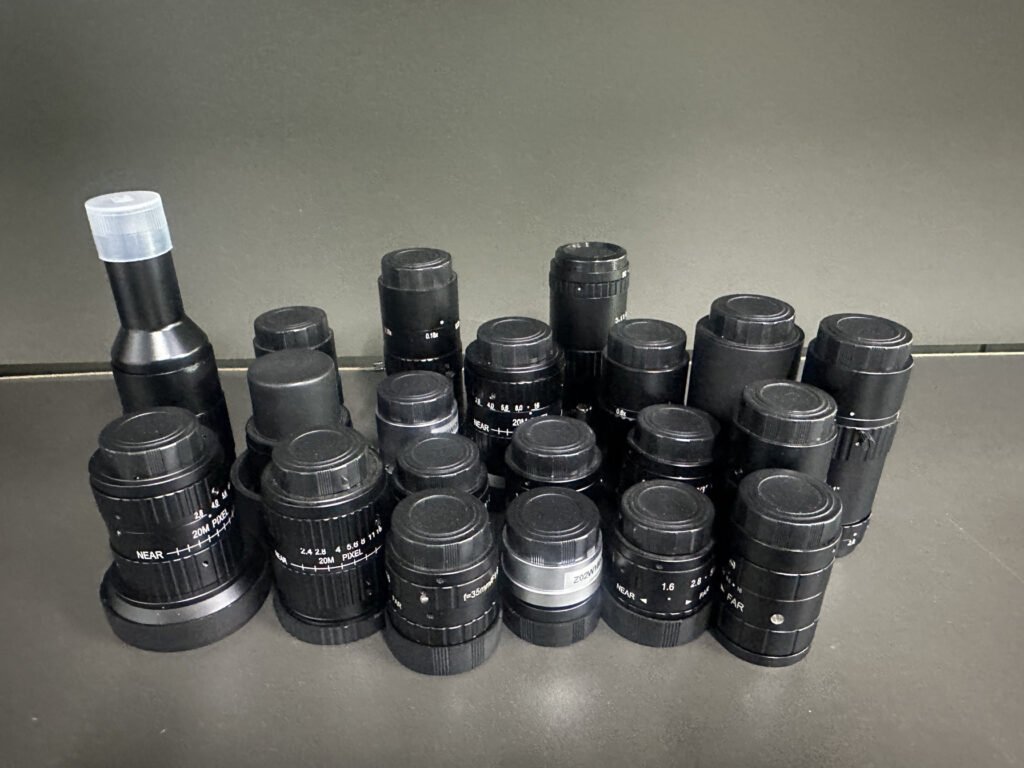
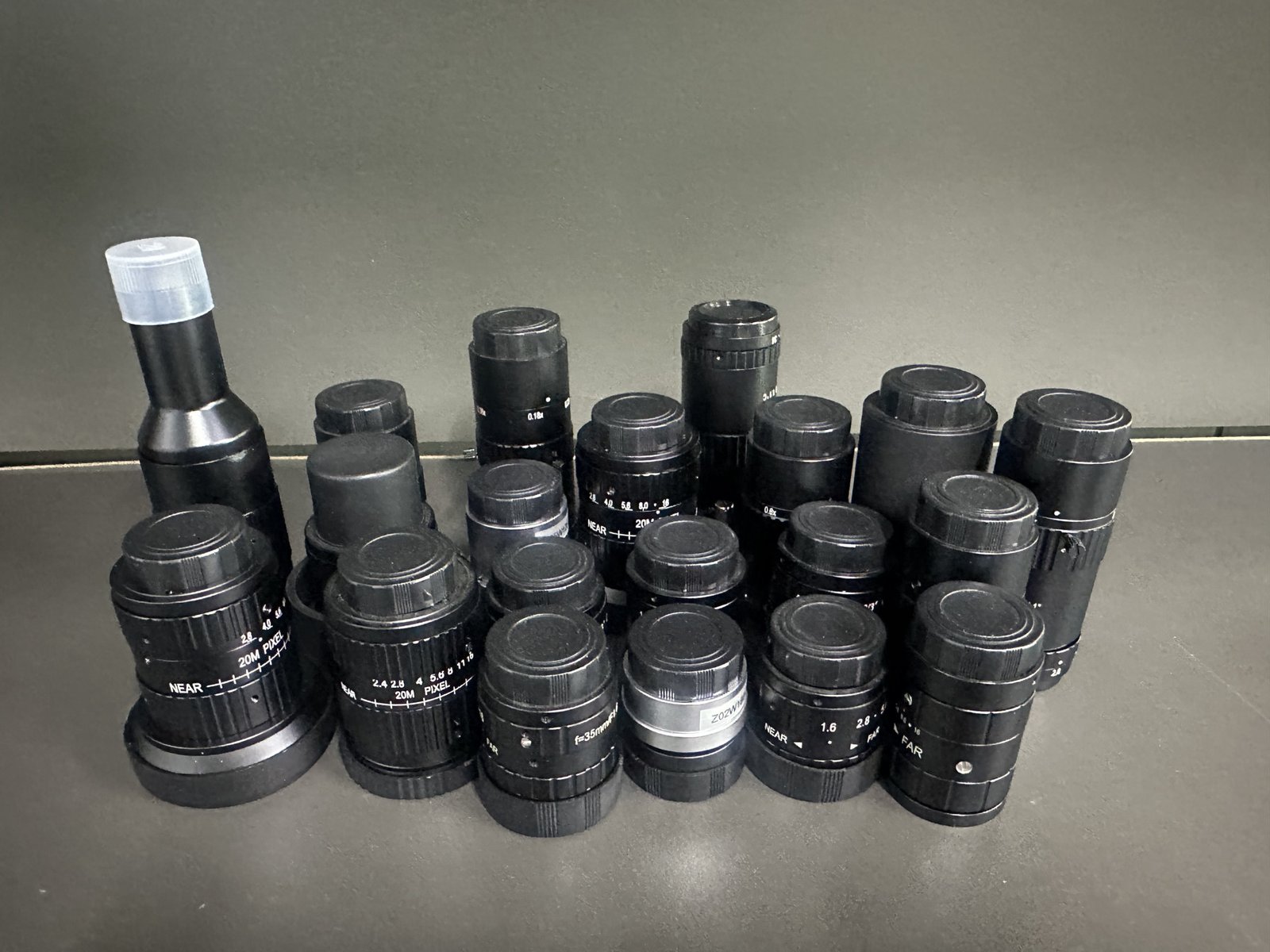
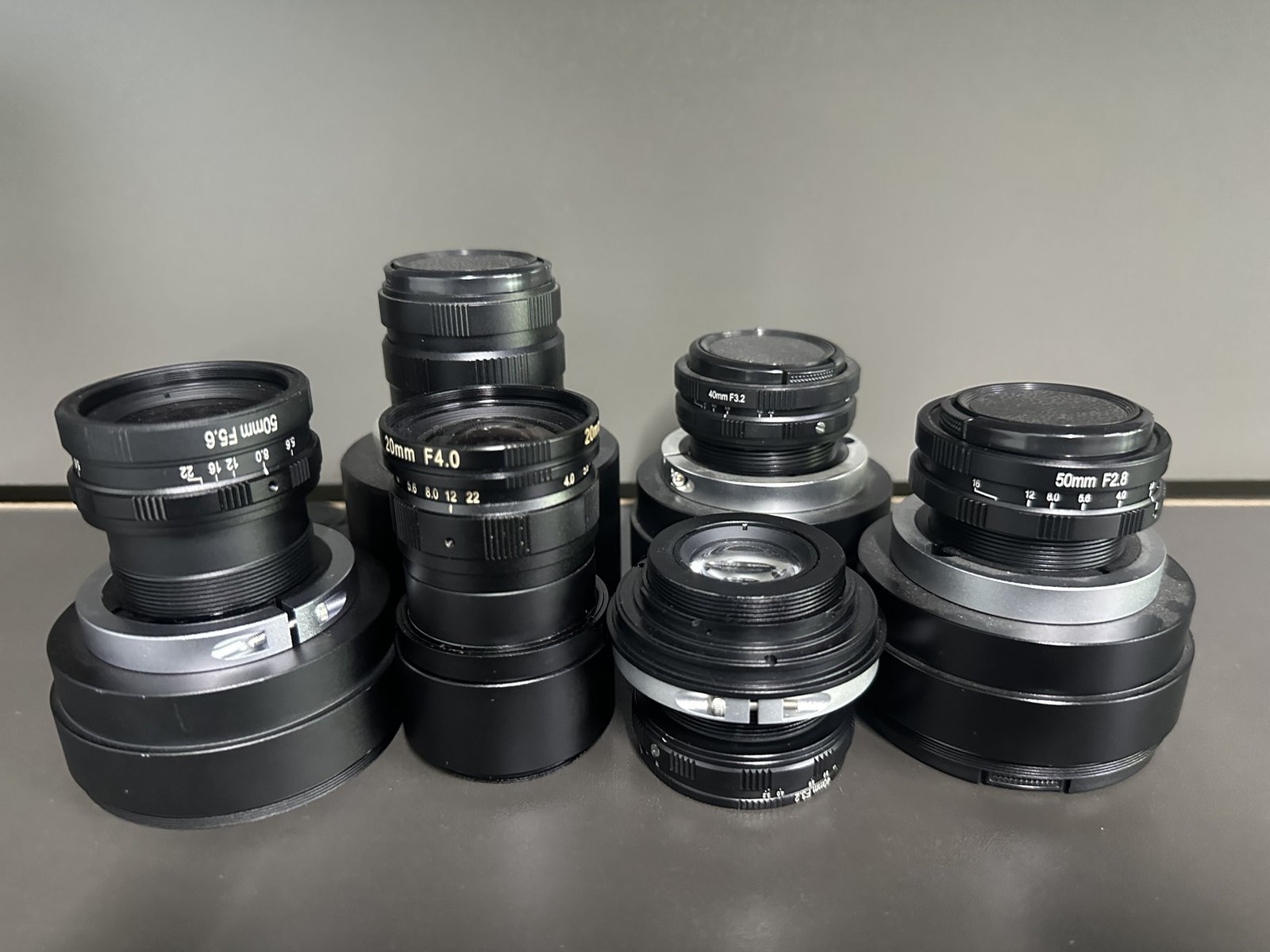
A 45 MP sensor arrives with a datasheet that promises a 0.8 µm pixel. Six months later the line is running at 12 MP because the images at full resolution were soft, and the investigation blamed the sensor. The lens was the constraint, and it had been specified against megapixels rather than against resolution.
Key Takeaways
Sensor format groups lenses more usefully than megapixel counts: the Lensmind HS FA sheet splits 29 C-mount models across 1/1.8" 8 MP, 2/3" 5 MP, 1.1" 10/20 MP and 4/3" 12 MP groups.
Resolution is a system property: pixel pitch, lens MTF at the working frequency and the diffraction limit all set it together.
Image circle has to exceed the sensor diagonal with margin; a 1.1" sensor on a 2/3" lens vignettes regardless of how good the MTF looks.
BFL is a mechanical constant: C-mount lenses register at 17.526 mm, and the focusing range decides whether your working distance is even reachable.
At small pixel pitches the aperture stops deciding depth of field and starts deciding sharpness, because diffraction sets a floor on the spot size.
Per-batch test records (MTF, distortion, BFL, DOF) are what turns a resolution claim into something a program can verify on arrival.
This selection guide walks the four numbers that decide whether a high-resolution sensor can actually be fed: image circle, MTF at your frequency, diffraction floor and mechanical fit. It assumes the five-input method in the machine vision lens selection guide; the specifics below are what change when the sensor gets dense.
Start From the Sensor Group, Not the Megapixel Count
Megapixels describe the sensor. Format describes the optical problem. A 5 MP 2/3-inch sensor and a 5 MP 1/1.8-inch sensor demand different image circles, different chief ray behaviour and different resolution targets, even though the count is identical.
That is why the Lensmind HS FA sheet is organised the way it is: twenty-nine C-mount models in four groups — 1/1.8-inch at 8 MP, 2/3-inch at 5 MP, 1.1-inch at 10 MP and 20 MP, and 4/3-inch at 12 MP. Choosing the group is the first decision, and it is made from the camera, not from the pixel count on a marketing page.
Within a group, the differences that matter are focal length, aperture range, distortion and focusing range. The 1/1.8-inch 8 MP group, for example, runs from 12 mm to 50 mm with distortion between <0.1% and <0.2%, and focusing ranges that start as close as 0.08 m on the 16 mm model.
The practical rule: pick the group from the sensor, then pick the focal length from the field of view and working distance, then check distortion and MTF against the measurement you need to make. Working in the other order — choosing megapixels first — is how programs end up with a lens that cannot cover the corners.
Image Circle: The First Hard Failure
A lens projects a circle of usable image. If that circle is smaller than the sensor diagonal, the corners go dark or soft, and no calibration fixes it. The check is arithmetic, and it should happen before a quotation is requested.
The published sensor sizes give the diagonals: a 1/1.8-inch sensor measures about 7.176 × 5.319 mm, diagonal 8.933 mm; a 2/3-inch sensor measures 8.800 × 6.600 mm, diagonal 11.000 mm. These are the numbers used in the selection maths, and they are why a 2/3-inch lens is not a drop-in replacement for a 1/1.8-inch lens on a denser camera.
Margin matters as much as matching. A lens whose circle equals the diagonal exactly will show corner degradation in real assemblies, because mounting tolerance, sensor tilt and field curvature all consume part of the budget. Selecting with a small margin is standard practice; the size of the margin depends on how much corner performance the application needs.
Vignetting is the visible symptom, and it is worth reading about in isolation if the line has ever blamed illumination for a dark corner. The vignetting reference covers the optical and mechanical causes, but in practice the first question is whether the image circle was larger than the diagonal with margin.
MTF and the Diffraction Floor
A dense sensor asks the lens to deliver contrast at a high spatial frequency. The frequency is set by pixel pitch: the Nyquist limit sits at half the sampling frequency, and a lens that cannot produce usable contrast near that frequency will show soft images no matter how many pixels are behind it.
The metric to compare is the modulation transfer function, and the comparison should be at the frequency the application needs rather than at a headline number. Optical transfer function is the standard language here, and Lensmind measures MTF versus image height in both sagittal and tangential directions on a production MTF station.
Then there is the floor no lens can beat. Diffraction sets a minimum spot size that grows as the aperture closes, so a small pixel pitch and a small aperture cannot coexist indefinitely. The Airy disk is the reference shape: once its diameter approaches the pixel pitch, stopping down further trades depth of field for sharpness.
In practice this is why high-resolution FA programs often run at wider apertures than their lower-resolution cousins, and why the aperture range on the datasheet — typically F2.4 to F16 on the 8 MP group — is read as a working range rather than as a menu.
Sensor group (HS FA sheet)
Models
Typical distortion
Aperture range
Notes
1/1.8" 8 MP
5
<0.1% to <0.2%
F2.4–16
Focusing ranges from 0.08 m
2/3" 5 MP
8
<0.1% to ≤3% (5 mm wide angle)
F1.6–16
Includes 5 mm and 6 mm wide options
1.1" 10 MP / 20 MP
11
Model-dependent, quoted at y=8.0/8.8 mm
F1.8–F32
Includes 6.5 mm 20 MP wide angle
4/3" 12 MP
5
Model-dependent
Per sheet
Largest format group
HANGZHOU FACTORY · ISO 9001
Feeding a dense sensor with a lens that can keep up?
Send the sensor model, the smallest defect you must resolve and the working distance. The FA optics team returns the sensor group, focal length and aperture that match, with per-batch MTF, distortion, BFL and DOF records attached to every shipment.
C-mount is a register: 17.526 mm from the mounting flange to the sensor plane, with a 1"-32 UN thread. Every C-mount FA model on the sheet lists that BFL, which is what makes them interchangeable on the camera side. CS-mount optics sit 5 mm closer and need an adapter ring; mixing the two without one is a common source of a lens that never reaches focus.
Focusing range is the second mechanical specification and the one that most often disqualifies an otherwise perfect lens. A model that focuses from 0.1 m to infinity cannot be used at 60 mm without extension, and a model that tops out at 1.5 m cannot be used at 3 m. On the 2/3-inch group the ranges vary from 0.06 m to 1.5 m depending on focal length, which is why the sheet publishes them.
The third is the front thread and barrel diameter, which decides filters and mounting fixtures. The 8 MP group mixes M27 and M28 threads across its five models; the 5 MP group uses M27, M30.5, M37 and M72 depending on focal length. If the assembly holds the lens by its barrel, that difference is a fixture drawing, not a footnote.
None of these three numbers is about image quality, and all three can stop a program. Checking them before sampling is cheaper than discovering them during integration.
Verifying a High-Resolution Lens on Arrival
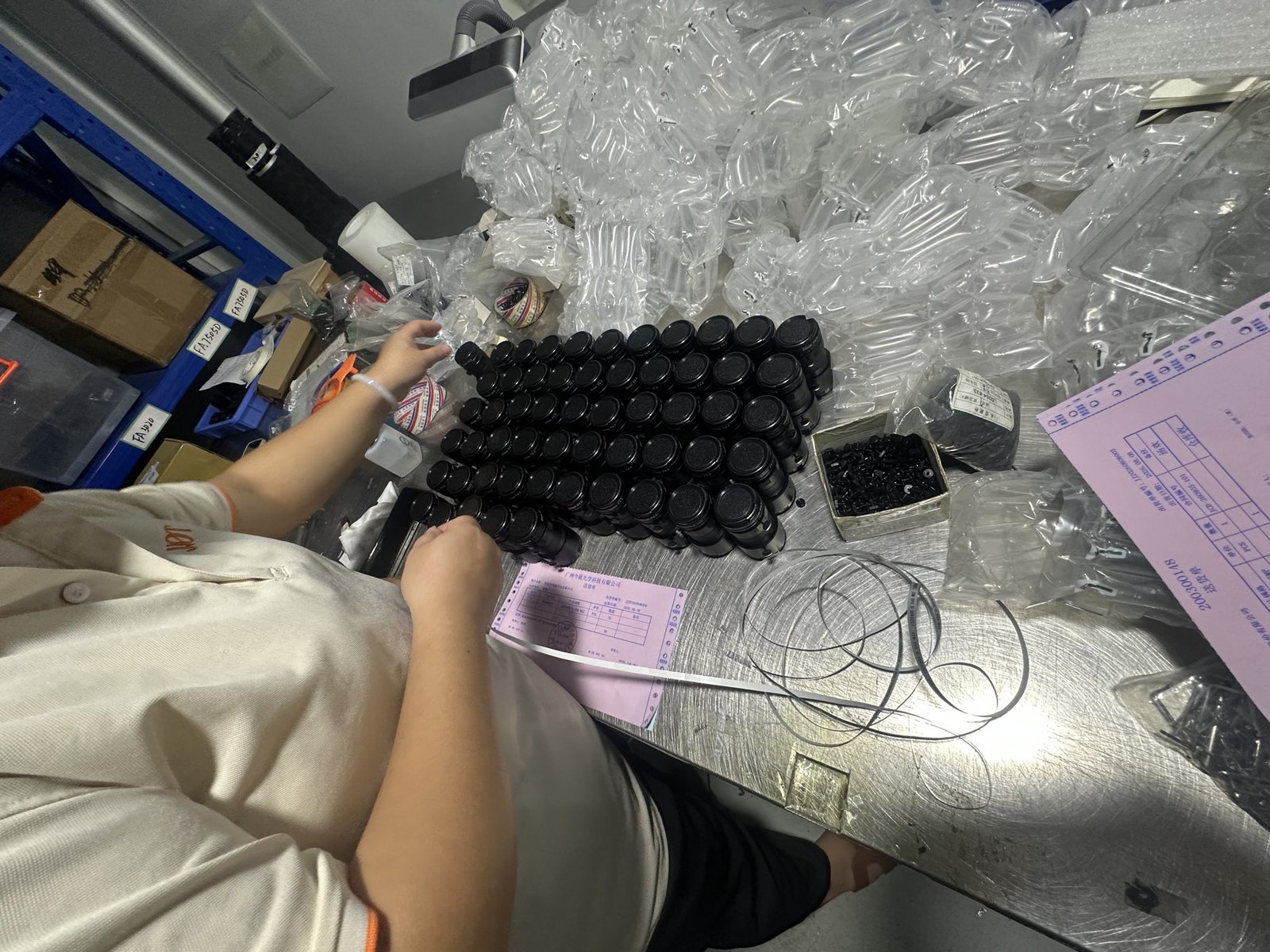
A resolution claim is worth exactly as much as the record behind it. Lensmind ships per-batch test documentation covering MTF, distortion, BFL and DOF, with the batch number, the test conditions, the inspection coverage and an explicit pass or fail judgment.
On arrival, three checks catch most problems. First, an imaged resolution target at the working distance and aperture, evaluated in the same way the application will evaluate it. Second, a distortion check against the published figure for that model. Third, a mechanical check of BFL and thread engagement, because a lens that is optically perfect but does not register is a mounting problem that will be blamed on the optics.
Where a program runs multiple lenses, keep the batch records with the serial numbers. When one cell underperforms, the comparison between its lens record and its neighbour’s is the fastest way to separate a lens issue from a lighting or mechanical one.
For AOI lines specifically, the promise that matters is consistency across a batch: the FA C-mount machine vision lens range is built for 10K+ batch consistency with distortion held below 0.05% on the flagship models, which is the property that keeps a recipe valid when the lens is replaced during maintenance.
When Not to Buy More Resolution
A denser sensor is not automatically a better inspection cell. Doubling the pixel count halves the light per pixel at the same exposure, which pushes lighting requirements up and often forces a wider aperture, which reduces depth of field on a part that may not be perfectly flat.
The second cost is data. High-resolution images at line rate are a throughput problem before they are an optics problem, and many programs gain more from a well-lit 5 MP image than from a marginally lit 20 MP one.
The honest test is the smallest defect you must detect, expressed in millimetres, divided by the number of pixels you want across it. That arithmetic gives the pixel size on the object, and it often shows that the sensor already in the machine is sufficient once the optics and lighting are correct.
Where the answer does point to a denser sensor, the lens group must move with it. Going from 2/3-inch to 1.1-inch is a change of family, not a change of model, and the earlier sections of this guide are the checklist for that move.
Conclusion
Choose the sensor group first: 1/1.8-inch 8 MP, 2/3-inch 5 MP, 1.1-inch 10/20 MP and 4/3-inch 12 MP on the HS FA sheet.
Image circle must exceed the sensor diagonal with margin, or the corners fail before any other specification matters.
MTF at the application frequency and the diffraction floor together decide whether a dense sensor can actually be fed.
BFL, thread and focusing range are mechanical disqualifiers; check them before requesting samples.
If the resolution question is still open, the most useful thing to send is a sample image from the current setup with the defect that is being missed. The FA team can usually say within a day whether the limit is the lens, the lighting or the sensor — and which of the four sensor groups would change the answer.
Frequently Asked Questions
How many C-mount FA models does Lensmind list?
Twenty-nine models in four sensor groups: 1/1.8-inch 8 MP (5 models), 2/3-inch 5 MP (8 models), 1.1-inch 10 MP and 20 MP (11 models) and 4/3-inch 12 MP.
How do I check whether a lens covers my sensor?
Compare the lens image circle with the sensor diagonal plus margin. A 1/1.8-inch sensor is about 8.933 mm diagonal; a 2/3-inch sensor is 11.000 mm.
Why does a denser sensor sometimes look worse?
Small pixels demand more contrast at high frequency and less light per pixel. If MTF at that frequency or the diffraction floor is limiting, more megapixels do not help.
What does the focusing range tell me?
Whether your working distance is reachable without extension tubes. Ranges vary by model — from 0.06 m on some wide models to 1.5 m and beyond on longer focal lengths.
What documents ship with a lens batch?
MTF, distortion, BFL and DOF test records with batch number, test conditions, inspection coverage and a pass or fail judgment.
Is C-mount always 17.526 mm?
The flange focal distance is 17.526 mm with a 1-32 UN thread. CS-mount is 5 mm closer and needs an adapter ring if used on a C-mount camera.
Baker Zhao
Founder, Lensmind Optics
Baker Zhao is the founder of Lensmind Optics, with 26 years of experience in the optical industry — including Vice President of Sales at Sunny Optical (Zhongshan) and earlier roles at Foxconn, LG and Sintai Optical. He leads Lensmind with a mission to help customers find reliable, application-specific optical solutions from development to volume production.
A short-working-distance large-FOV feasibility input pack is the maker-ready file that states part size, stand-off, pixel budget, and which image costs the buyer will...
Turning a 50 micrometre defect at 200 millimetres into a lens commitment means locking pixel pitch, image height, and a verification target before anyone...