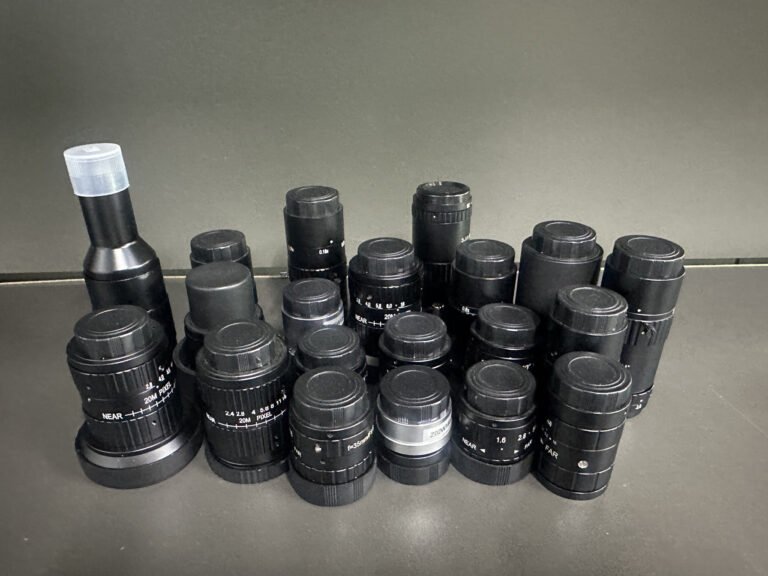
360° Panoramic Lens Family Guide: Pericentric, Catadioptric and Fisheye
One lens, one camera, the whole circumference: what pericentric panoramic optics do, where the fisheye boundary sits, and how side-wall builds are quoted.
read more…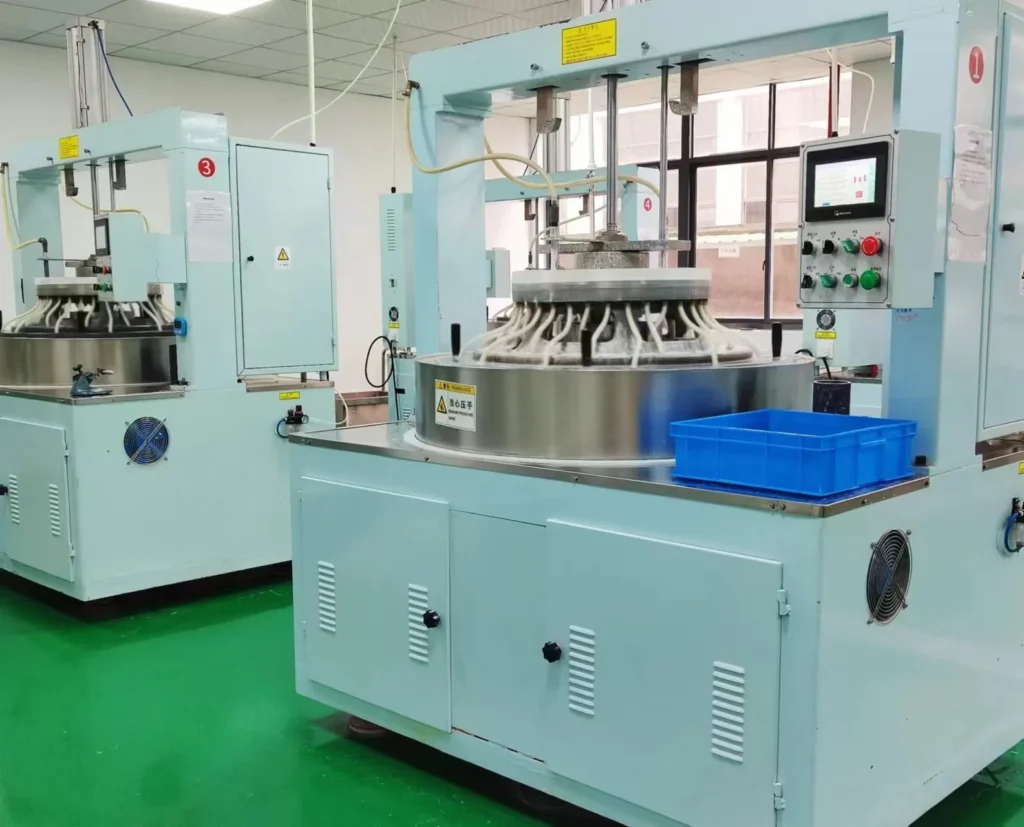
The camera has to look straight down at a solder joint that sits under a lip. A mirror would fold the path, but the mounting tolerance and the ghost image from the second surface are both problems. A right-angle prism solves it in one solid part — provided the hypotenuse coating, the material and the flatness are specified instead of assumed.
Key Takeaways
This family guide covers what the prism and planar-optics line makes, how to specify each type, and where the boundary sits between a standard catalog part and a made-to-drawing build. For imaging systems rather than beam paths, the five inputs in the machine vision lens selection guide remain the right starting point.
A lens changes the shape of a wavefront. A prism changes its direction, its polarization state or its spectral content. That difference is why prism selection starts with a sketch of the beam path rather than a sensor size.
In machine vision the common jobs are folding, steering and splitting. Folding puts the camera where the machine has space: down a bore, along a rail, inside a housing. Steering sends the view to a second station. Splitting sends the same scene to two sensors — one for imaging, one for measurement, or two for different wavelengths.
The physics behind the simplest case is ordinary refraction and total internal reflection. A right-angle prism with an uncoated hypotenuse reflects by TIR, which is why the part can be a solid block of glass with no metal coating to degrade and no protective overcoat to apply.
Where a metal-coated mirror is the better answer, the prism line makes those too, alongside the prism range on the optical prisms page. The choice between folding with glass and folding with a mirror is usually mechanical: a prism is more tolerant of mounting error and gives a cleaner fold, while a mirror is lighter and cheaper in large apertures.

The right-angle prism is the workhorse. It bends a beam by 90° or, with two reflections, by 180° to send it back along a parallel path. Lensmind makes them in N-BK7 and equivalent glasses, with the hypotenuse either coated or left bare for total internal reflection, and in sizes built to drawing.
Two specification lines decide whether a right-angle prism works in a vision path. The first is surface flatness of the reflecting face, because flatness error multiplies into the wavefront the camera sees. The second is the angle tolerance between the two leg faces, because that error displaces the outgoing beam.
V-type prisms exist for the opposite reason: not to fold a beam, but to separate wavelengths. They are used in spectrometers and wavelength-separation optics, coated or bare depending on the dispersion requirement, and they are quoted with the prism angle as the primary tolerance.
Both types are made-to-drawing at Lensmind. The catalog covers standard PBS and right-angle sizes; everything else is cut and polished against a drawing, with first articles in seven days.
A polarization beam splitter cube separates S and P polarization with high extinction ratio, which makes it the standard way to route light in polarization-sensitive imaging and metrology. The Lensmind PBS family covers the 400–700 nm band and beyond, in standard and custom geometries.
Cemented PBS assemblies are the next step up: matched coating pairs in one bonded part, built for low insertion loss. Where a system needs several channels, cemented beamsplitter arrays split the beam by channel map — the arrangement found in camera modules and sensor optics rather than in a single-camera vision cell.
Polarization conversion prisms serve projector and display light engines, where uniformity across the aperture matters more than extinction ratio alone. The requirement is specified as a uniformity budget over the aperture, not as a single point measurement.
For all three, the interesting specification is the bonded interface, not just the coated surface. Beam splitters fail at that interface under thermal cycling when the cement and the coating were not matched as a pair — which is why coating and cementing sit on the same line here rather than at two suppliers.
| Type | Job in the system | Primary specification |
|---|---|---|
| Right-angle prism | Fold 90° or 180° | Leg angle, hypotenuse flatness, coating or TIR |
| V-type prism | Disperse and separate wavelengths | Prism angle, material dispersion |
| PBS cube | Separate S/P polarization | Extinction ratio, band, aperture |
| Cemented PBS | Low-loss polarized routing | Coating pair match, bond quality |
| PCS prism | Polarization conversion for light engines | Uniformity across aperture |
| Cemented array | Multi-channel splitting | Channel map accuracy |

Three planar families sit alongside the prisms. Galvanometer scanning mirrors for LiDAR use low-inertia substrates so the mirror can be driven fast without exciting a resonance, with high-reflectivity coatings that survive the scan duty cycle.
Polygon scanner mirrors are the second: faceted wheels with tight facet-to-facet angle control, where the angle budget directly becomes the scan-line straightness budget. Both LiDAR families are coated in-house, which keeps the reflective stack and the substrate specification in one set of records.
The third family, AR waveguide substrates, is the most demanding on flatness. The standard part is 60 × 60 × 1.2 mm with 1/10λ surface flatness and 20/10 scratch-dig to MIL standard, shipping from stock tooling, with other sizes and edge profiles quoted from drawing.
These substrates are volume-polished and inspected in a class-1000 cleanroom, which is the practical reason a waveguide program can start on a standard part and move to a custom outline without changing supplier and re-qualifying the polish.

The prism line runs its own complete chain: raw cutting, SPG precision grinding, double-sided polishing, vacuum optical coating and final inspection in a class-1000 cleanroom. Nothing critical is outsourced, which is what keeps lead times and batch consistency under the factory’s own control.
Small-batch prototypes and volume production run on the same line, with per-batch records shipped with every order. That is the structure that makes a seven-day sampling promise meaningful: the sample is not a special build, it is the front of the production queue.
Monthly capacity reaches two million pieces across the prism and planar families. For programs that scale from a few hundred prototypes to a container of parts, the same tooling and the same inspection culture carry through, which removes the usual re-qualification step between pilot and volume.
The line also carries forward the manufacturing discipline of a Japanese-precision optical workshop — tooling practice, process control and inspection culture accumulated over more than thirty years. That heritage describes the line, not the age of the company.
A workable prism request carries six items: the function (fold, split, disperse, scan), the material, the geometry with its critical angles, the surface quality by scratch-dig standard, the flatness for any reflecting or imaging face, and the coating specification with the wavelength band.
It also helps to state the mount. A prism that will be bonded into an assembly has a different edge-tolerance requirement from one that sits in a kinematic holder, and saying so at quotation avoids a second iteration on the drawing.
Send a CAD model, a sample, or even just the target parameters — the line accepts all three, and first articles come back in seven days. Where the part will run in volume, the same drawing repeats it at production rates, and the same discipline applies to custom lens assemblies on the custom optics side of the factory.
The single most common omission is the wavelength band on the coating. A coating that is right across the visible range can fall off exactly where a NIR or LiDAR channel needs it, and the error appears as a transmission loss that gets blamed on the substrate.
For a prism or planar-optics program, the fastest route to a reliable quotation is a drawing plus the two numbers that decide cost: the surface quality standard and the coating band. Send those three and the optical line will return a first-article plan alongside the price.
A prism folds or splits light inside a solid glass part, which is more tolerant of mounting and gives a cleaner fold. A mirror is lighter and cheaper in large apertures, and both are made on the same line.
When the hypotenuse works by total internal reflection. That removes the metal coating and its overcoat from the stack, which simplifies both the specification and the lifetime argument.
Function and geometry, the surface quality standard (scratch-dig), the flatness requirement on any imaging or reflecting face, and the coating band. Those four lines decide the process route.
60 × 60 × 1.2 mm with 1/10λ surface flatness and 20/10 scratch-dig to MIL standard, shipped from stock tooling. Other sizes are quoted from drawing.
Seven days for prototype sampling, on the same line that runs volume production, with per-batch records shipped with every order.
Yes. Prototypes and mass production share one line, with monthly capacity of two million pieces across the prism and planar-optics families.

One lens, one camera, the whole circumference: what pericentric panoramic optics do, where the fisheye boundary sits, and how side-wall builds are quoted.
read more…
Matched pairs, not random lenses: the optics behind stereo depth accuracy and laser line profiling, with per-pair verification records.
read more…
Four numbers pick the model: field of view, tube diameter, total track length and the matched sensor. The six catalog industrial models explained.
read more…