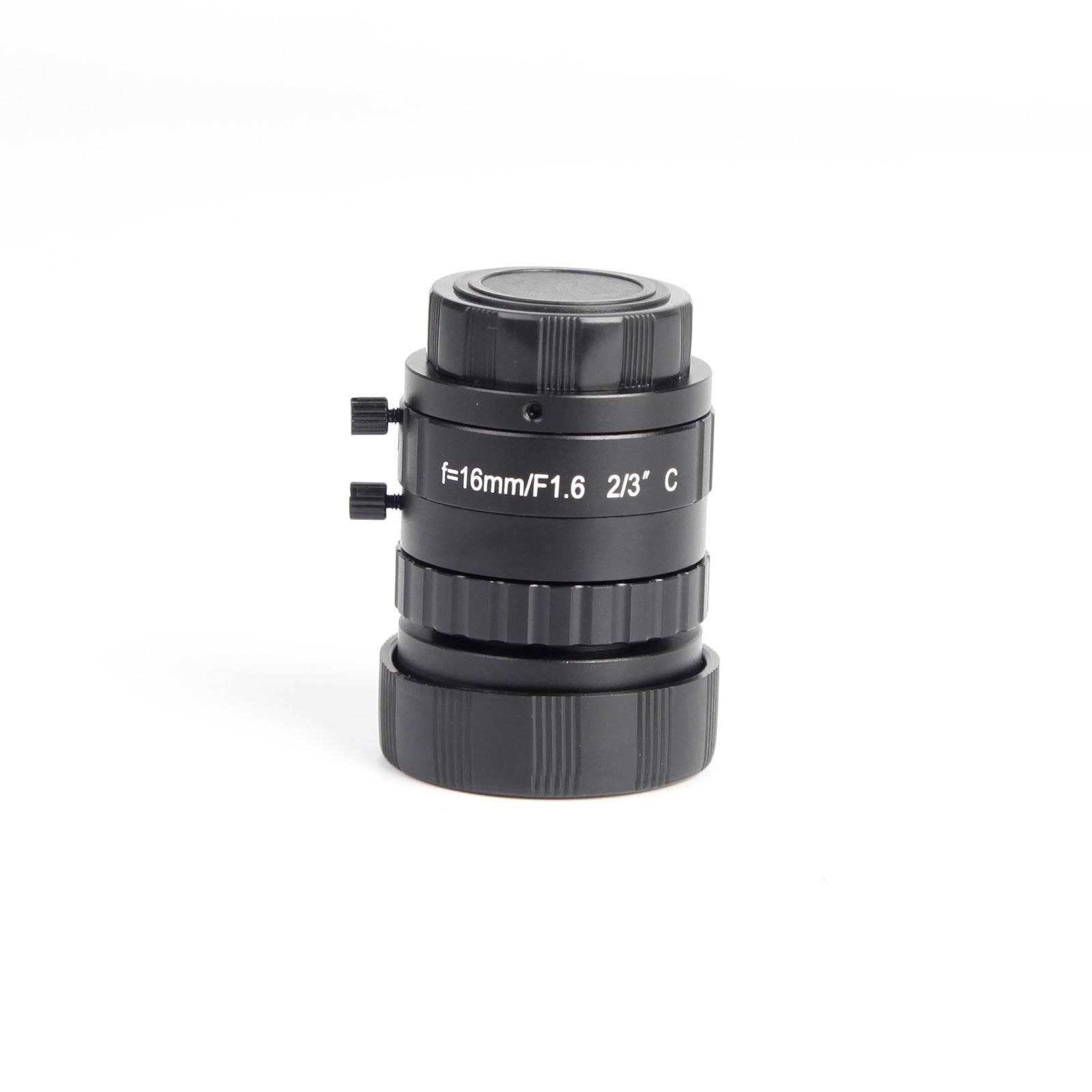
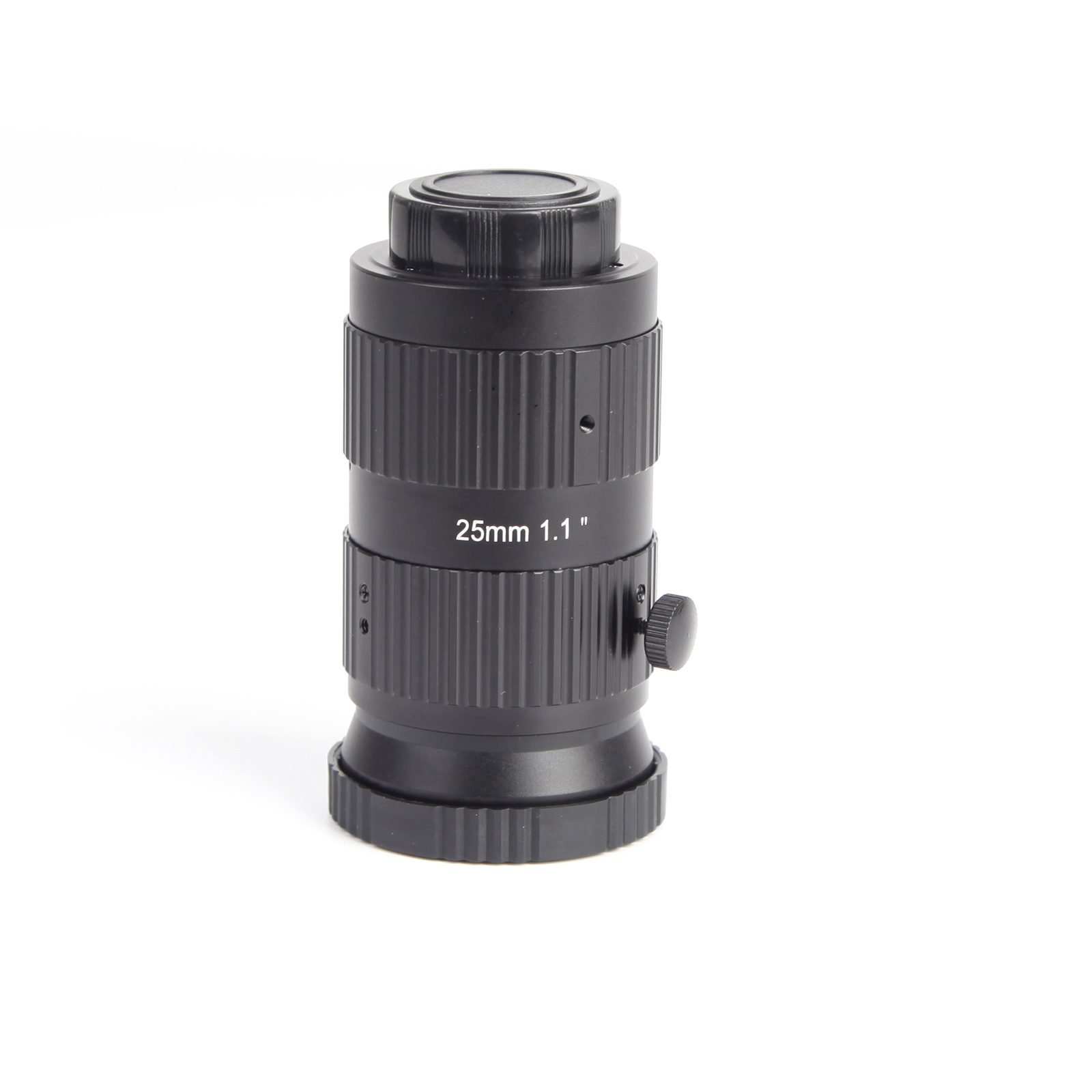
The inbox said “C-mount lens, 5 MP, 25 mm, send samples.” No sensor format, no working distance, no field, no distortion budget. That RFQ is how a 2/3″ barrel lands on a 1.1″ chip and the corners go dark on the first night shift. A C-mount thread only promises 1″-32 UN and a 17.526 mm flange. It does not promise coverage, distortion, or the right focal length.
Key Takeaways
C-mount flange focal distance is 17.526 mm. CS-mount sits 5 mm closer (about 12.5 mm). A C-lens on a CS body needs the 5 mm ring. The reverse usually will not reach infinity.
Image circle must cover the sensor diagonal: 2/3″ is 11.000 mm; 1″ is about 16 mm; 1.1″ is larger still. Format, not megapixels, sizes the glass.
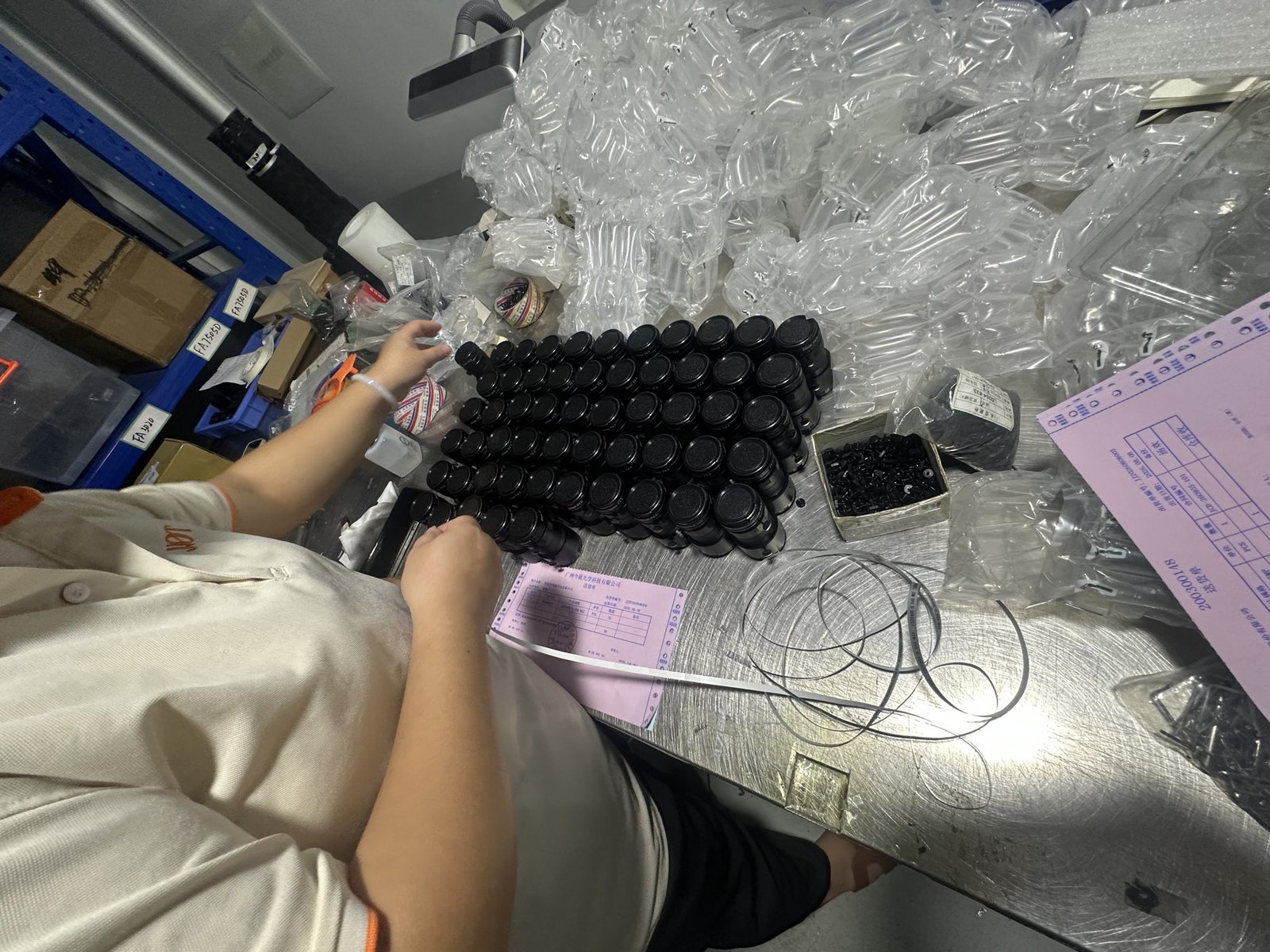
Lensmind FA production holds distortion below 0.05% with 10K+ batch consistency. Convert that percentage into millimetres on your field before you call it “low distortion.”
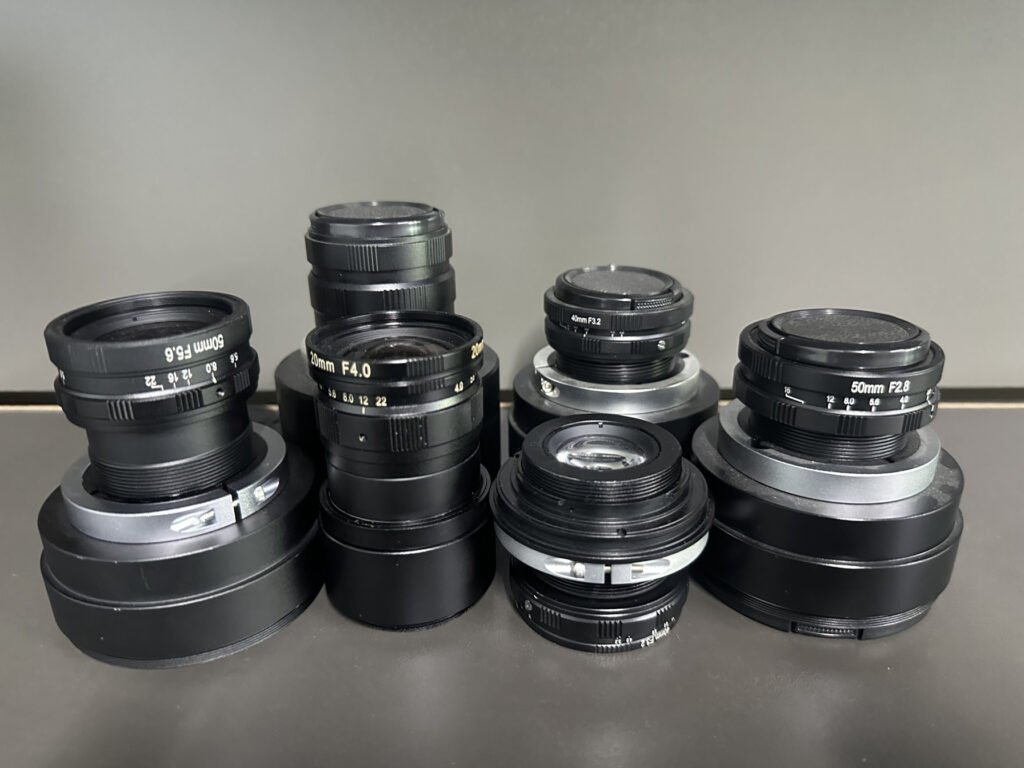
Named macro models include FA3505W, FA5005W, FA2520W, FA3520W, FA5020W, FA7520W. The family page lists 30 C-mount SKUs covering 2/3″ to 1.1″.
Stay on C-mount for industrial bodies and accessory flexibility. Move to M12 on board cameras. Move to telecentric when object height changes the measured size.
This is the practitioner pass on that inbox: flange, format, distortion in millimetres, then focal length. The five inputs in the machine vision lens selection guide are still the minimum RFQ. On FA glass the format line is the one that gets skipped.
What the RFQ Usually Leaves Out
“5 MP” is not a lens spec. A 1/1.8″ 5 MP board sensor and a 2/3″ 5 MP global-shutter chip want different image circles. “25 mm” is not a field of view until you name the sensor width and the working distance. “C-mount” only names the thread and the flange.
Write five numbers before anyone opens a catalog: sensor format (or active W × H), working distance, field width × height, smallest feature or distortion budget, environment. If any one is missing, the sample is a guess. Guesses vignette.
C-Mount Geometry: 17.526 mm and the CS Ring
Edmund Optics records the C-mount flange distance as 17.526 mm. Wikipedia’s C-mount article uses the same number. Basler’s C-mount lens pages add the thread: 1″-32 UN, 25.4 mm nominal diameter. That pair — thread plus 17.526 mm — is the interchangeability contract.
CS-mount uses the same thread and a shorter register, 12.5 mm in Lensmind site copy (commonly quoted as 12.526 mm). The difference is 5 mm. A C-mount lens on a CS camera needs a 5 mm spacer to restore 17.526 mm. A CS lens on a C camera usually cannot reach infinity: the flange stops it 5 mm too far out. Threading the wrong pair until it “feels tight” is how back-focus never collimates.
Sensor Format From 2/3 in to 1.1 in
The FA family is specified for 2/3″ to 1.1″. Typical diagonals from the Opto Engineering lookup: 2/3″ = 11.000 mm (8.800 × 6.600 mm); 1″ 4:3 ≈ 16.000 mm (12.800 × 9.600 mm). 1.1″ class sensors such as Sony IMX253 sit around 17.5 mm diagonal. A 2/3″ lens on a 1.1″ chip vignettes. A 1.1″ lens on a 2/3″ chip covers, but you are paying for unused glass and a different distortion map.
Format
Typical W × H (mm)
Diagonal (mm)
FA start
2/3″
8.800 × 6.600
11.000
Default industrial body
1″
12.800 × 9.600
16.000
Need a 1″ circle, not 2/3″ glass
1.1″ class
~14.1 × 10.3 (example IMX253)
~17.5
1.1″ FA / 20 MP class barrels
Always finish on the sensor datasheet active area. Format names are classes. Two “1.1″” chips can differ by a millimetre of diagonal, which is the difference between full-field MTF and a dark corner.
Distortion Below 0.05% in Millimetres
FA line distortion is held below 0.05% with 10K+ batch consistency. That is a first-party production claim, not a brochure adjective. On a 50 mm object width, 0.05% is 0.025 mm of mapping error at the edge if the percentage is TV distortion referred to that field. On a 1.0 mm feature it is 0.0005 mm — usually below the pixel. Convert the percentage on your actual field before you pay telecentric money to “fix distortion” that is already smaller than the algorithm’s edge uncertainty.
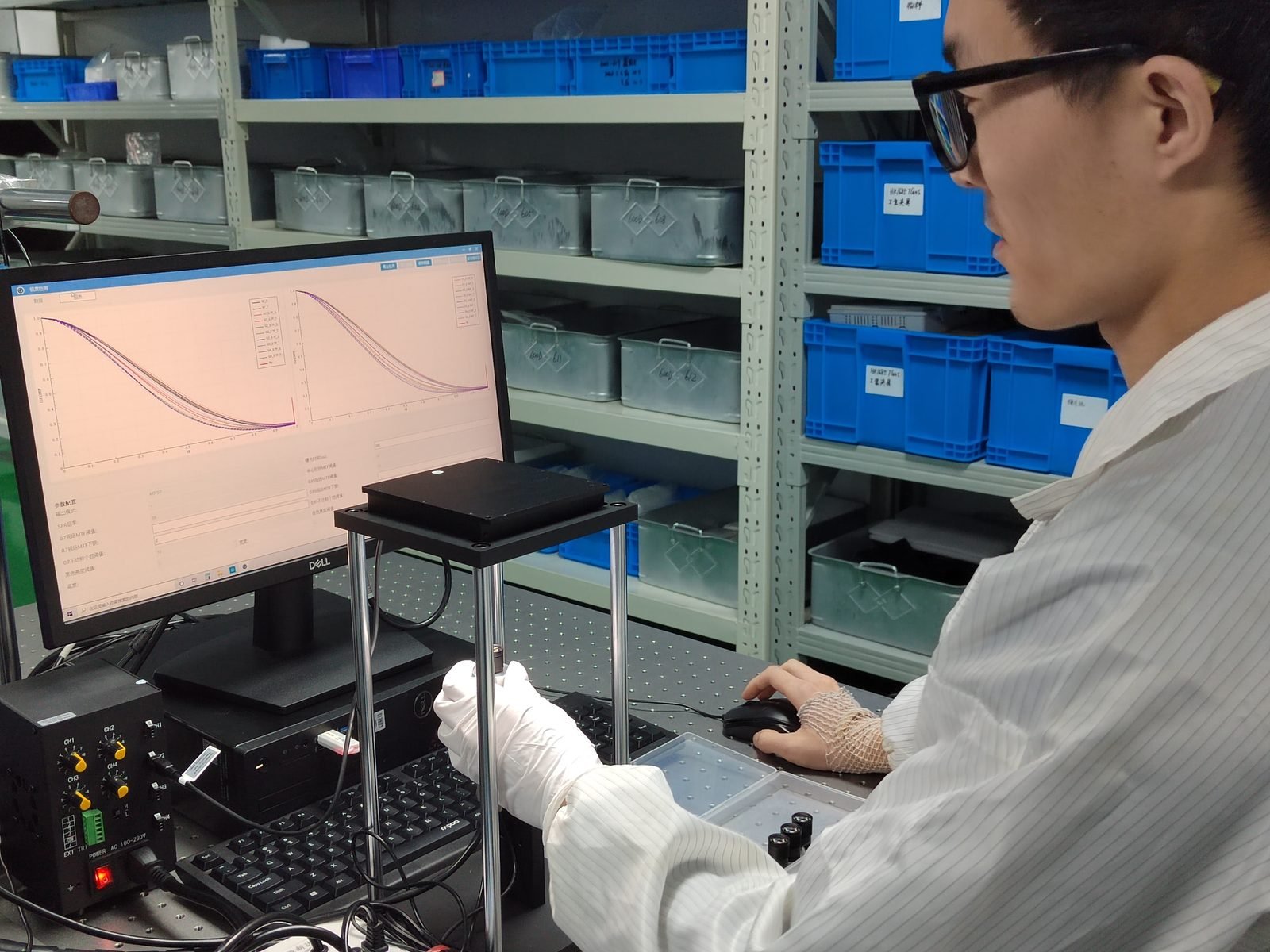
Every production batch ships with test documentation covering the agreed parameters — typically MTF, distortion, BFL, DOF — plus batch number and a pass/fail judgment. Reports are default. If a supplier cannot attach last-lot distortion, the 0.05% on the datasheet is a design target, not a shipped number.
Focal Length From Sensor and FOV
Thin-lens first pass: f ≈ (sensor width × working distance) / (field width + sensor width). Worked example from the hub guide: 2/3″ at 8.8 mm width, 200 mm WD, 40 mm object plus margin to 44 mm → f ≈ 33.3 mm. Nearest catalog values 25 mm and 35 mm. 25 mm buys placement margin. 35 mm buys sampling. Confirm on a drawing; principal-plane offset is not in the thin-lens estimate.
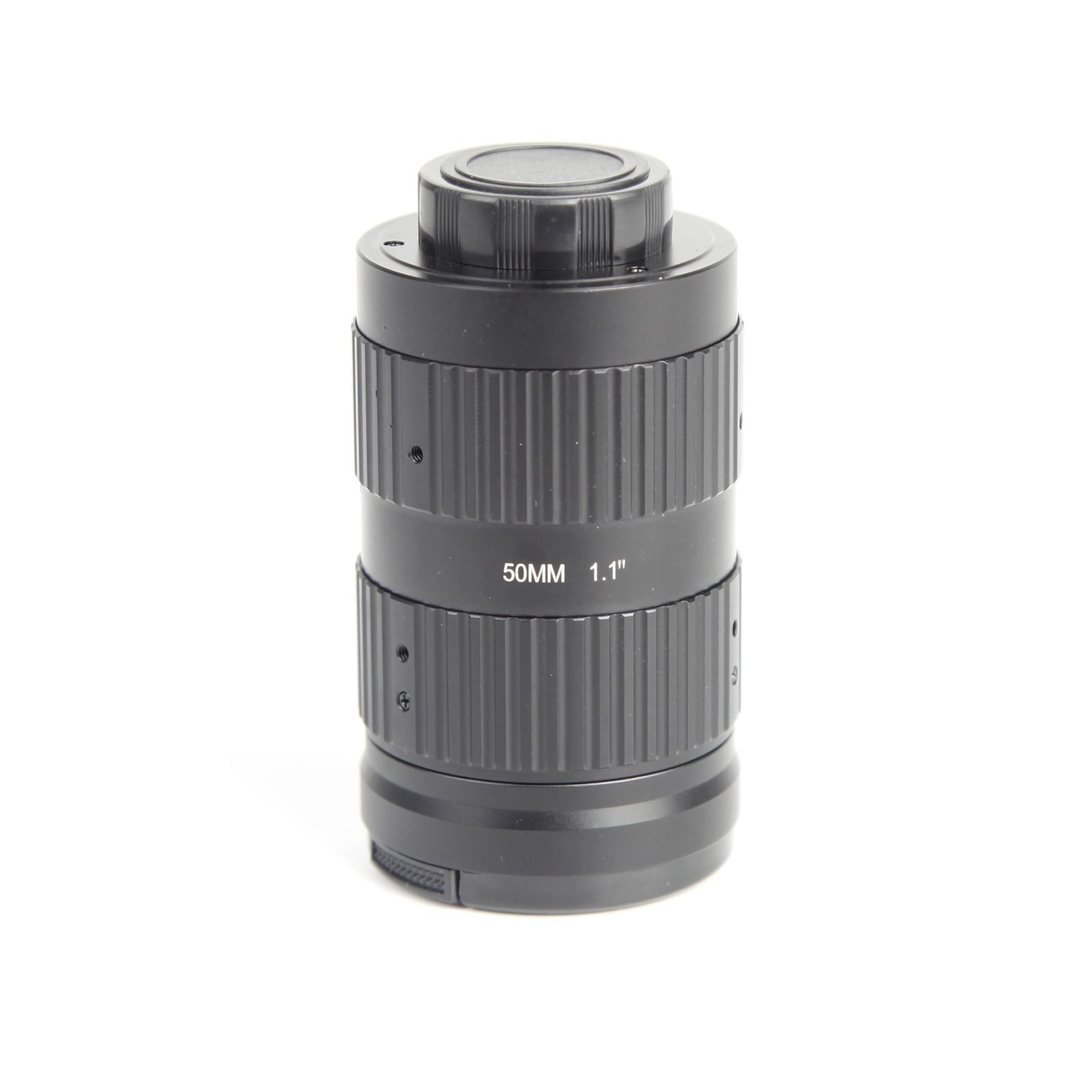
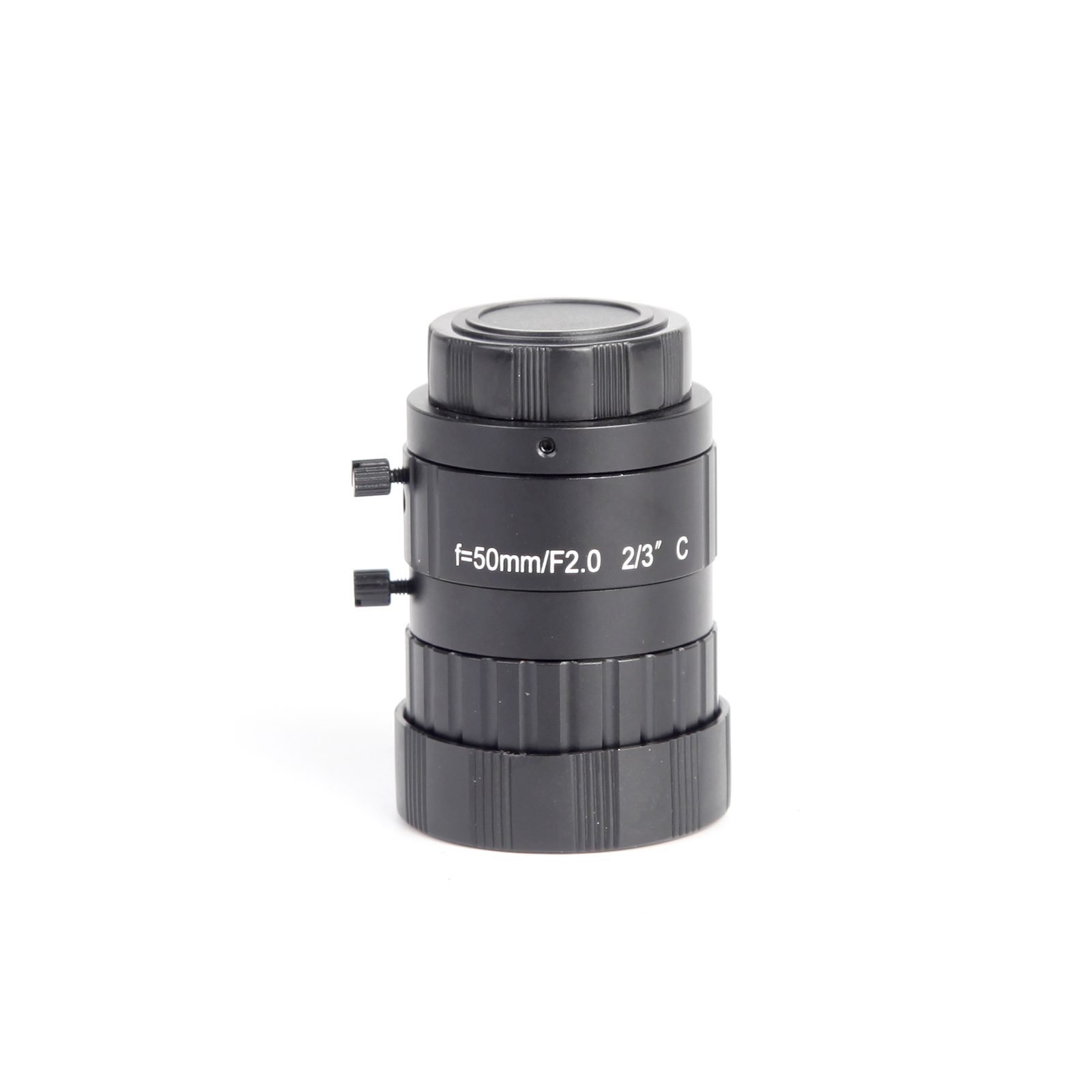
The FA C-mount machine vision lens family is the catalog you open after that estimate, not before. Iris rings exist here. They do not exist on most M12 barrels. If the line changes light level, that ring is why you stayed on C-mount.
30 C-mount FA SKUs from 2/3″ to 1.1″, distortion held below 0.05% with 10K+ batch consistency, macro models named FA3505W through FA7520W. First-pass feasibility in 48 hours. Batch reports ship as default.
Standard FA barrels are the discrete-part default at typical machine-vision working distances. The macro family (FA3505W, FA5005W, FA2520W, FA3520W, FA5020W, FA7520W) is for close-distance gauging where a 35 mm or 50 mm standard cell cannot reach the conjugate. Additional catalog models include FA0410A through FA5017A and the LMHS-MH series (MH0088, MH1825, MH2012, MH2016, MH2025, MH2035, MH2050, MH2406). Quote the SKU. “25 mm C-mount” is not a SKU.
If the working distance is tens of millimetres and the field is a connector face, start in the macro list. If the working distance is hundreds of millimetres and the field is a whole PCB, start in the standard FA list. Mixing those two is how you get a sample that focuses at 80 mm when the nest is at 22 mm.
When C-Mount Is the Wrong Spend
Best for C-mount FA
Not for C-mount FA
Industrial camera bodies, 2/3″–1.1″
PCB modules that want M12×0.5
Iris, filters, extension tubes
8K/16K line sensors (need M42–M72)
Flat parts, locked WD, <0.05% distortion
Thick parts whose size must not change with Z
Board cameras belong on M12 with FT lock. Gauging on thick objects belongs on telecentric. Long lines belong on line-scan glass. C-mount FA is the default when the camera is already an industrial C body and the part is discrete. That is a large default. It is not the whole catalog.
What We Check Before an FA Quote
A usable FA RFQ names the sensor model, not “5 MP C-mount.” First-pass feasibility is 48 hours. Prototype to mass production is 60 working days. Repeat orders are 30 days. Payment is 50% advance and 50% before shipment. Custom tooling is stored free for 5 years.
Sensor: model, format, active area, pixel size. C or CS body.
Conjugate: working distance, field, smallest feature.
Budget: distortion in millimetres, not an adjective.
Reports: MTF, distortion, BFL, DOF with pass/fail. ISO 9001 (2024). Company registered 2019.
Illustrative inbox: 2/3″ 5 MP, 200 mm WD, 40 mm field, 0.1 mm feature, dry cabinet. First sample 25 mm or 35 mm FA, distortion report attached, no telecentric, no M12 adapter. If the next email adds “1.1″ IMX” the first sample is already the wrong circle — that is the email to catch before glass ships.
Conclusion
C-mount is a flange contract at 17.526 mm, not a coverage contract. Size the circle to the sensor diagonal, convert 0.05% into millimetres on your field, then pick focal length from sensor width and working distance. Write those numbers in the RFQ. “5 MP, 25 mm” is how corners go dark.
Key takeaways
C = 17.526 mm. CS is 5 mm closer. Use the ring in one direction only.
2/3″ is 11.000 mm diagonal. 1.1″ is not. Match the circle.
FA distortion below 0.05% with 10K+ batch consistency is a production claim with reports attached.
Macro SKUs (FA3505W–FA7520W) are for close conjugates. Standard FA is for typical WD.
If the camera is already a C-mount industrial body and you can name format, WD, and field, send those three. Hangzhou will map them onto the 30-SKU FA list or tell you the job is M12, telecentric, or line-scan. First-pass feasibility is 48 hours.
Written by the Lensmind Optics team — Hangzhou factory (Lin’an) and Zhongshan office, company registered 2019, ISO 9001 certified 2024. Founder on this site: Baker Zhao.
Frequently Asked Questions
What is the C-mount flange distance?
17.526 mm from flange to sensor, with a 1″-32 UN thread. That pair is the interchangeability contract. Image circle is a separate spec.
Can I put a C-mount lens on a CS-mount camera?
Yes, with a 5 mm spacer that restores 17.526 mm. A CS lens on a C camera usually cannot reach infinity without modifying the body.
Will a 2/3 inch lens cover a 1.1 inch sensor?
No. 2/3″ is 11.000 mm diagonal. 1.1″ class chips are around 17.5 mm. The corners go dark. Specify a 1.1″ image circle.
What does 0.05% distortion mean on my part?
On a 50 mm field, 0.05% is 0.025 mm at the edge if that percentage refers to the field. Convert it on your width before you upgrade the family.
When do I need a macro FA lens?
When the working distance is short and a standard 25–50 mm cell cannot reach the conjugate. Start with FA3505W–FA7520W and confirm the WD on the sheet.
Is C-mount the same as M12?
No. M12×0.5 has no flange standard. C-mount registers at 17.526 mm. Use M12 on board cameras and C-mount on industrial bodies.
Baker Zhao
Founder, Lensmind Optics
Baker Zhao is the founder of Lensmind Optics, with 26 years of experience in the optical industry — including Vice President of Sales at Sunny Optical (Zhongshan) and earlier roles at Foxconn, LG and Sintai Optical. He leads Lensmind with a mission to help customers find reliable, application-specific optical solutions from development to volume production.
A short-working-distance large-FOV feasibility input pack is the maker-ready file that states part size, stand-off, pixel budget, and which image costs the buyer will...
Turning a 50 micrometre defect at 200 millimetres into a lens commitment means locking pixel pitch, image height, and a verification target before anyone...