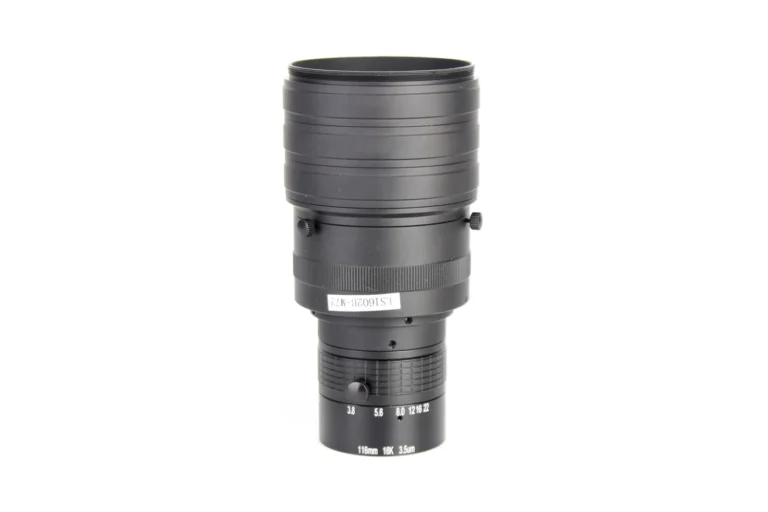
Dry them and put them back is not a decision. It is a hope with a schedule. Coolant is not water: a used metalworking emulsion carries oils, emulsifiers, corrosion inhibitors, biocide residues and whatever the sump has been growing, and that film keeps working on cement edges, seals and coatings long after the puddle is gone. The verdict belongs to whoever can open the lens, measure it against its own factory record, and sign a disposition for that serial number. Between the flood and that verdict there is a sequence you can run this week: quarantine both lenses, record the exposure, ship them with the right paperwork, and let the assessment end in measurements instead of opinions. Here is that sequence from the maker’s side of the bench.
The First Hour on Your Line
Nothing you do in the first hour decides whether the lenses survive. Plenty of things decide whether they can be judged honestly.
- Stop exposing them. Pull both lenses off the line. A wet lens on a running station collects more of everything: more fines, more mist, more heat cycling that pumps fluid past seals.
- Do not wipe the optics. Coolant carries swarf. Wiping turns a rinseable film into a scratch pattern. Your cleaning rules for coated elements already say which agents and materials are allowed; flooded optics are outside those rules until assessed.
- Do not rinse, bake or blow. Tap water adds its own minerals; heat gunning drives moisture deeper and bakes residue onto internal surfaces; compressed air drives fluid past the front seal into the cavity you wanted to keep dry.
- Record the exposure. Coolant type and concentration, how long each lens was under, water temperature, and whether the flood was clean coolant or sump bottoms with chips and tramp oil. Photograph the lenses as found.
- Bag and tag. Each lens in its own sealed bag, labeled with the station, the serial number and the date. No further handling until they reach the bench.
Why Drying Is Not a Verdict
Evaporation only removes the carrier. What stays behind is the problem. A used water-based coolant is a chemical and biological system, not dirty water: published studies of metalworking fluids in service document colonies of bacteria and mycobacteria growing in the emulsion, sustained by the fluid’s own additives, and a study of biocide resistance in contaminated metalworking fluids is one place to see that chemistry documented. That is also why fluid identity belongs in your exposure log. Dried residue on a coated surface is hygroscopic; it pulls in humidity on the next temperature swing and restarts the attack underneath the film. At the edge of a cemented element or an edge seal, residue wicks into the joint by capillary action, where no amount of surface drying will ever reach it. Inside the barrel, trapped fluid condenses on the cool glass every night and evaporates every morning, moving dissolved solids from warm zones to cold zones one shift at a time. None of that shows from the outside. A lens can look clean, focus fine on the bench and still carry a clock that runs for months.
Symptoms, Paths and What They Mean for Reuse
What you can see from outside points to where the fluid went, and where it went decides who can judge the lens. Read the table left to right: the observation, the likely ingress path, and what it means for the reuse question.
| What you observe |
Likely path the fluid took |
What it means for reuse |
| Droplets between the front element and its retaining ring |
Capillary gap at the front seal or filter thread |
Judgeable: maker re-cleans and re-tests; salvage is common if it stopped there |
| Haze under the coating that survives a gentle rinse |
Residue sitting on the coating long enough to etch |
Coating damage is permanent; front group replacement or lens replacement |
| Cloudy patch between two cemented elements |
Crossed the edge seal into the cement joint |
Re-cement at the factory or replace; field drying never reaches this joint |
| Fluid visible in the focus thread or lock ring |
Threads are not sealed interfaces |
Maker dries, re-lubricates and function-checks; often salvageable |
| Fog that comes and goes with temperature |
Trapped fluid in an internal cavity; the hermetic seal has already lost |
Factory rebuild with new seals, or replace; never “wait for it to clear” |
| Nothing visible at all |
Internal contamination with no external trace |
Assume nothing; only measurement and opening can decide |
The last row is the expensive one. Two flooded lenses that look identical can hold completely different amounts of fluid inside, and the outside of the barrel cannot tell you which is which. That is why the assessment runs on data, not on the wipe test.
What to Ship Back With the Lenses
An assessment is only as good as its inputs. Three items turn a returned lens from a mystery into a case file.
The Exposure Record
Send the log from the first hour: coolant brand and type if known, concentration, hours submerged, temperature, and whether the fluid carried chips or tramp oil. Chemistry drives the verdict. A brief splash of clean, fresh emulsion and an overnight soak in sump bottoms are different cases with the same photograph, and the maker’s disposition will differ accordingly.
Serial Numbers and Their Factory Records
Tell the maker which serial numbers went under, and expect the assessment to compare against what those units measured when they were built. Every batch we ship carries test documentation with MTF, distortion, BFL and DOF, the batch number, the test conditions, the inspection coverage and an explicit pass or fail judgment; reports are the default, not a favor. A flooded lens that measured at the top of its batch can be allowed less drift than one that measured at the edge, and that comparison is only possible if the original record is in the file. Keep the same discipline you would use when qualifying a reworked module against its serial record, where the factory baseline, not a generic datasheet, is the reference.
The Verdict You Want in Writing
Ask for a per-serial disposition document: reused as is, rebuilt with named work done, or replaced, with the measurements that support the call. This is the same structure as any returned-lens disposition record: incoming condition, what was found, what was done, what was measured, and the decision. If your quality system feeds a warranty or insurance claim later, that document is the evidence, and the incident photos and exposure log you shipped are what make it credible.
What the Maker Should Do Before Any Verdict
Between receiving the box and signing the disposition, a competent assessment follows the same route every time. The lenses are opened in a cleanroom assembly cell, because opening a lens in open shop air trades one contamination for another. Internal surfaces are cleaned under a controlled process: ultrasonic cleaning and spin-drying on optical parts, not a bench dryer pointed at an open barrel. Seals and cements are inspected; anything that met coolant is replaced, not dried and reused, because elastomers and edge seals hold contaminants the way a sponge holds water. Then the optics are measured on the same instruments the batch was built on, and the numbers are read against the unit’s own factory record with the same conditions, coverage and pass or fail judgment as the original report. Units that pass are re-sealed, and where the build is specified for harsh duty, that means IP67 or IP68 class sealing and hermetic packaging before the lens is allowed back into service. A lens that skips any step in that chain has not been assessed. It has been wiped.

The Three Exits and the Evidence Each Requires
Every flooded lens ends in one of three exits. The table is the decision sheet; the evidence column is what has to exist before the exit is real.
| Exit |
Condition that supports it |
Evidence required before return to service |
| Return to line as is |
Fluid stayed external, external cleaning sufficed, optics measure at their factory values |
Per-serial measurement report against the original batch record, with a signed pass judgment |
| Rebuild at the factory |
Cavity or seal contamination, or a single damaged group, with the rest of the build sound |
List of parts replaced, re-measurement against the factory record, new seal specification stated |
| Replace |
Coating etch, cement-joint contamination, or measurement drift the rebuild cannot recover |
The measured findings that rule out rebuild, so the replacement decision is documented rather than assumed |
Conclusion: Dry Is a State, Not a Disposition
A flood is a chemistry event, and chemistry does not respect a towel. The two lenses on your bench can probably be judged within days, but only if the next move protects the evidence: quarantine, log, ship with the exposure record and serials, and demand a signed disposition backed by measurements against each unit’s own factory data. The same file protects you twice, once when the lens goes back on the line and once if the incident ever turns into a claim, a subject we cover in detail in the warranty claim file guide. And when the assessment is done, close the loop on the cleaning habits that were never meant for flooded optics, starting from the cleaning specification every coated element deserves. If the line needs replacements rather than verdicts, the per-batch test documentation that ships with the FA C-mount machine vision lens family is the standard a flooded lens gets judged against. Dry is easy. Signed, measured and sealed is what puts a lens back to work.
Written by Baker Zhao, Founder at Lensmind Optics