LED Flicker After Power Supply Swap: Lighting Specs That Match Camera Exposure
LED flicker after a power supply swap is an electrical-to-exposure matching miss. Lock lighting electrical specs to the camera exposure plan before the next...
read more…
Ask the maker for one measurement and one piece of design information before the next batch runs. The measurement: a lens from this lot focused cold, marked across the focus ring and the barrel with a paint line, run to its working temperature, and photographed at both ends, so you can see whether the mark moved. The design information: the focus drift of the design over the temperature range your machine sees, measured rather than modelled, and whether the design carries any compensation for it. If the mark has not moved while the image has gone soft, you have a thermal focus shift. If the mark has moved, the lock has crept, and that is a mechanical problem rather than an optical one.
A soft image after a few hours of running has three plausible causes, and they are separated by the same experiment. The first is thermal focus shift: the lens and its barrel warm up, the spacing between elements changes, and the plane of best focus moves away from the sensor. Thermal expansion is the tendency of materials to change size with temperature, which the reference on thermal expansion describes, and in an optical assembly a fraction of movement in the wrong place is enough to soften an image at a working aperture. The second is the sensor or camera body warming and moving the sensor plane relative to the lens. The third is the focus lock itself, which may clamp the barrel well enough when the lens is cold and slip as the parts expand.
The paint mark tells you which one you are dealing with. Focus the lens at start-up, draw a line across the focus ring and the fixed barrel, and photograph the mark. Run the machine to temperature, photograph the image and the mark again. An unmoved mark with a soft image points to the optics or the sensor plane; a mark that has shifted means something rotated, and on a locked lens that means the lock is not holding. That single pair of photographs replaces a week of discussion, and it can be done by the maker on their bench or by your own technician on the machine.
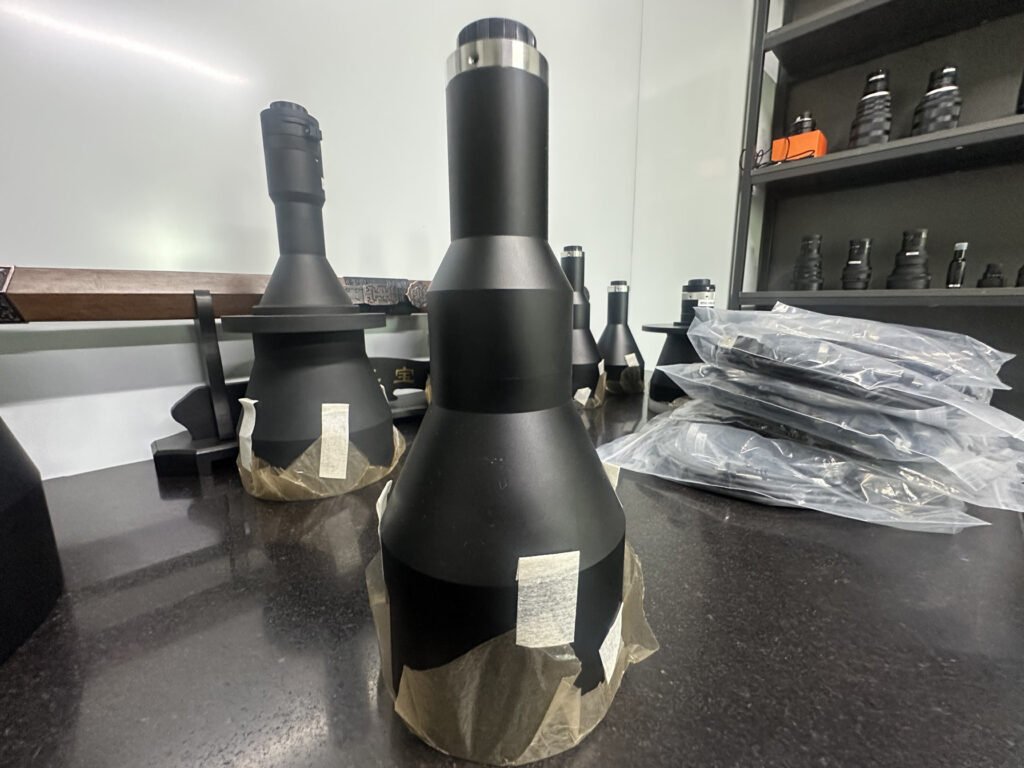
A lens tested on a bench in an air-conditioned room tells you very little about a lens inside an enclosure next to a lamp. The heat that reaches the assembly comes from the camera’s own electronics, from illumination, and from the enclosure’s air, and the components that expand first are the ones closest to those sources. So ask for the drift measurement to be made with the assembly in a representative condition: the same camera body, the same kind of lighting, the same enclosure if it can be arranged, and the same duty cycle. A maker who measures on a bench and reports the result as the design’s behaviour has measured the bench.
Ask for the number and the method, not only the conclusion: how the focus position was measured, at what temperatures, and how long the assembly was held at each one. A drift figure with a method behind it can be compared with your own measurements, which is what makes it useful. Where the maker’s figure and your own observation disagree, the difference is usually the condition rather than the lens, and the two measurement records are what let you find out which.
There are three honest answers to a thermal drift problem, and they differ in cost. The first is a design that is compensated for temperature, where the materials and the spacing are chosen so that the focus position moves very little across the range; ask whether the design has that, and for the measured drift rather than a claim. The second is a lens choice with more depth of focus, so the same drift matters less in the application. The third is acceptance: warm the machine, refocus at working temperature, and treat the refocus as part of the start-up procedure, which is a legitimate answer where the drift is small and the process allows it.
Ask the maker which of the three they are proposing, in writing, and what they will do for the units already in the field. Where the answer is a compensated design, ask for the variant’s part number and for the drift measurement of that variant. Where the answer is refocusing, ask for the warm-up period and the refocus procedure to be written into the product documentation, so the practice is repeatable by every operator rather than invented on the night shift. The custom side of this work, described under custom optics, is where a compensated design is normally quoted, and the question of which family suits a hot enclosure belongs in the selection stage, which the lens selection guide covers.
A focus lock holds a setting; it does not stop materials from expanding. Where the assembly is a small format with a thread and a lock ring, the lock screw clamps the barrel, and if the mark test shows movement, the question is how the lock engages: on the barrel, on a locking ring, or through a thread-locking compound. Each behaves differently as the assembly warms. Ask the maker how the lock on this model engages and what its measured behaviour is over the working temperature range, and ask for the same paint-mark test on the balance of the order.
On the workshop side, three habits reduce the problem while the design question is open. Focus the machine at working temperature rather than cold, since a cold focus is a guarantee of drift. Keep a target on the line and check the focus at the start of every shift, which turns a slow soft image into a scheduled check. And record when the refocus was needed, because the pattern over a month tells you whether the drift is thermal, mechanical, or simply the machine’s environment.
Before the rest of the lenses are shipped, ask for two things on one unit from the new batch: the paint-mark test photographed cold and hot, and the focus position recorded at start-up and at temperature, with the same target and the same camera. A batch that behaves like the first one is a consistency question, and a batch that behaves differently is a specification question. Either way the measurements are comparable because the method is the same, and the record travels with the serial numbers.
Ask for the drift measurement to be repeated if the design, the supplier of a barrel or the coating changes, since a change in any of those can move the drift without changing the drawing. Keep the two measurement sets, cold and hot, in the order folder with the lens serials. Where the balance of the order will be used in the same enclosures, the measurement is what tells you whether to expect the same refocus procedure or a smaller drift. The site’s notes on the M12 family and its focus locking describe the small-format side of this, and the test in this article is the field version of it.
Keep one affected lens in the state that shows the problem and photograph it before anyone adjusts it. Then agree the procedure with the maker: is this unit within the design’s stated drift, and if so the refocus routine applies; if it is outside, the lens is a claim and the replacement should come with the measurement. Where several lenses on the line show the same behaviour, the batch is consistent and the conversation is about the specification rather than about individual units, which is the easier position to argue from.
Where the drift is within the design’s range and the process can absorb a periodic refocus, document it: the warm-up time, the refocus step, the target used, and who signs the check. A documented routine makes the behaviour predictable, and predictability is what a production line needs. What you should not accept is a verbal assurance that the lens is thermally stable while the image on the line says otherwise, because the paint mark and the target are cheaper than the argument.
Send one message to the person who controls the lens production. Name the order and the model. Say the image is sharp cold and soft after a few hours with the lens locked, and state the hold in one sentence: the balance is not shipped until the drift is measured and attributed. Name what you need. First, the paint-mark test on a lens from this lot, photographed cold and at working temperature. Second, the measured focus drift of the design over the working range, with the method and the conditions used. Third, the answer on how the focus lock engages and what a compensated variant would cost. Fourth, the same measurement on one lens from the new batch, with the serial numbers recorded.
A release is your note that the drift has been attributed to a cause, that the next batch is measured the same way, and that the refocus or compensation procedure is written into the product documentation. A datasheet statement about thermal stability, a modeller’s calculation, and a promise to make the lock tighter do not release the hold.
Keep the marked lens, the two photographs and the measurement sheets in the order folder with the serials. Thermal behaviour is the one lens property that a bench measurement can hide and a production line reveals, and the records from this order are what make the next one a planned check rather than a night shift mystery.

LED flicker after a power supply swap is an electrical-to-exposure matching miss. Lock lighting electrical specs to the camera exposure plan before the next...
read more…
A telecentricity bench proof pack is the acceptance file that turns a datasheet telecentric claim into measured magnification-versus-object-distance curves and written reject limits before...
read more…
An illumination pupil pack is the optical data set that tells a lighting designer where the lens aperture stop and entrance pupil sit before...
read more…