LED Flicker After Power Supply Swap: Lighting Specs That Match Camera Exposure
LED flicker after a power supply swap is an electrical-to-exposure matching miss. Lock lighting electrical specs to the camera exposure plan before the next...
read more…
Liquid lens technology on Lensmind’s ZWA series shifts focus in about 20 ms with no moving parts in the fluid path. That number is the reason a 24/7 sorter can change working distance without wearing a voice-coil spring. The cell is electrowetting: voltage changes the curvature of an oil–water interface. Mechanical autofocus still has a place. It is not this place.
Key Takeaways
If your last voice-coil module started hunting after six months on a robot, the failure was mechanical, not “the algorithm.” Read the cell type before you write another AF SKU onto the BOM.

About 20 ms is the first-party focus-shift figure on the ZWA family. It is not a marketing “fast AF” label. Voltage hits the cell; the interface curvature changes; the image plane moves. There is no screw to back-drive, no coil to hold against a spring, no grease to thicken at 5 °C. For a DWS lane that sees a flat envelope then a tall tote, that is one frame-class of wait, not a motor travel.
The Association for Advancing Automation (A3) notes the same industrial case for electrowetting cells in barcode reading: no mechanical moving parts, and a speed mechanical actuators do not match on continuous duty. Lensmind’s number is the ZWA spec — about 20 ms — not a third-party datasheet copied onto the page. If a quote says “liquid AF” without a millisecond figure and a model name, it is not specified.
If the working distance never changes, do not pay for a cell. A locked M12 or FA barrel is simpler and stays put.
Field reality: the 20 ms is the optical step. Your camera’s exposure, trigger jitter, and the time to decide a new voltage still sit on top. Open-loop (a look-up of millimetres to volts) is how you stay near one frame. Closed-loop contrast hunt will eat the advantage. Specify the drive mode in the RFQ, not only the lens.

Electrowetting is a contact-angle change under an electric field. In a liquid lens the useful version is two immiscible fluids — typically a conducting aqueous phase and an insulating oil — sitting on a coated electrode. Apply voltage and the interface bows. That bow is a lens. Reverse the voltage and the power goes the other way, from diverging through flat to converging, without translating glass.
A3’s industrial write-up of electrowetting cells stresses equal-density fluids so orientation does not dump the drop, and cycle life measured in hundreds of millions because nothing slides. That is the physics Lensmind packages into the ZWA barrels. The glass around the cell still has to be a machine-vision objective — image circle, distortion, C-mount or M12, coating. The cell is the focus actuator, not the whole optic.
Z-axis stacking is the second use. Instead of one “best” plane, you step the cell through a few diopters, grab frames, and keep the sharp slice. That is how a liquid cell covers height mix without stopping the line for a mechanical rack. The YT telecentric series uses the same electrowetting idea on a constant-magnification barrel when the gauge also cannot tolerate perspective.
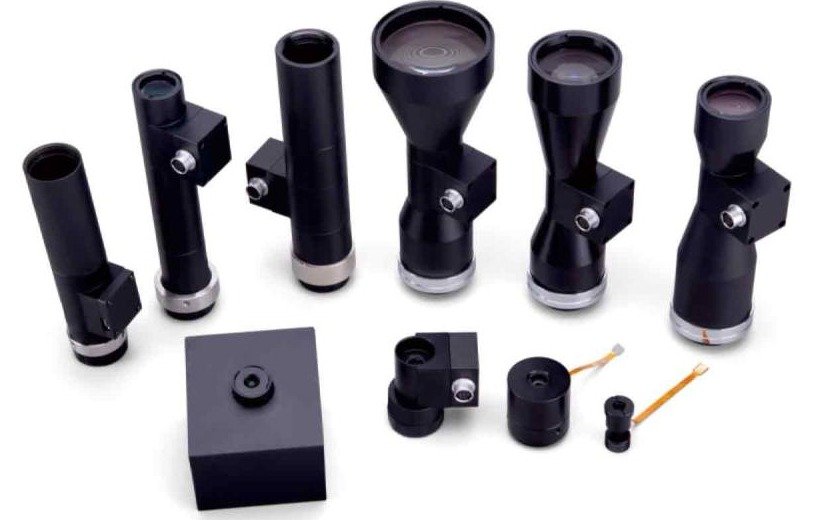
Voice-coil motors were built for phones and cameras that refocus a few times per shot. A machine-vision lane can refocus every part. Springs fatigue. Coils heat. Particles shed into a clean cell. A lead-screw plus motor is worse on cycle time — seconds-class travel over a long range — and backlash shows up as a hysteresis you will chase in software.
| Dimension | Electrowetting (ZWA) | VCM | Motor + screw |
|---|---|---|---|
| Focus step | About 20 ms | Coil travel + settle | Seconds over long range |
| Wear | No moving parts in fluid path | Spring/coil fatigue | Screw backlash, grease |
| Hold power | Capacitive cell | Current against spring | Unpowered hold, slow move |
| Cleanliness | Sealed static cell | Particle risk | Largest envelope |
Pick VCM only if the module is already qualified, the duty is light, and you accept a wear item. Pick a screw when the travel range is huge and cycle time is not the constraint. Pick electrowetting when the line cannot stop and the heights keep changing. That is the field ranking, not a catalog slogan.
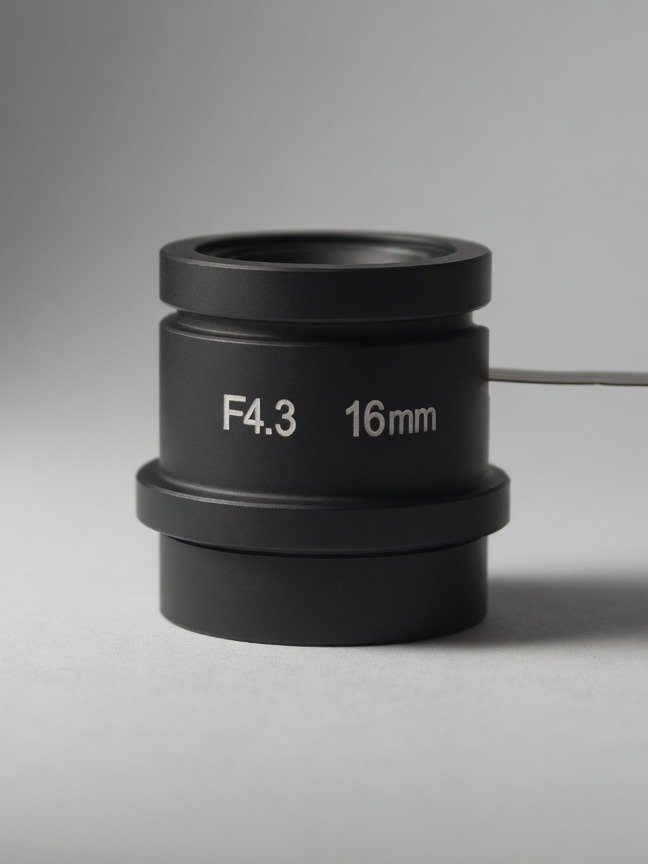
Do not RFQ “a liquid lens.” RFQ a ZWA part number. The five catalog models are on the liquid lenses product family with measured fields, mounts and MAX distortion. Three share a 2/3" Φ14 envelope. Two share a 16 mm F6.4 optic for 1/1.8" and split only on the mount.
| Model | EFL / F# | Sensor / mount | MAX distortion |
|---|---|---|---|
| M0834AFC | 8.1 mm F3.4 | 2/3" · Φ14 | 3.5% MAX |
| M1238AFC | 12 mm F3.8 | 2/3" · Φ14 | 1.0% MAX |
| M1643AFC | 16 mm F4.3 | 2/3" · Φ14 | 0.5% MAX |
| H1670AFC-A | 16 mm F6.4 | 1/1.8" · M12×0.5 | 0.2% MAX |
| H1670AFC-B | 16 mm F6.4 | 1/1.8" · Φ10 | 0.2% MAX |
M0834AFC is the wide one: 69.8° / 56.1° / 47.8° D/H/V on the sheet, 6 MP class, 19.32 mm length. Distortion at 3.5% MAX is a wide-field tax — do not put that SKU on a gauge that needed the FA-line 0.05%. M1643AFC tightens to 0.5% MAX at 16 mm. The H1670 pair is the board-camera version; -A shares the M12 thread family, -B is Φ10 when the holder is not an S-mount. All five are 6 MP class on the catalog table.

A liquid cell is a moving specification. If every part sits on the same nest at the same height, a fixed FA C-mount or an M12 with FT lock is the cheaper, quieter station. Distortion on the FA line is held below 0.05% with 10K+ batch consistency — a gauging number the wide ZWA SKUs do not try to beat. For embedded cameras that rattle, M12 S-mount lenses with FT/HT focus lock keep the thread from walking; they do not need a driver board.
| Best for | Not ideal for |
|---|---|
| DWS, mixed parcel height, robot pick with changing WD | A single-height nest that never moves |
| 24/7 refocus where VCM wear is already a ticket | Sub-0.05% gauging that belongs on FA or telecentric glass |
| Z-stacking without a mechanical stage | Sites that cannot support a lens driver |
Use the machine vision lens selection guide for the five inputs (sensor, WD, FOV, resolution, environment) before you add autofocus as a sixth. Autofocus does not fix a wrong focal length. It only walks the focus plane after the field is already wrong.
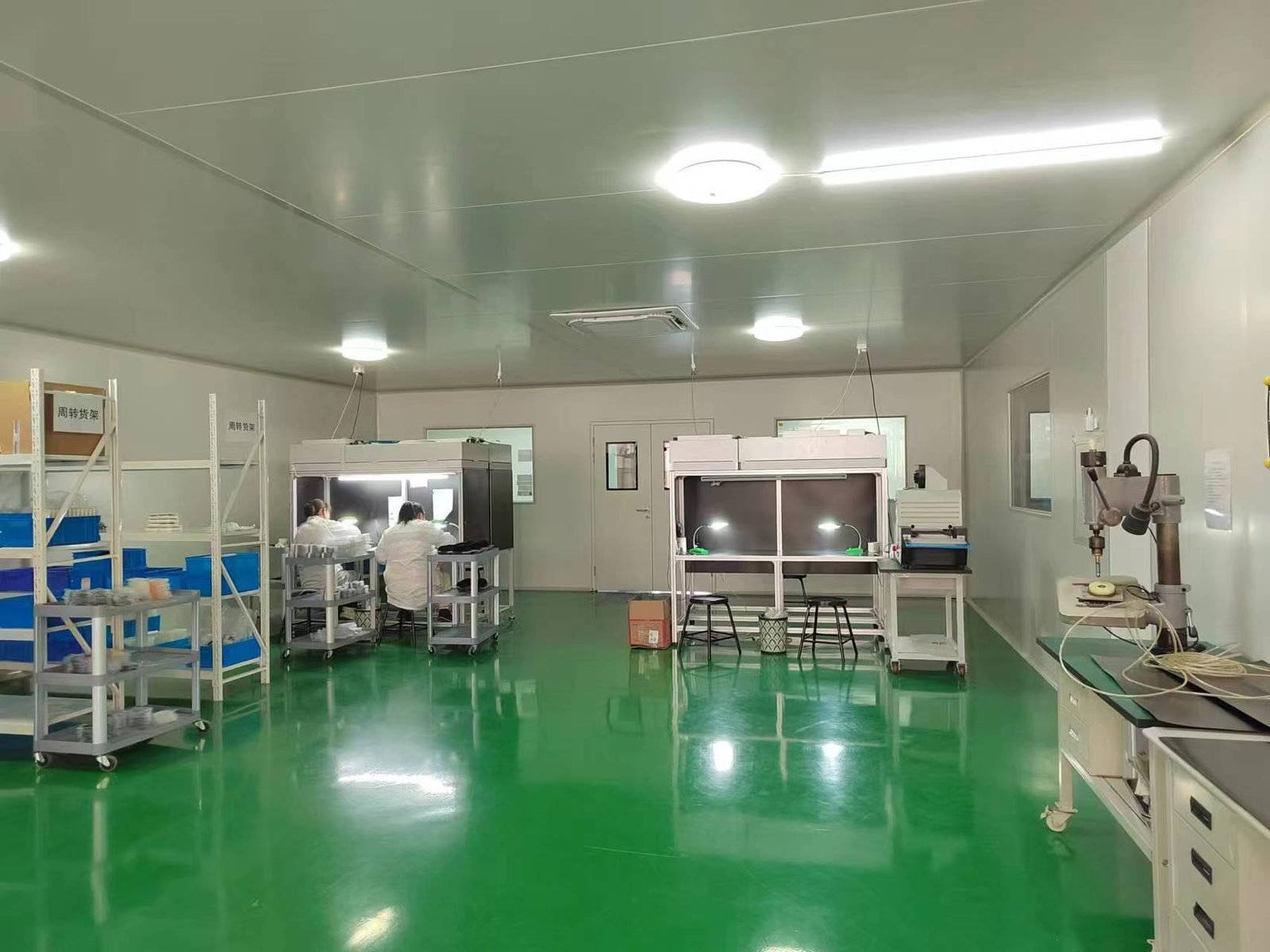
Hangzhou still machines, coats, cements, assembles in Class 10,000 cells, and aligns at 1 μm class when the stack needs it. A liquid cell does not exempt the barrel from metrology. Batch documents cover the agreed family parameters — typically MTF, distortion, BFL, DOF — with conditions and a pass/fail line. ISO 9001 (2024) is the system. No ISO 13485 or IATF badge is claimed.
Custom cells or a telecentric-plus-liquid YT build run the 60-working-day prototype-to-mass path. Repeats 30 days. First-pass feasibility 48 hours. NDA before drawings. If you need the gauge to stay telecentric while you Z-stack, that is a YT conversation, not a ZWA drop-in.

Illustrative, not a named shipper. A dimensioning lane sees envelopes at 80 mm height and totes at 280 mm. A fixed 12 mm FA lens focused on the envelope plane turns the tote into a blur and a no-read. A VCM module that hunts every tote will make the 20 ms cell look expensive until the coil fails on night shift.
The field fix is a ZWA 12 mm or 16 mm on 2/3" (M1238AFC or M1643AFC) with an open-loop millimetre-to-volt table from a height sensor. The cell steps in about 20 ms; the camera grabs; the lane does not stop. If the camera is 1/1.8" board-level, H1670AFC-A on M12×0.5 is the matching optic — same 16 mm F6.4 as the Φ10 -B. Distortion at 0.5% or 0.2% MAX is acceptable for barcode and cubing. It is not a shaft-diameter gauge.
If every carton is the same height, skip the cell. Lock an FT M12 or a C-mount FA, ship the batch MTF report, and spend the driver budget on lighting. The 20 ms figure only pays when height mix is real.
Electrowetting is how you refocus a machine-vision station without a wear item in the optical path. Lensmind’s ZWA number is about 20 ms on five named models. The cell does not replace a correct focal length, and it does not turn a 3.5% MAX wide optic into a 0.05% gauge.
Key takeaways
If the lane already mixes heights or a VCM is a recurring ticket, send sensor format, WD min/max and the trigger you can actually wire. Hangzhou will match a ZWA SKU or say the job is a YT telecentric-plus-liquid or a 60-working-day custom. If the nest is a single plane, you will be told to stay fixed-focus.
Written by Baker Zhao, Founder at Lensmind Optics
Hangzhou factory and Zhongshan office. Company registered 2019. ISO 9001 certified 2024. Founding-team optics practice is 26 years — not the company age.
The ZWA series specifies electrowetting focus in about 20 ms, with no moving parts in the fluid path. Camera exposure and your voltage decision still add to cycle time.
Voltage changes the contact angle of two immiscible fluids so the interface curvature — and therefore optical power — changes without translating glass.
H1670AFC-A is 16 mm F6.4 on M12×0.5 for 1/1.8" sensors. H1670AFC-B is the same optic on a Φ10 mount.
No. Liquid focus walks the plane; it does not freeze magnification versus depth. Use YT telecentric-plus-liquid or a fixed telecentric when the number must not change with height.
Yes. Agreed parameters — typically MTF, distortion, BFL and DOF — ship with the batch. Reports are default, not a paid extra.

LED flicker after a power supply swap is an electrical-to-exposure matching miss. Lock lighting electrical specs to the camera exposure plan before the next...
read more…
A telecentricity bench proof pack is the acceptance file that turns a datasheet telecentric claim into measured magnification-versus-object-distance curves and written reject limits before...
read more…
An illumination pupil pack is the optical data set that tells a lighting designer where the lens aperture stop and entrance pupil sit before...
read more…