LED Flicker After Power Supply Swap: Lighting Specs That Match Camera Exposure
LED flicker after a power supply swap is an electrical-to-exposure matching miss. Lock lighting electrical specs to the camera exposure plan before the next...
read more…
Optical distortion on Lensmind’s FA line is held below 0.05% with 10K+ batch consistency. That is not a rounded marketing “low distortion” badge. On a 10 mm object width, 0.05% is 5 μm of magnification error at the field point where the number is specified — small enough that many 2D gauges can live without a telecentric barrel, and large enough that you still have to know whether the datasheet meant geometric distortion or TV distortion.
Key Takeaways
If the last rejected lot was blamed on “the camera,” read the distortion definition the supplier used. A lot of those arguments are unit mismatches, not bad CCDs.

Distortion is a monochromatic aberration: magnification that changes across the field at a fixed working distance. Edmund Optics specifies it as a percentage of field height. Geometric (optical) distortion is the radial miss between where a point lands and where an ideal mapping would put it. On a 10 mm half-field, 0.05% is 5 μm at that field point. On a 50 mm object, it is 25 μm if you naively scale a corner percentage — and you should not scale it linearly, because the curve is not a straight line.
The FA-line figure is first-party: distortion held below 0.05% with 10K+ batch consistency on the C-mount factory-automation family (2/3" to 1.1" formats, plus the macro cards). It is a process claim, not a promise that every wide SKU on a datasheet is 0.05% at every field point. LMJJ-FA2505A’s product card, for example, lists distortion <0.12% for that 25 mm F1.6 2/3" unit. Read the SKU. Then read the batch report that ships with the order.
0.05% is a line discipline. The card in your cart is still allowed to state its own MAX.
Edmund’s rule of thumb — ±2 to 3% unnoticed when you are not measuring — explains why a 4 mm wide-angle can look “fine” on a monitor and still wreck a calliper tool. Presence detection can live at 2%. A printed millimetre cannot.

Datasheets mix two percentages. Geometric / optical / radial distortion is the point-by-point field-height error. TV distortion (RIAA) looks at a square that fills the vertical field and reports how much the top edge bows: ΔH/H × 100%. Edmund warns that TV values will almost always look lower, and that specifying one field point can make a non-zero lens read as 0% at that point while the rest of the field is not.
SMIA TV distortion, used in some mobile and module reports, is defined differently again (and Imatest notes it can be twice traditional TV). If a vendor quotes “0.1% distortion” with no method, you cannot audit it against 0.05% geometric. Write the method on the RFQ: geometric (optical) distortion at maximum field of the sensor you will mount, plus the plot.
| Method | What it reports | Trap |
|---|---|---|
| Geometric / optical | Radial miss / field height | Need the curve, not one point |
| TV (RIAA) | Edge bow of a square | Looks smaller than geometric |
| SMIA TV | Mobile-module variant | Not interchangeable with RIAA TV |
Edmund’s telecentricity-and-distortion note adds the metrology sting: telecentric lenses can show mustache at very low magnitude. A 0.00% callout at one height is not a flat curve. Ask for the plot on FA C-mount machine vision lenses and on telecentric SKUs alike.

Barrel (negative, in the sign convention Edmund uses for points sitting too close to centre) makes a grid bulge. Pincushion (positive) pinches it. Mustache / wave changes sign across the field: mid-field one way, corner the other. Software that applies a single k1 barrel term will make the mid-field worse while it “fixes” the corner. That is why a plot beats a percentage.
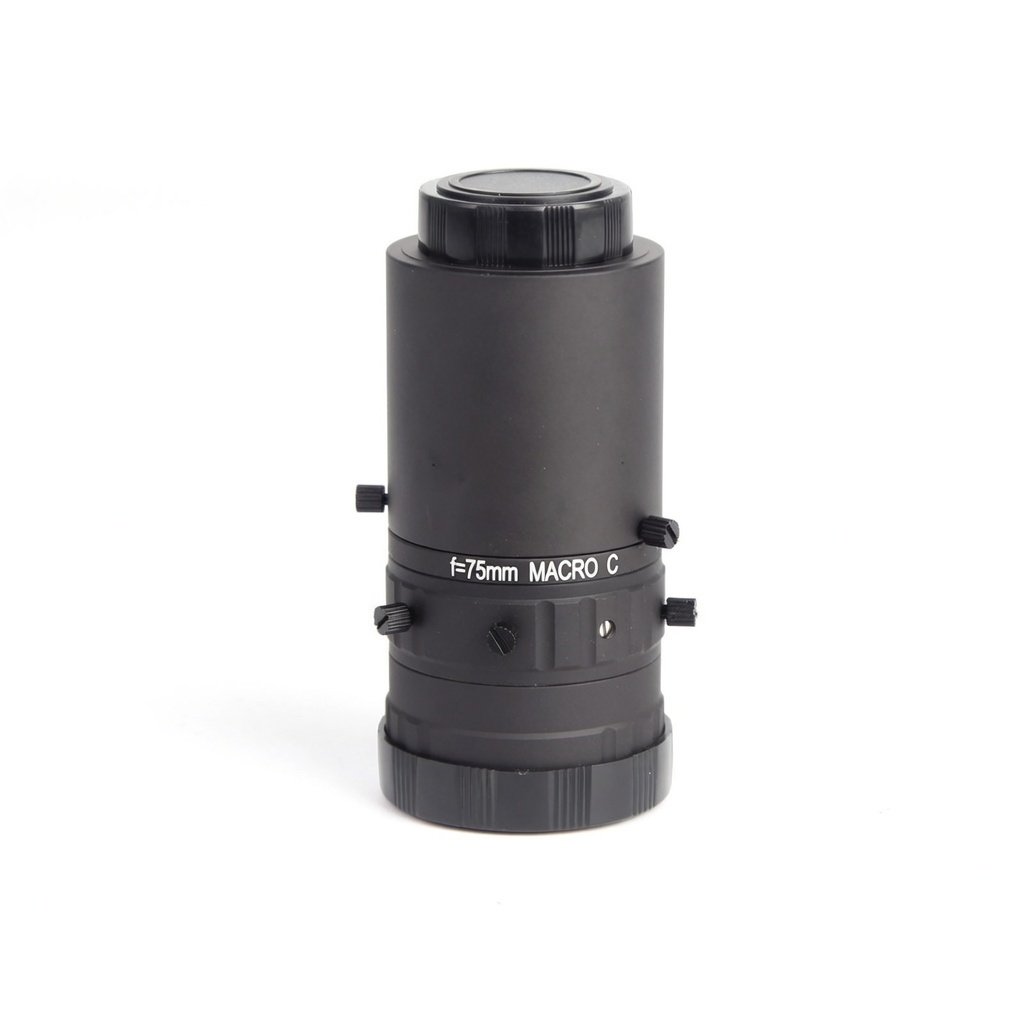
Wide FA glass and fisheye families carry more barrel; macros and longer FA focal lengths are usually calmer. The FA3505W / FA2520W / FA7520W macro cards exist because close-distance gauging needs the distortion budget at finite conjugates, not at infinity. Distortion is conjugate-dependent. A curve at 350 mm WD is not the curve at 80 mm.
Sign conventions flip between vendors. Never subtract 0.05% from 0.12% across two brands without reading the method paragraph. Inside one factory, use one method and keep it on the report.

Parallax is magnification changing with working distance. Distortion is magnification changing with field position at one WD. An FA lens can be below 0.05% distortion and still grow a part that sits 8 mm closer to the camera. That growth is entocentric perspective, not a failed distortion spec. Object-space telecentricity is the optical answer to parallax. Do not buy a tighter distortion SKU to fix a height-mix problem.
The reverse error is also common: a telecentric barrel with excellent constant mag and a mustache plot someone ignored because “telecentric means zero distortion.” It does not. Telecentricity is the pupil. Distortion is still a percentage you measure on a grid.
| Best for FA (<0.05% line) | Step up to telecentric |
|---|---|
| 2D gauging at one tightly nested height | Height mix or thick parts (parallax) |
| AOI, robot guidance, print inspection | Side-wall widths that must not show perspective |
| Macros (FA2520W–FA7520W class) at close WD | When mag must not change with Z |
The practitioner rule: if the nest holds Z, FA glass at the line’s 0.05% discipline is the honest buy. If Z walks, no distortion percentage saves you. Use the machine vision lens selection guide to lock focal length first, then spend the distortion budget on the family that matches the error you actually have.
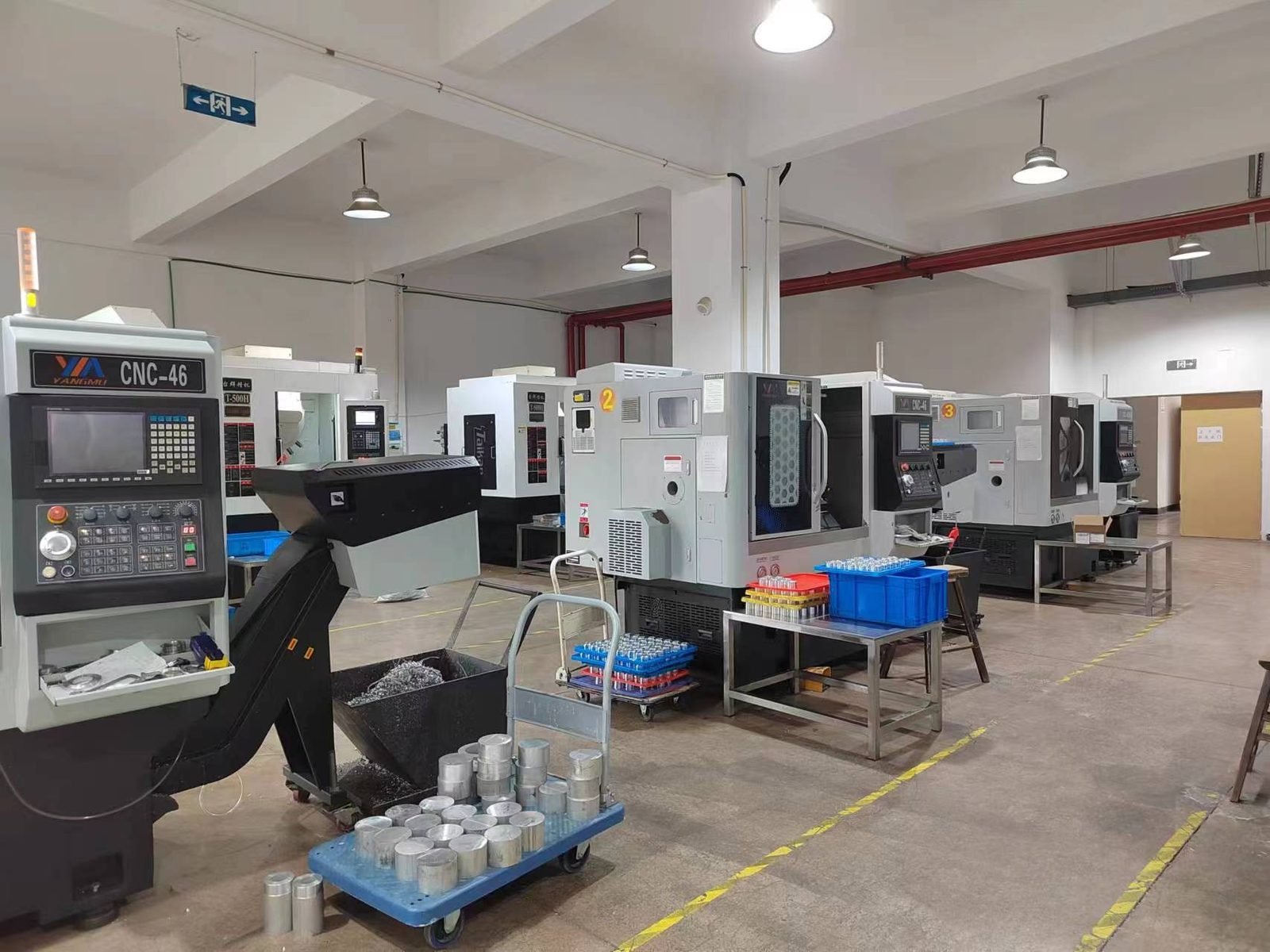
Distortion in Hangzhou is grid deviation on a calibration target, written into the batch report with MTF, BFL and DOF. It is not a design-stage leftover. 1 μm-class active alignment, Class 10,000 cells, Trioptics centration, collimation-referenced benches. ISO 9001 (2024). Reports default. 10K+ batch consistency is why the 0.05% line is worth putting in an RFQ — a prototype that hits 0.03% once is not a process.
Custom optics that need a different envelope still run 60 working days prototype to mass, 30 days repeat, 48-hour first-pass RFQ. NDA before drawings. Do not invent CE/FDA/IATF on the PO — they are not claimed here.

Illustrative. A stamped tab is 10.000 mm wide at the nest. Geometric distortion of 0.05% at that field height is 5 μm. Geometric 1% is 100 μm — a tenth of a millimetre, enough to fail a press-fit spec. TV distortion of “0.3%” on a competitor sheet may still be a larger geometric error; you cannot convert it in your head. Put both parts on a grid, or refuse the unit mismatch.
If the tab also sits 2 mm higher on some pallets, the FA lens adds parallax on top of the 5 μm. That second error is why the telecentric catalog exists. If the pallet is stiff, stay on FA, demand the 0.05% line plus the SKU MAX, and keep the batch plot. That is the practitioner close.
Distortion is a field-height percentage at one working distance. 0.05% on the FA line is a process number with 10K+ batch consistency, not a license to ignore TV-versus-geometric unit tricks or a mustache plot. Parallax is a different physics and needs a different family.
Key takeaways
Send sensor format, WD, object size and whether Z is locked. You will get an FA shortlist with the report format, or a telecentric recommendation when magnification must not walk. If you only write “low distortion,” you will get a TV percentage that cannot be compared to 0.05%.
Written by Baker Zhao, Founder at Lensmind Optics
Hangzhou FA line, ISO 9001 (2024). Company registered 2019.
Geometric distortion of 0.05% is 0.0005 times the field height at the specified field point — 5 μm on a 10 mm height — at one working distance.
No. TV distortion uses an edge-bow formula and usually looks smaller. Compare only like methods.
Only if working distance is locked. Distortion is at one WD. Height mix is parallax and needs object-space telecentricity.
The FA line is held below 0.05% with 10K+ batch consistency. Individual cards may list a different MAX — read the SKU and the batch plot.
Yes, with the agreed family parameters — typically MTF, distortion, BFL and DOF — plus batch number and pass/fail.

LED flicker after a power supply swap is an electrical-to-exposure matching miss. Lock lighting electrical specs to the camera exposure plan before the next...
read more…
A telecentricity bench proof pack is the acceptance file that turns a datasheet telecentric claim into measured magnification-versus-object-distance curves and written reject limits before...
read more…
An illumination pupil pack is the optical data set that tells a lighting designer where the lens aperture stop and entrance pupil sit before...
read more…