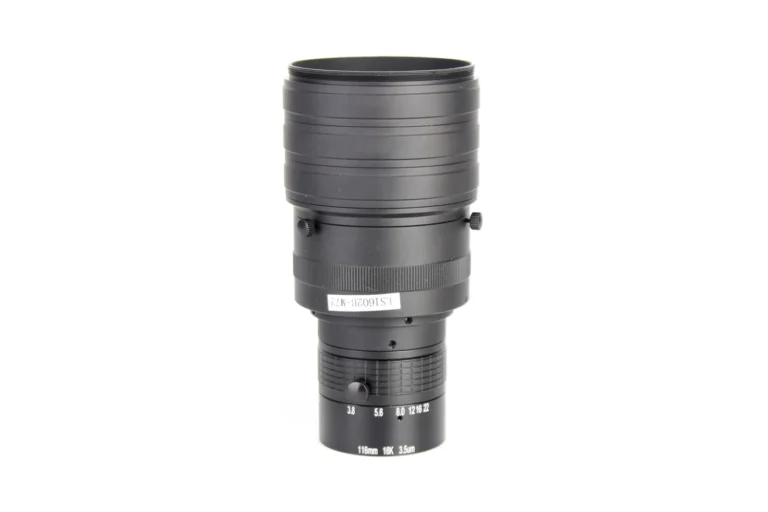
When a purchased lens becomes a part record in your PLM, the maker can reasonably supply four things per part number without a fight: a controlled datasheet, a dimensioned outline drawing tied to a revision, the coating designation, and batch test documentation that carries conditions and a pass or fail judgment. Certificates of conformity, material information and measured coating curves belong in the order as named line items, because most makers supply them when asked and skip them when not. What no maker will hand over is another customer’s paperwork, and some will guard the native optical design while offering an equivalent model instead. Write all of this into the order with four moves: name the documents per part number, bind each document to a revision, state when each one must arrive, and say what happens when it does not.
If you are comparing suppliers for this kind of optic, the Lensmind machine vision lens catalog is the hub for our standard models and custom options.
Three file sets and the part each one fits
Buyers overshoot by demanding everything for every part, then undershoot when the volume gets real. It cleans up fast once you sort purchased lenses into three tiers and attach a file set to each.
| Tier |
Documents the maker supplies |
Fits |
| Catalog part |
Published datasheet, outline drawing with revision letter, coating designation; conformity certificate per shipment on request |
Stock lenses doing non-critical jobs |
| Qualified production part |
Everything above plus batch test documentation per lot: measured parameters, conditions, coverage and judgment |
Lenses feeding a running line, where drift costs money |
| Custom or critical part |
Everything above, all bound to a drawing revision, plus agreed acceptance criteria and change notification duties |
Custom optics, medical and harsh-environment builds |
Catalog tier: datasheet plus outline drawing
A catalog lens needs the vendor’s controlled datasheet and the outline drawing your mechanical team fits around, each carrying its revision. That pair, plus a lot code on the box, covers the part record. Demanding per-lot optical test data for a stock lens is usually wasted money, and plenty of makers will either decline or charge for it.
Qualified tier: batch documentation becomes the spine
Once a lens feeds a production line, the batch report matters more than the brochure. Ask what the maker ships by default: the practice on this site is that every production batch leaves with test documentation covering the agreed family parameters, typically MTF, distortion, back focal length and depth of field, plus batch number, test conditions, inspection coverage and an explicit pass or fail judgment. Reports as a default, not a special request, is the sentence to listen for when you qualify any supplier.
Custom tier: everything hangs on a drawing revision
Custom parts change the question from “what does the maker supply” to “what does this revision commit to”. The datasheet, the drawing, the acceptance criteria and the batch reports all reference one revision letter, and the NDA usually comes first because drawings move before anything else. If you are still shaping that request, the OEM buyer’s guide to sourcing custom optics walks the upstream steps.
What a maker supplies by default, by negotiation, and not at all
Knowing the boundaries saves weeks of email. By default, a serious production shop ships batch documentation with the parameters you agreed, and treats the report as part of the product. By negotiation sit the items that cost the maker real effort or expose their supply chain: melt and material certificates for the glass, transmission curves measured at your named band and incidence angle, per-unit serial records with a marking scheme that survives your cleaning chemicals, and native CAD for the barrel. None are exotic; all deserve a line in the order so they do not become favors.
Inside the factory, that documentation habit looks unremarkable: measured parts, labeled racks, test benches at each station. The paper trail exists because the physical trail does:

Not at all means what it says. You will not receive another customer’s designs or test data, and you should be suspicious of any house that offers. You will not receive certificates a maker cannot honestly hold: a shop whose system is certified to ISO 9001, as this one is, says exactly that and no more, and a buyer who demands more badges than exist is shopping for fiction. And the native optical prescription may stay home; many builders treat the prescription as crown jewels and offer a black-box model that behaves identically at your interface. Decide in advance whether your PLM truly needs the prescription or just the interface data, because the answer changes the negotiation.
Order language that makes documents arrive
The gap between “we always send those” and the documents sitting in your PLM is usually one paragraph of purchase order text. Six clauses carry the weight:
- Name the documents per part number. List them: datasheet, outline drawing, coating designation, conformity certificate, batch test report. “All relevant documentation” procures a brochure.
- Bind each document to a revision. Every file carries the part number, the document type and the revision it certifies, in the file name as well as inside the file.
- State the timing. Controlled documents before or with the first shipment; conformity certificate with every shipment; batch report with every lot; refreshed documents on every revision.
- Describe the batch report’s minimum content. Measured values at agreed conditions, coverage statement, batch number and an explicit judgment, so a report that only says “pass” without data does not qualify.
- Set the delivery channel. Searchable PDF to a named intake address or portal, referenced to the purchase order line, so intake is not archaeology.
- State the consequence. A shipment missing its documents is incomplete and can be held at receiving. A clause nobody enforces is a clause nobody reads.
Add one ask at quotation time: request blank samples of the datasheet and the batch report before you award. The sample shows you exactly what “documentation” means inside that factory, and the difference between makers is larger than buyers expect.
Binding document revisions to the part record
PLM hygiene for purchased optics comes down to where files live. Approved masters, the datasheet and drawing you formally accepted, attach to the part revision. Shipment evidence, conformity certificates and batch reports, attach to the lot or receipt record, linked to the part number but never overwritten by the next delivery. File naming that starts with the part number and ends with the revision keeps searches short and mislabels rare. The discipline of keeping product data linked to the part across its life has a name in manufacturing research, and the NIST program on the digital thread for manufacturing describes the same pattern at larger scale: data that travels with the part instead of sitting in inboxes.
Revisions are where records rot. When the maker bumps the drawing, refresh the masters, note what changed, and decide whether incoming parts need requalification before the old stock and new stock share a line. The same instinct protects you at end of life: the continuity file you build before any discontinuation notice is mostly these same documents, already organized. And when the next audit asks why a label faded into mystery, the barrel marking specification you hold is what ties a physical lens to its record at all.
When the file set shows up incomplete
Even good suppliers ship paperwork late. Climb the ladder in order and write each step down:
- Hold at receiving. Log the gap as a receiving note referencing the purchase order clause, not as an email favor.
- Written recovery request. One message naming the missing documents, the revision expected, and a date. Vague chasing produces vague results.
- Interim verification. While you wait, run your own incoming checks and mark the lot as conditionally accepted, so a later dispute has a clean story.
- Corrective action, not just delivery. A repeated gap is a process failure at the maker; ask what changed in their document control, the same way you would for a dimensional escape.
- Requalification on your terms. If documents cannot be produced for goods already on your line, treat their consistency claims as unproven and requalify before the next build.
Pattern matters more than any single miss. One late report is logistics; a maker who cannot produce batch evidence for shipped lots is telling you their process records cannot support the claim file you would need in a dispute, and the document package that lets a second source quote will fail for the same reason. Paper is not clerical work. It is the memory of the part.
The habit that keeps the record honest
Tiers tell you what to ask for. Order language makes it arrive. Revision binding keeps the record true as parts evolve, and the recovery ladder keeps a late Tuesday from becoming a missing quarter of traceability. Buyers who inherit clean lens records almost always inherited a maker whose reports ship by default; if you are choosing one, ask to see a redacted batch report during qualification and judge the habit before the first purchase order. The file set you hold at the end is simply the design review and the production promise, filed where the next engineer can find them.
Written by Baker Zhao, Founder at Lensmind Optics