A Spot Inside a Returned Lens: Make the Disposition a Document
Home - Application Notes - A Spot Inside a Returned Lens: Make the Disposition a Document
Reading Time: 7 min ( Word Count: 1,653 )
A spot inside a returned lens needs a disposition with a stated cause, not a verdict, and the difference between the two is a document. Ask the maker for a return package: the unit identified by its serial, the as-shipped record for that unit, an incoming inspection report with photographs taken through the optics, a root cause with the evidence behind it, and the disposition options with what each implies for the station. Then the decision is a page both sides have signed rather than a conversation about whose fault it is. This is the discipline of corrective and preventive action applied to a single part.
Read the location before the story
The position of the spot carries most of the diagnosis, and it can be read from an image plus a look through the optics. A spot on an outer surface is usually something that arrived after assembly: dust from a cell, a fibre from a wipe, a fingerprint from handling. A spot inside the front group is either contamination from the assembly process or debris that migrated through a gap, and the two are distinguishable by what the particles are, which is why the inspection report should say what was seen under magnification rather than only that something was seen.
Three details sharpen it further. Whether the spot sits on a coated surface or in the cement between elements, because cement bubbles and coating defects are manufacturing artefacts while loose particles are not. Whether it moves when the lens is tilted, which separates a loose particle inside a cavity from one that is bonded or embedded. And whether it appears as a dark shadow or a bright scatter in the image, which tells you whether it blocks light or reflects it, and therefore roughly where in the stack it sits.
Why the serial number decides the conversation
Without a serial number and a record, three questions cannot be answered: whether the unit is the one that was supplied, what it was built with, and whether it is inside whatever warranty applies. That is not a bureaucratic point, it is the reason a serialised unit with batch documentation gets a fast answer and an unmarked unit gets a slow one. Ask for the unit identification in the order, agree the format, and keep your own setup sheet with the same number so the two records can be put side by side.
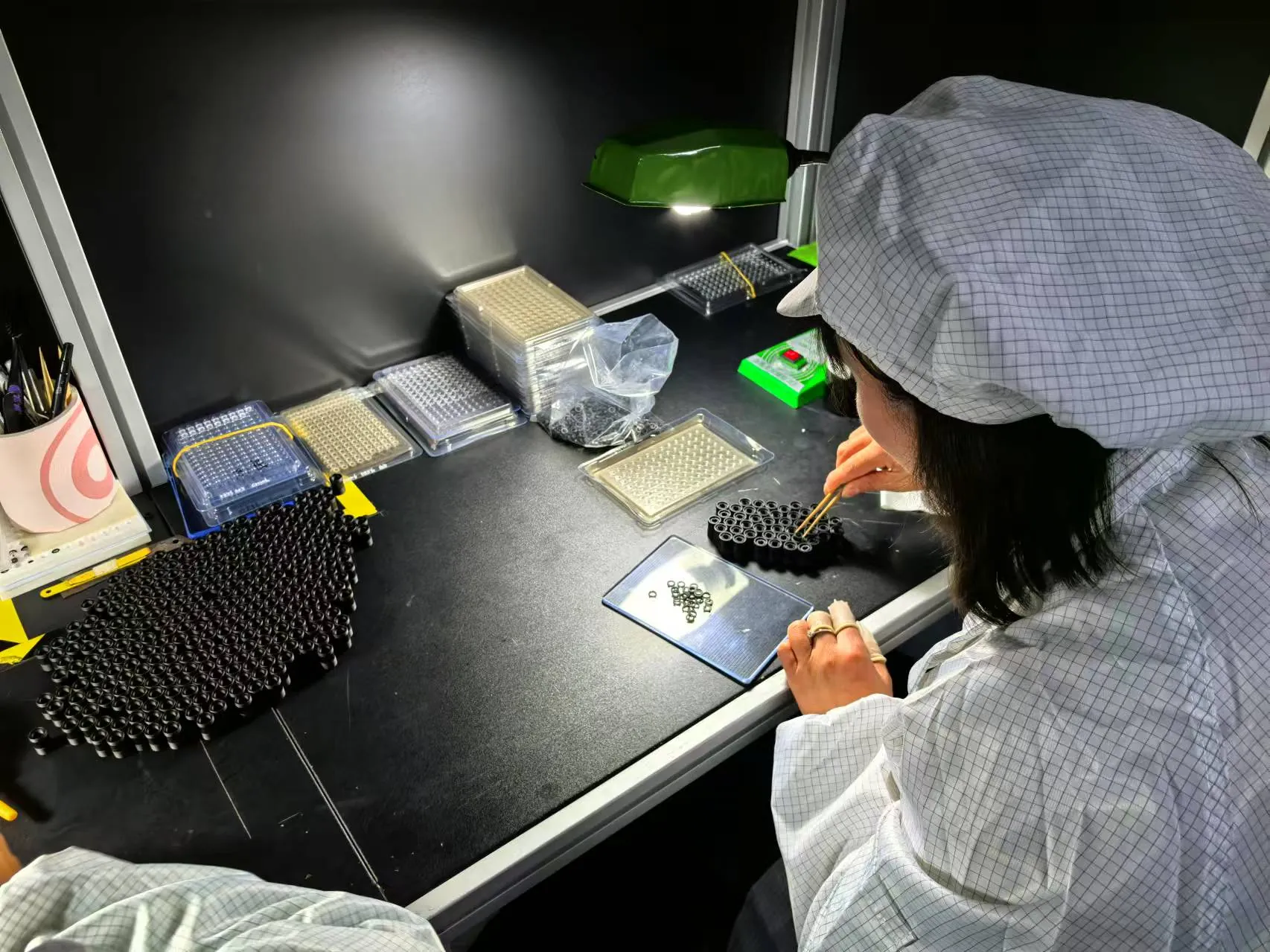
The maker’s side of that record is the batch documentation that ships with each order, covering the agreed parameters with test conditions and a pass or fail judgment, plus per serial metrology where the application justifies it. For a unit that is part of a medical or harsh environment build, the same identification travels with the assembly record from a cleanroom zoned for that work, which is the part of traceability that matters when the unit has to be opened.
What the return package should contain
Seven items, and asking for all of them at the first return prevents the argument later. The unit identified by serial. The maker’s as-shipped record for that serial. A description of the failure as it appeared on the line, including the image and the station settings, supplied by you. The handling and environment history for the unit: how it was cleaned, whether it is a sealed variant or an open one, and what it was exposed to. The maker’s incoming inspection report, with photographs and, where relevant, the magnification used. The root cause, stated with its evidence, or an honest statement that the cause cannot be determined from what was received. And the disposition options with their implications.
The last item is the one that most often goes missing. Cleaning, replacing a group and replacing the unit are three different commercial answers, and the buyer should be able to see all three before committing. An honest package will also say when cleaning is not appropriate, which is the case for anything bonded, for anything inside a cemented interface, and for a coated surface that has been damaged.
Repair or replace, and when the answer is neither
The decision is a comparison between downtime and cost. A documented repair that restores the unit and keeps its identification is usually the cheapest route where the part is serviceable and the station is not critical. A replacement is the simpler route where the unit is not serviceable, where the failure mode is not fully understood, or where a spare on the shelf removes the downtime entirely. What should not happen is a repair that leaves the unit without a record, because the next failure then starts from zero again.
There is also the case where neither is right: the spot was introduced by the buyer’s cleaning routine or by debris in the cell, and replacing the lens will produce the same failure in a few months. That is why the cause matters more than the disposition. A fibre from the wipe, a particle from an open cell and a solvent residue tell three different stories about what to change, and only one of them is the maker’s to fix.
Read the inspection report properly
An inspection report is only useful if it separates observation from conclusion. The observation is what was seen, where, and under what magnification: a particle on the second surface of the front group, a bubble in the cement between two elements, a coating defect on an outer surface, a smudge at the edge of the field. The conclusion is the cause and the disposition. A report that jumps to the second without the first cannot be checked, and a report that lists the first without a conclusion leaves the buyer where they started.
Two photographs make the difference. One through the optics showing the defect as it appears in the image, and one of the opened assembly, where the unit is serviceable, showing the location. Where the unit is a sealed build or a medical module, the opened photograph may not be possible, and the report should say so and describe the finding in words plus magnification instead. That honesty is more useful than a picture of the outside of a barrel.
Spares, and what to hold for the next one
The decision on a returned unit is easier when the station has a spare on the shelf, and the spare list is a design decision rather than a purchasing one. For a critical station, one spare of the same model and the same mount turns a failure into an hour of work; for a station with several identical units, one spare covers the group. Where the model has serviceable parts, the same reasoning applies at the next level down: a front window, a group or a seal kit held locally removes the same downtime that a whole spare removes, at a fraction of the cost.
The spares decision also has a technical side. A spare unit that is not serialised, or whose record was not kept, will start the next investigation from zero, so the spare belongs in the same filing system as the units in service, with its identification and its as-shipped data. Assemblies that were built to a drawing rather than chosen from a catalogue, such as a custom objective or a prism assembly, need the same treatment, which is why custom optics programmes usually keep the drawing, the tooling and the first article together.
Feed the finding back into the process
On the maker’s side the traceability exists for exactly this purpose: in-house machining, coating, cementing, cleanroom assembly and final metrology mean the assembly conditions, the coating run and the batch can be looked up rather than guessed, and a particle found inside a sealed unit points at a specific station rather than at the product in general. Where a unit is built for a wet or medical environment, the cleanroom class and the handling rules are part of that chain, and a repeated finding in the same position across several units is a process signal rather than a product complaint.
On the buyer’s side the same discipline applies to the cell. If two lenses from different batches fail with the same particle in the same place, the common factor is probably the station: the light that bakes dust onto a surface, the extraction that pulls swarf past the front element, or the cleaning routine. Correcting the cause rather than the part is the difference between a rework and a fix.
What to write into the order
Six lines. Unique identification for each unit, in a format both sides use. The as-shipped record per unit, with the parameters, conditions and the pass or fail judgment. A stated return path, with the documents that will come back with the unit and the party responsible for producing each one. The response expectation, agreed in advance rather than assumed, so that a failure does not stall while everyone waits for the other side. The availability of serviceable parts, whether that is a front window, a group or a seal kit, because a spare on the shelf is what turns a failure into an hour. And the acceptance criterion for the returned unit, meaning the measurement that decides whether the repair is acceptable.
Where the unit is part of a metrology or measurement application, the acceptance criterion deserves to be written carefully, because the requirement is different from an inspection station: a telecentric lens used for gauging has to be returned to its stated magnification behaviour, not merely to a clean image, and the report should carry the measurement that proves it. On assemblies built to a drawing, whether that is a custom objective or a prism module, the same logic follows the custom optics programme rather than a catalogue page. Written that way, a spot inside a lens stops being a dispute about responsibility and becomes a decision with a date on it.
Baker Zhao
Founder, Lensmind Optics
Baker Zhao is the founder of Lensmind Optics, with 26 years of experience in the optical industry — including Vice President of Sales at Sunny Optical (Zhongshan) and earlier roles at Foxconn, LG and Sintai Optical. He leads Lensmind with a mission to help customers find reliable, application-specific optical solutions from development to volume production.
“Low distortion” without a distortion map is a claim without evidence. Require maps, measurement conditions, and accept limits on the PO before buy-off. Generic...
A conveyor redesign that changes working distance is a lens re-check trigger, not a same-lens assumption. Recalculate magnification, DOF, and resolution before the next...
An orderable-subcomponent pack is the maker-backed boundary list that states which caps, clamps, front windows, and similar parts can be purchased alone, which fields...