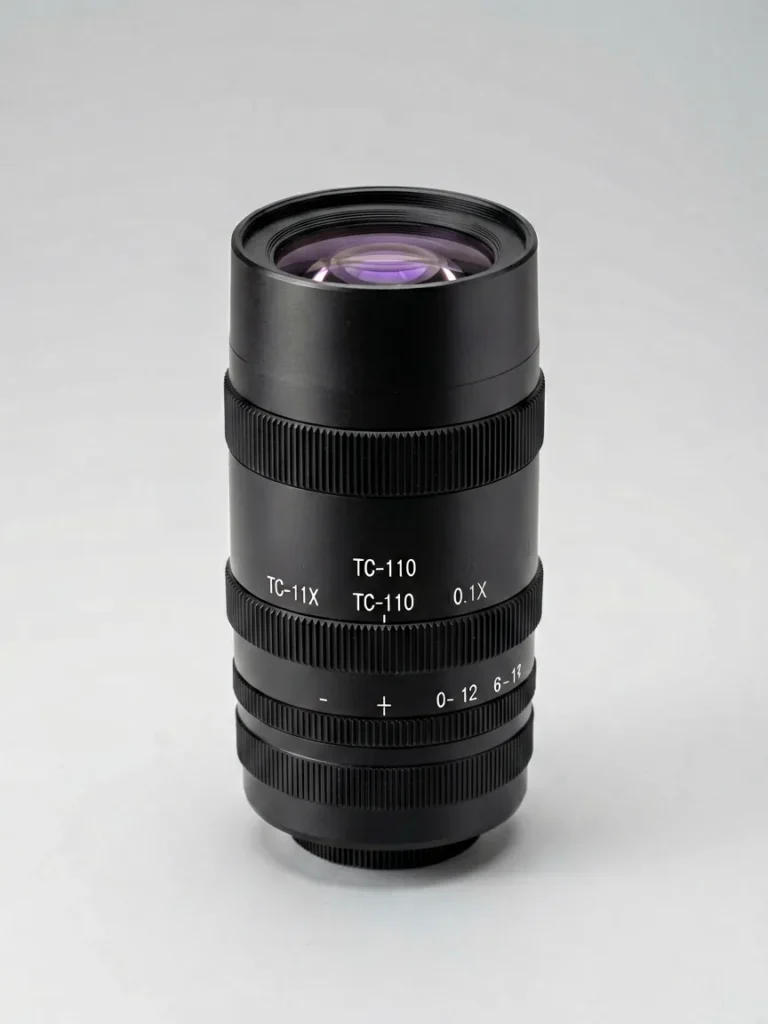
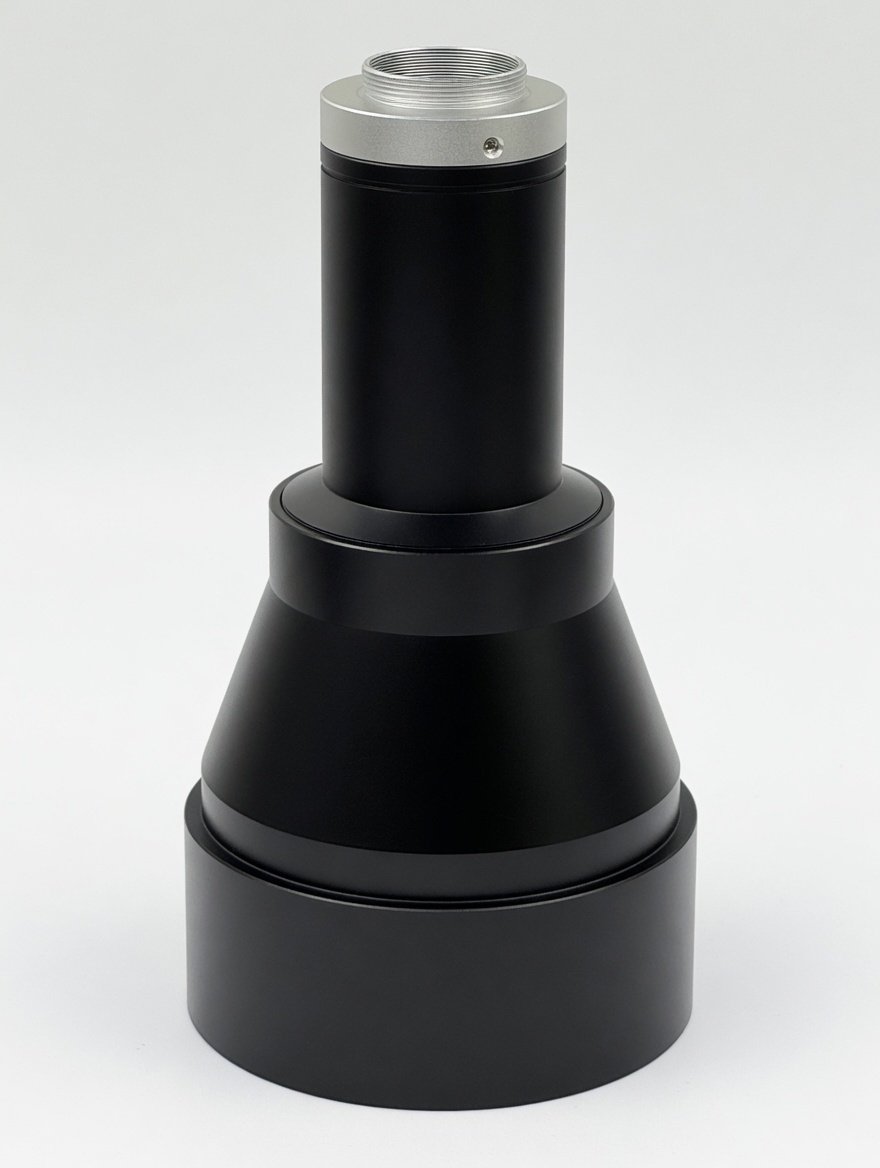
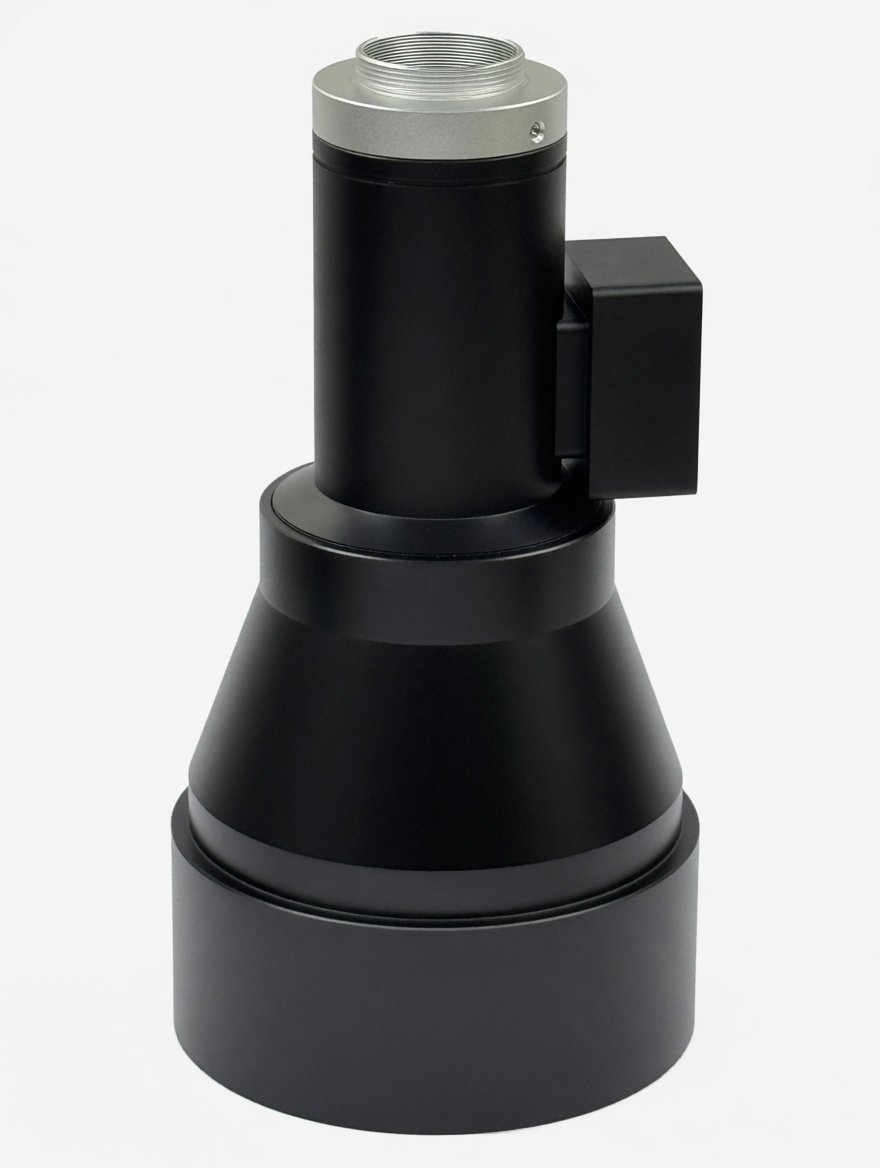
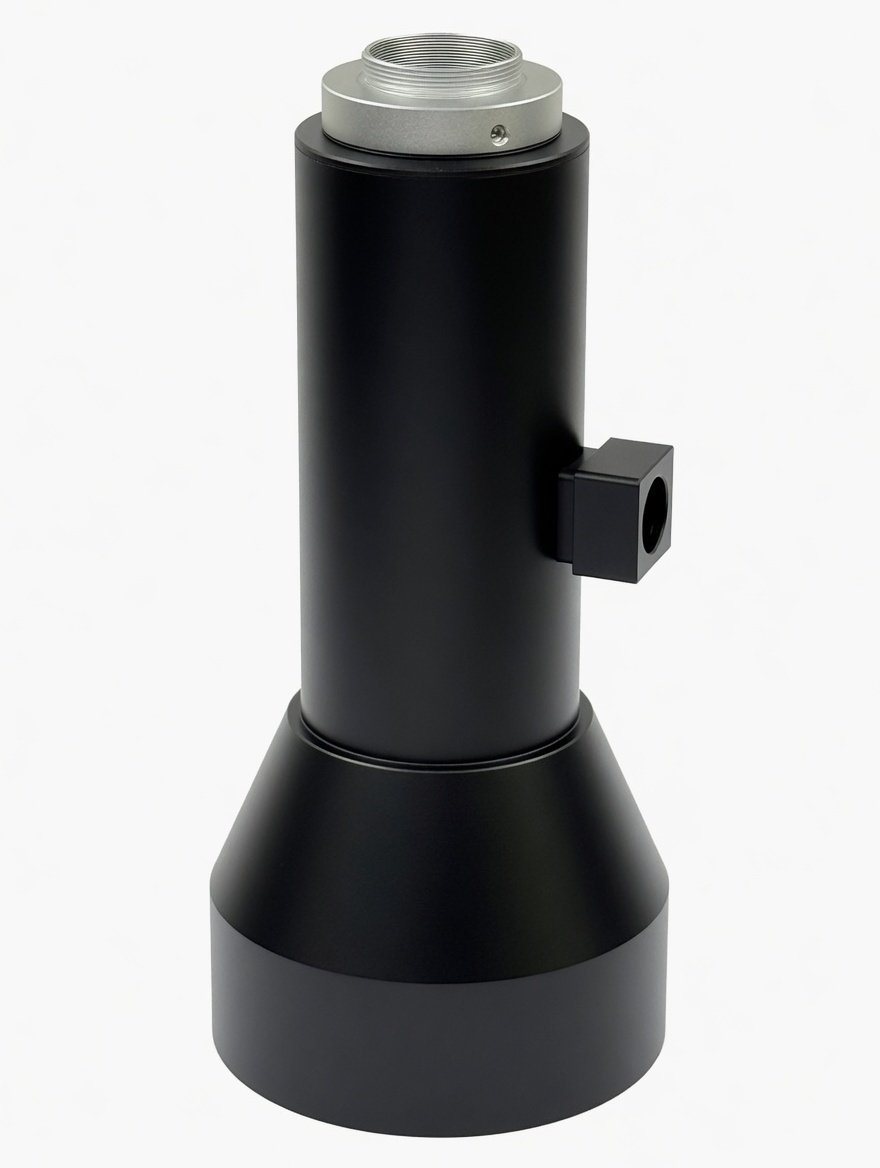
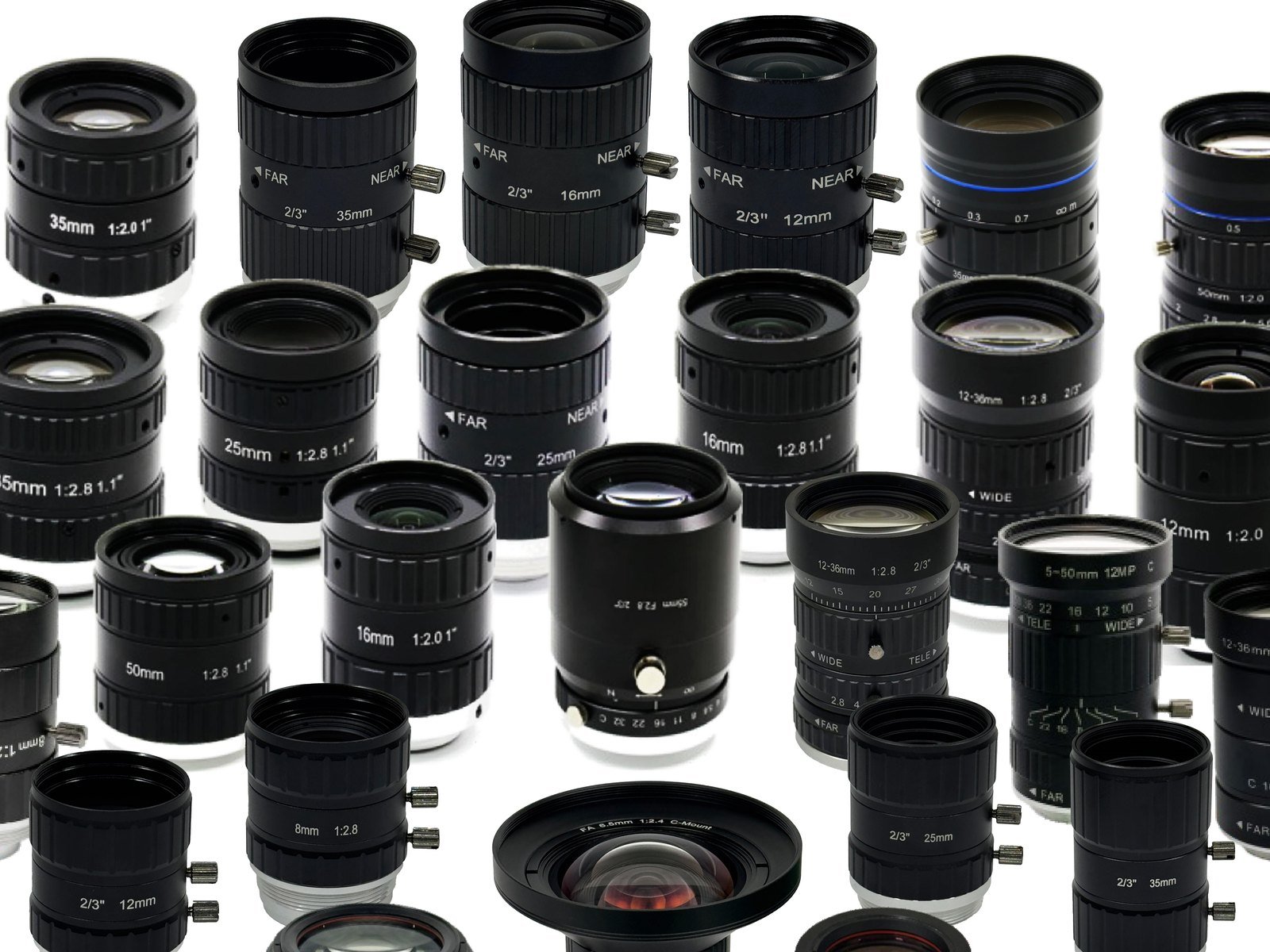
The usual RFQ for a machine vision telecentric lens is not a metrology problem. It is a presence station that already works, with a buyer who heard that telecentric glass is “more accurate.” Accuracy of what? If the algorithm only needs a blob in frame, a locked-focus FA lens is the cheaper, smaller, honest spend. Telecentric optics earn their barrel when a millimetre of object height would otherwise become a millimetre of measured size.
Key Takeaways
Buy telecentric when measured dimensions must not change with object depth. Do not buy it to “get more sharpness” or “more depth of field.”
Object-space telecentricity holds magnification versus working distance. Image-space telecentricity holds illumination on the sensor. Bi-telecentric does both.
A conventional lens at 110 mm WD watching a 50 mm field, with ±5 mm part height, swings about ±4.5% in magnification — roughly ±2.3 mm of apparent size error.
Sill Optics states depth of field is not larger on telecentric lenses than on entocentric ones. What you gain is usable measurement across that depth at constant scale.
Front clear aperture must exceed the field diagonal. A 110 mm field wants a 110 mm-class front. Size scales with FOV, not with a C-mount focal length.
Lensmind’s YT band runs 0.23X to 4X across 12 catalog models with an electrowetting cell in the path (about 20 ms). The family page lists 52 inspection models in total.
This page is the audit trail for that decision: what the optic actually locks, how to size magnification, and when to walk the RFQ back to FA glass. The five-input method in the machine vision lens selection guide still applies. On a gauge, the resolution line is a tolerance in millimetres, not a megapixel count.
The Misconception: Telecentric Is Not Extra Sharpness
Three claims show up in almost every first RFQ. All three are wrong as stated.
“Telecentric is sharper.” Sharpness is MTF at the working frequency. A well-corrected FA lens on a flat, fixtured part can out-resolve a cheap telecentric that is the wrong magnification.
“Telecentric has more depth of field.”Sill Optics’ technical guide is explicit: depth of field is not larger than on an entocentric lens. You can use the whole depth for measurement because magnification stays put.
“Software can undistort it.” A 2D undistort map cannot recover a scale that changed with object height. The pixels already mixed two different magnifications along Z.
If the station prints a pass/fail on a logo, a code, or a missing screw, stop here and price FA glass. If the station prints a millimetre, keep reading.
What a Telecentric Lens Actually Locks
A telecentric design places the aperture stop so that chief rays are parallel to the optical axis in object space, image space, or both. Thorlabs’ bi-telecentric note states the measurement lock directly: magnification stays constant independent of object location. Object-space telecentricity puts the entrance pupil at infinity, so field of view does not grow or shrink as the object moves along Z.
That is the lock you are paying for. Magnification β’ = image size / object size stays constant through the depth of field. A thick connector, a slightly tilted washer, or a part that sits ± a few millimetres on a nest still measures the same width. Entocentric FA glass cannot make that promise. Its scale is a function of working distance.
Use telecentric when measured dimensions must not change with depth, or when a thick object needs constant magnification. That is the Product Bible rule. Everything else is optional.
Working distance is fixed on most designs. You do not “zoom” a telecentric by sliding the camera. You pick a magnification, a field, and a WD band, then fixture to that band. Custom WD is a mechanical or optical modification, not a focus ring.
Object-Space, Image-Space, and Bi-Telecentric
Type
Chief rays parallel
What it locks
Typical use
Object-space
On the object side
Magnification vs working distance
Dimensional gauging
Image-space
On the image side
Illumination and pixel response
Uniform-measurement imaging
Bi-telecentric
Both sides
Scale and image-side cones
Metrology-grade gauging
Object-space is the measurement lock. Image-space is the illumination lock: chief rays land more perpendicular on the sensor, which cuts cos⁴θ roll-off and keeps shading from looking like geometry. Bi-telecentric (double telecentric) does both. Thorlabs’ machine-vision bi-telecentric designs are built so neither object location nor image location moves the magnification — that is why metrology buyers pay for the second pupil.
Sill notes that in many tasks an object-sided design already matches bi-telecentric performance, and that bi-telecentric helps on very large line or matrix sensors and on chips that want a defined chief-ray angle (microlens arrays). Ask for the type in the RFQ. “Telecentric” alone usually means object-space. If the camera is 1.1″ with microlenses, say so.
The Arithmetic of Perspective Error
For a thin-lens first pass, magnification scales with working distance. ΔM/M ≈ ΔWD/WD. The Lensmind telecentric family page walks a number you can check: a standard lens at 110 mm WD watching a 50 mm field, part height ±5 mm.
±5 / 110 ≈ ±4.5% magnification swing. On a 50 mm object that is about ±2.3 mm of apparent size error. No gauging tolerance survives that. A telecentric path removes the first-order scale term. What remains is residual telecentricity error and distortion, both of which belong on a batch report, not in the algorithm’s undistort table.
Software cannot reliably recover geometry the optics never preserved. If your gauge R&R is failing and the nest has a few millimetres of Z, look at the lens family before you look at another camera megapixel.
Magnification, Front Aperture, and Barrel Size
Magnification is image size divided by object size. Rearrange: object size = sensor size / β’. A 1″ sensor is typically 12.8 mm × 9.6 mm (16.0 mm diagonal). At 0.13X that field is about 98.5 mm × 73.8 mm — Sill’s worked example. At 1X the field equals the sensor. At 4X you are looking at a 3.2 mm-class width on that same 1″ chip.
The front objective must be larger than the field diagonal. A 110 mm FOV needs a 110 mm-class front diameter. That is why low-magnification telecentrics are the heavy ones, and why they do not fit a 30 mm camera envelope. You are not buying a 25 mm C-mount. You are buying a front aperture that swallows the part.
Coaxial (in-line) illumination is a separate mechanical choice: a beam splitter in the tube for shiny, recessed, or hole features. Non-coax is the default for diffuse edges. Neither choice changes the magnification math. Both still need the front aperture rule.
Shortlist the magnification before you buy the barrel
YT telecentric models from 0.23X to 4X, with an electrowetting cell in the path and per-batch telecentricity records. Send the part, the tolerance, and the sensor. If the job does not need constant magnification, the desk will say so and point you to FA glass.
Lensmind FA production holds distortion below 0.05% with 10K+ batch consistency. That is already a gauging-friendly FA number for a flat, fixtured part at a locked distance. Telecentric is the next spend when that 0.05% is not the error that is killing you — perspective is. If the part is flat and the nest is rigid, start with FA C-mount machine vision lenses and keep the telecentric budget for the station that prints millimetres on a thick object.
How to Pick Magnification on the YT Band
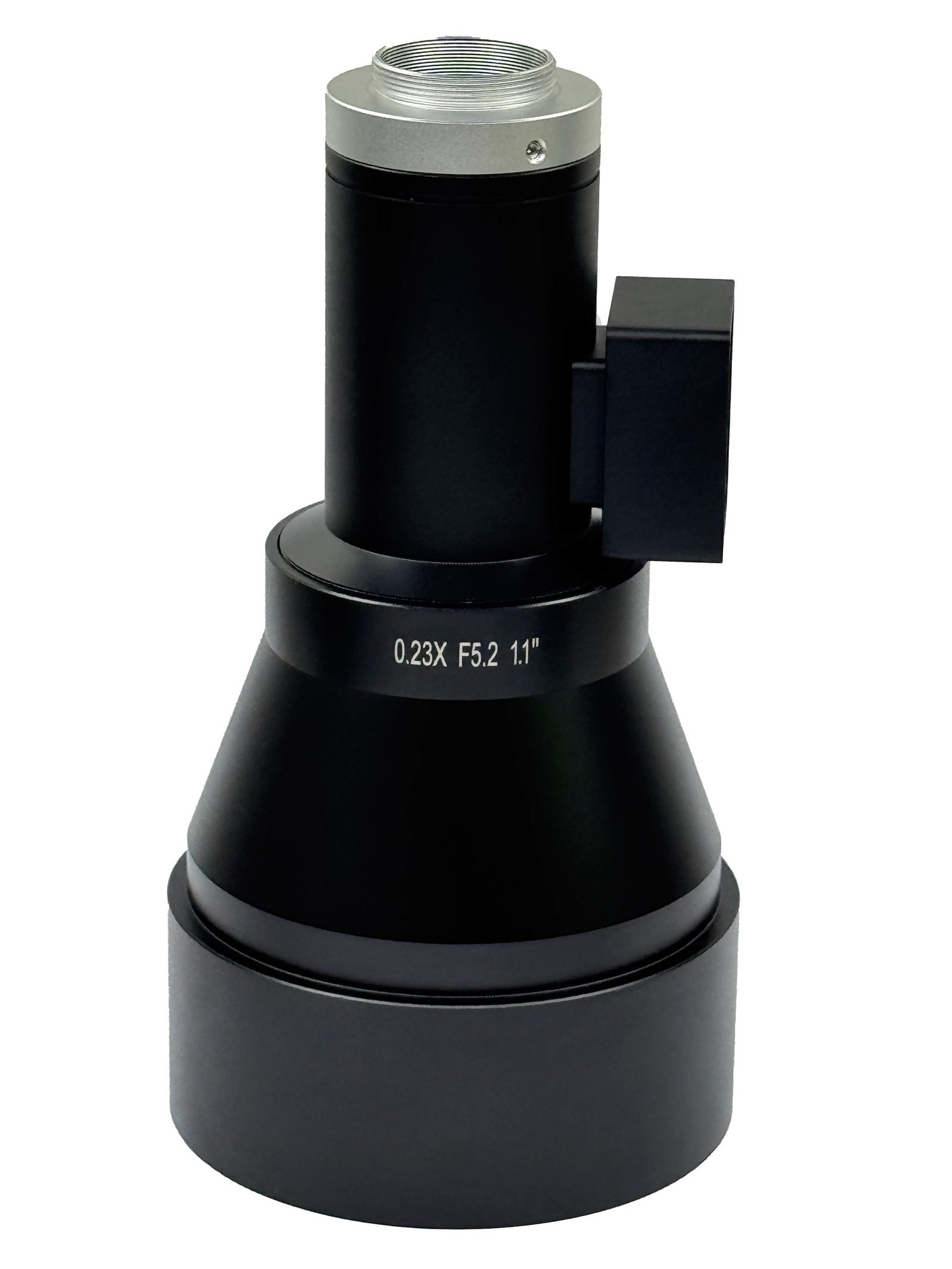
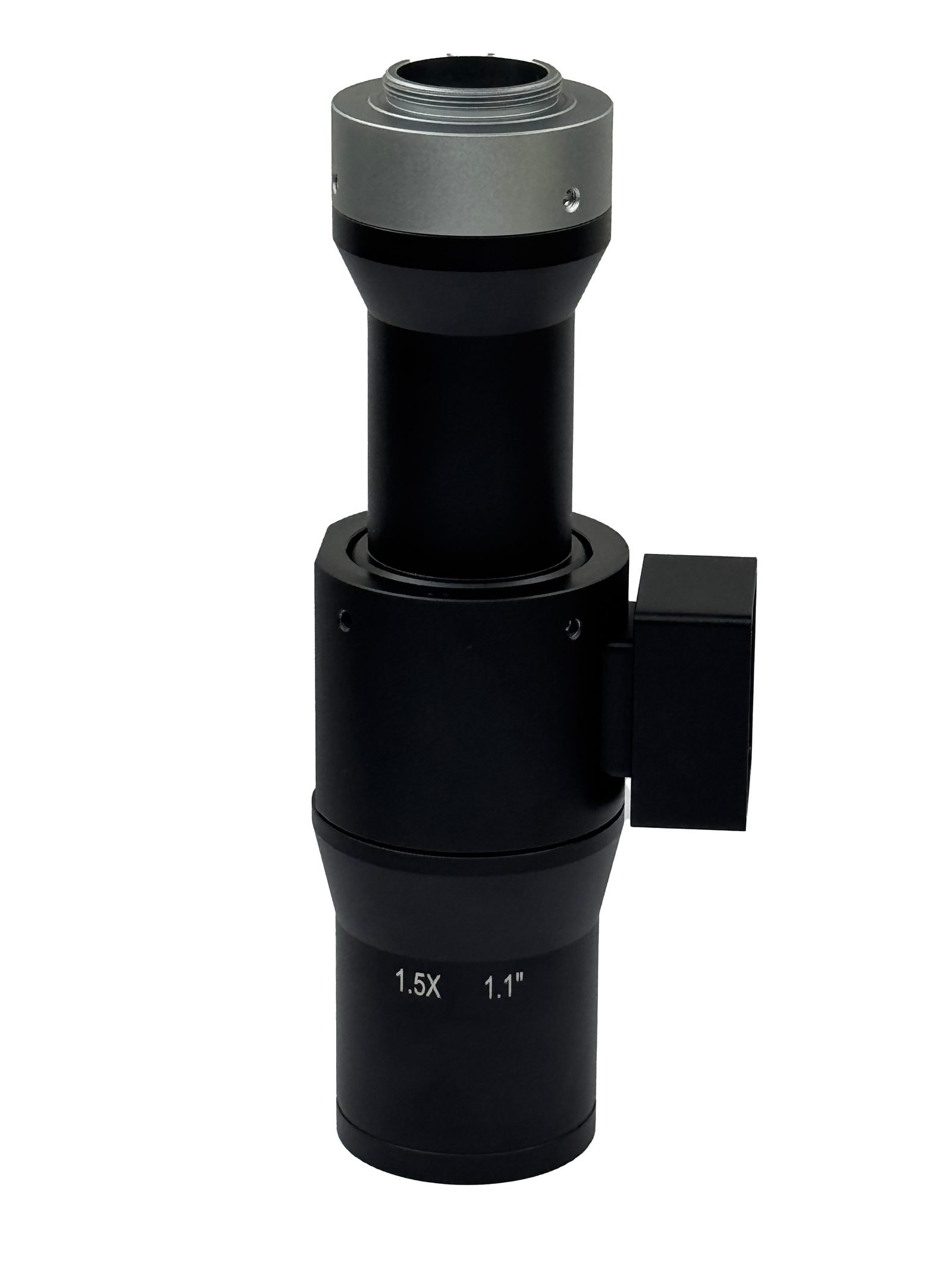
The live telecentric lens family lists 52 inspection models. The YT series is the 12-model liquid-focus band from 0.23X to 4X. Every YT SKU ships with a single-page spec sheet. Magnification, not focal length, is the selection key.
Band
Example models
WD (mm)
Use
0.23X
YT0.23X160N1.1-Y2, YT0.23X165N1.1-Y2
145–175 / 120–200
Wide field, large front
0.4X–0.5X
YT0.4X110N23-L4, YT0.5X110N23
104–116 / 105–115
General gauging
1X–2X
YT1X110N1.1-Y, YT1.75X110N23, YT2X110N23-L
108–117 / 107–113
Mid-range metrology
3X–4X
YTC3X65N1.1, YT4X65N23-L
63–67 / 64.5–65.5
Fine features, close WD
Suffixes encode the clock: L / L4 = software trigger and micro USB; Y / Y2 / C = hardware trigger and aviation connector. N1.1 and N23 are matched sensor classes. MH0088 is a 0.23X catalog optic for 1.1″ sensors in the same family language. Quote the SKU. Do not quote “a 0.5X telecentric” and hope the WD band matches the nest.
Depth of Field Is Not the Selling Point
High magnification thins depth of field. That is physics, not a defect. Sill’s guide is the sentence to keep on the RFQ: the complete depth of field can be used for correct measurements at constant magnification. You do not get a thicker slab of sharpness. You get a slab whose scale does not lie.
When the part has several heights, the YT answer is not a bigger stop. It is the electrowetting cell in the telecentric path: focus steps in about 20 ms, 10–30 frames stacked, no mechanical Z stage. Magnification stays locked across the stack, so the frames register. That is a different family from a standalone liquid lens on an FA barrel. Use Z-stacking when height variation exceeds native DOF. Use a single WD when the nest is two-step and short.
Do not stop the lens down until MTF collapses just to fake depth. Ask for the NA that matches pixel size, then stack if Z still overflows.
What We Check Before a Telecentric RFQ
A telecentric quote that omits tolerance and Z height is a catalog browse, not an RFQ. Hangzhou first-pass feasibility is 48 hours under NDA if drawings move. Prototype to mass production is 60 working days. Repeat orders are 30 days. Payment is 50% advance and 50% before shipment. Custom tooling is stored free for 5 years.
The number you defend: feature size and tolerance in millimetres, not “high accuracy.”
Z: part height variation and nest tilt. If ΔWD/WD already fits the tolerance, FA may be enough.
Sensor: format, pixel size, microlens CRA. This picks object-space versus bi-telecentric and the N1.1 / N23 class.
Field and WD: largest object, mechanical envelope, coaxial or non-coax light.
Clock: hardware trigger (Y/Y2/C) or software (L/L4).
Reports: telecentricity and distortion versus design, plus MTF, BFL, DOF. Instruments on site include Trioptics-class centration and a laser Fizeau interferometer.
Illustrative path: a connector with 0.3 mm pitch tolerance on a 1.1″ camera, hardware-synced line, two-step height. Route to the 1X–2X band (YT1X110N1.1-Y or YT2X110N23-L). If the casting has many heights, add 10–30 frame stacking instead of a motorized stage. If the job is a missing-pin check on a flat nest, the honest shortlist is FA, not YT.
Conclusion
Telecentric glass is a scale lock, not a sharpness upgrade. Object-space parallelism kills perspective error. Bi-telecentric adds image-side uniformity. Depth of field does not grow. The barrel grows because the front aperture must cover the field. Size the magnification from sensor and FOV, then spend the money only if ΔWD would otherwise print a false millimetre.
Key takeaways
±5 mm of height at 110 mm WD is about ±4.5% scale error on a conventional lens. That is the business case.
Sill: telecentric depth of field is not larger; it is usable at constant magnification.
YT runs 0.23X–4X across 12 models with about 20 ms electrowetting focus. The family lists 52 inspection models.
If the station does not print a millimetre, FA distortion below 0.05% is usually the right spend.
If you already know the feature, the tolerance, and the sensor, send those three plus the Z height. The Hangzhou desk will map them onto the YT table or tell you the job belongs on FA. First-pass feasibility is 48 hours. You want a named magnification, not a generic “telecentric” line item.
Written by the Lensmind Optics team — Hangzhou factory (Lin’an) and Zhongshan office, company registered 2019, ISO 9001 certified 2024. Founder on this site: Baker Zhao.
Frequently Asked Questions
When do I need a machine vision telecentric lens?
When a change in object height would change the measured size past your tolerance. Presence, color, and codes usually do not need it. Gauging, pitch, and coplanarity often do.
Does a telecentric lens have more depth of field?
No. Depth of field is not larger than on an entocentric lens. The gain is constant magnification across that depth, so the whole slab is usable for measurement.
What does bi-telecentric mean?
Chief rays are parallel to the axis in both object space and image space. Magnification stays constant and illumination on the sensor stays more uniform, including on microlens arrays.
Why are telecentric lenses so large?
The front clear aperture must exceed the field. A 110 mm field needs a 110 mm-class front. Size follows FOV, not a C-mount focal length.
How do I choose telecentric magnification?
β’ = sensor size / object size. Wide fields sit at 0.23X (WD 120–200 mm). Fine features sit at 3X–4X (WD about 63–67 mm). Match the nest to the published WD band.
Can a telecentric lens autofocus?
The YT series puts an electrowetting cell in the telecentric path. Focus steps in about 20 ms. Use 10–30 frame Z-stacks when part height exceeds native depth of field.
Baker Zhao
Founder, Lensmind Optics
Baker Zhao is the founder of Lensmind Optics, with 26 years of experience in the optical industry — including Vice President of Sales at Sunny Optical (Zhongshan) and earlier roles at Foxconn, LG and Sintai Optical. He leads Lensmind with a mission to help customers find reliable, application-specific optical solutions from development to volume production.
A short-working-distance large-FOV feasibility input pack is the maker-ready file that states part size, stand-off, pixel budget, and which image costs the buyer will...
Turning a 50 micrometre defect at 200 millimetres into a lens commitment means locking pixel pitch, image height, and a verification target before anyone...