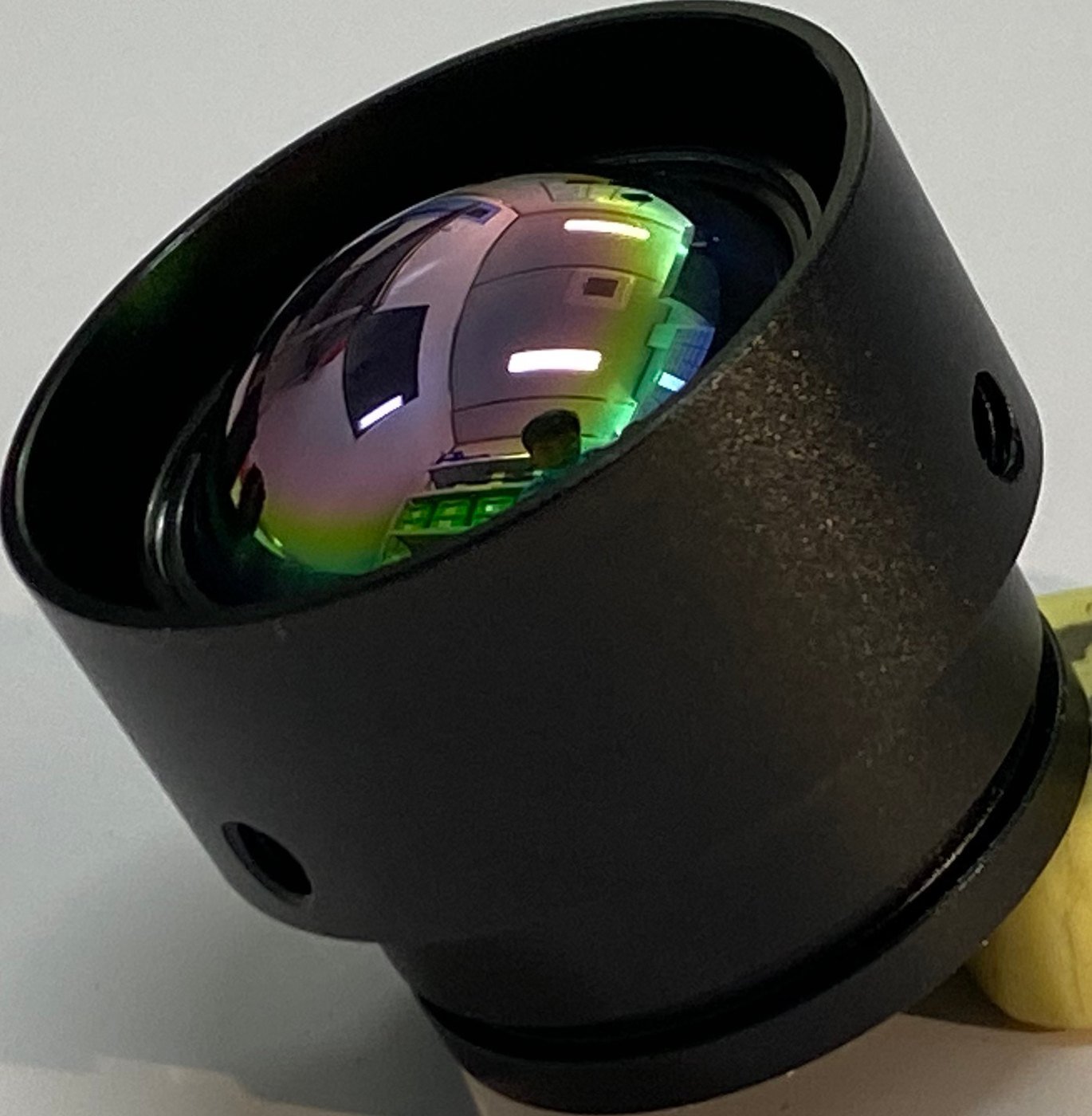
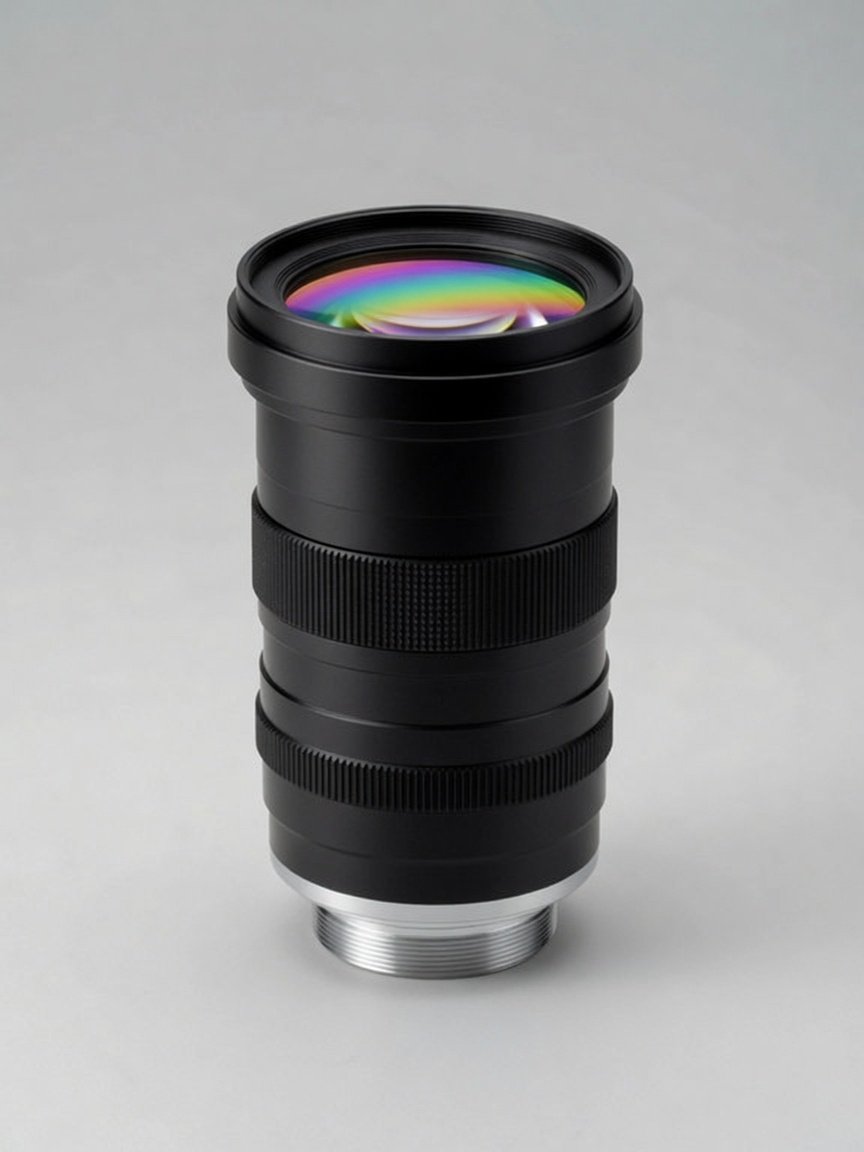
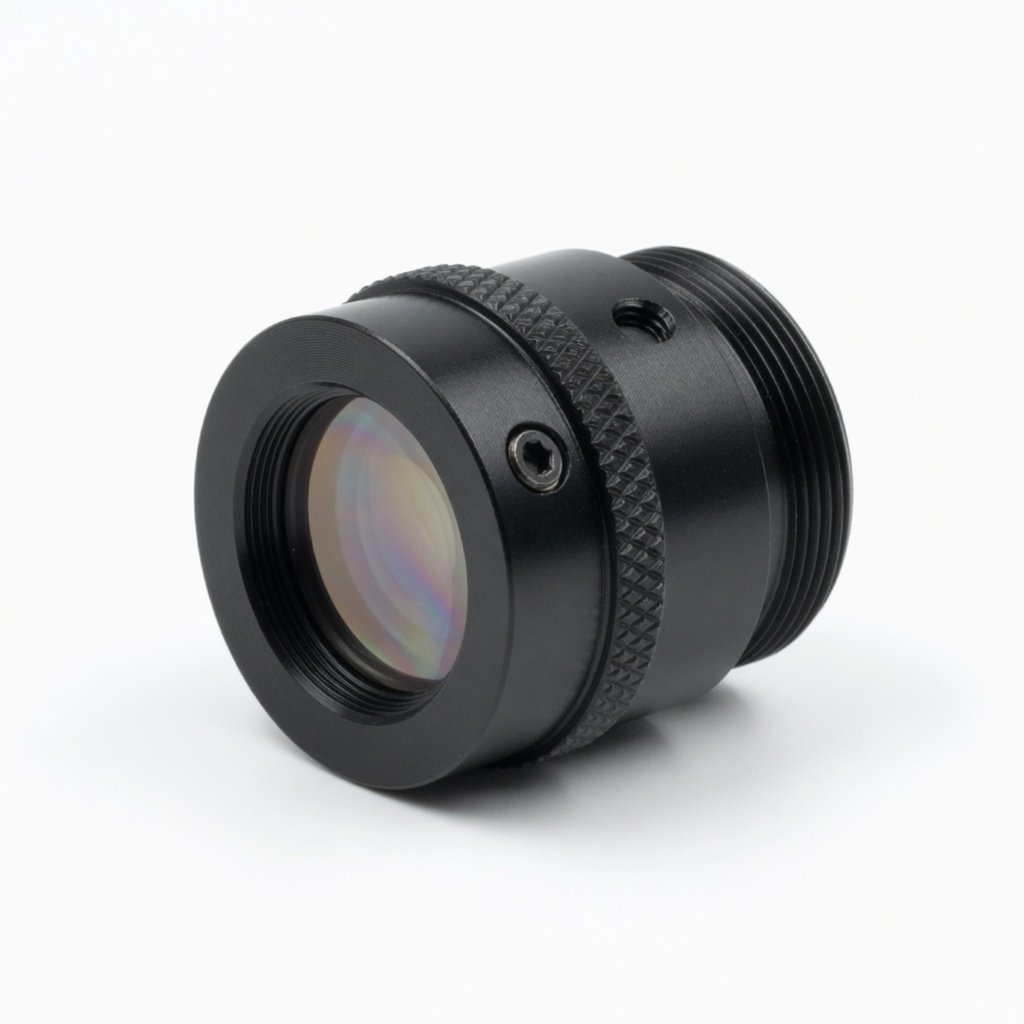
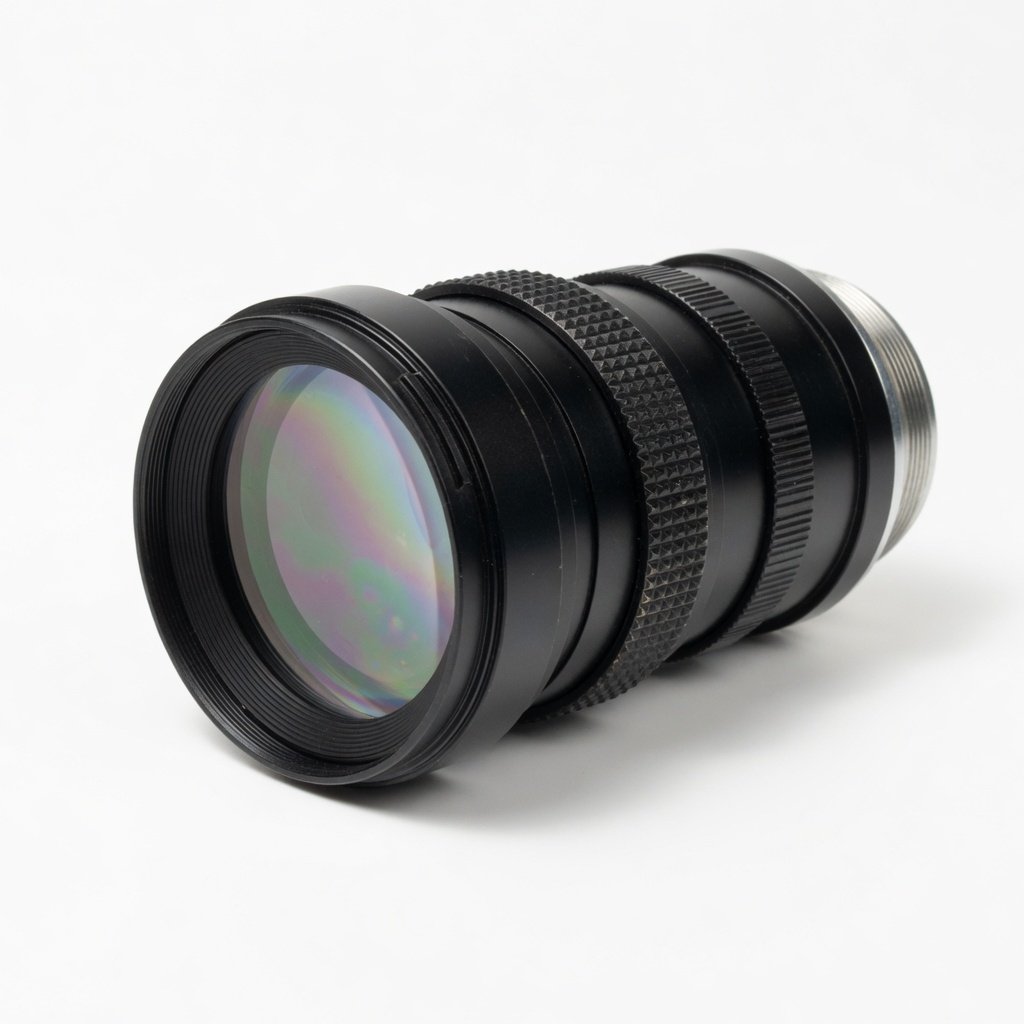
12 µm × 640 = 7.68 mm. That is the horizontal silicon a 640-pixel uncooled array actually presents. A thermal imaging lens that was drawn for a 17 µm VGA chip will not cover a 12 µm 640-class detector the same way, and a visible C-mount FA barrel will not transmit the band the bolometer sees. Selection starts at pixel pitch and array format, then at the material that can pass that light.
Key Takeaways
Uncooled microbolometers typically respond in the 7.5–14 µm long-wave infrared. Visible glass is the wrong material.
Lensmind catalog photography is built around uncooled detectors at 8, 12 and 17 µm pixel pitch. The horizontal size is pixels × pitch, same math as any other sensor.
A 640×480 array at 17 µm is 10.88 × 8.16 mm. The same format at 12 µm is 7.68 × 5.76 mm. Smaller pitch needs a different focal length for the same field.
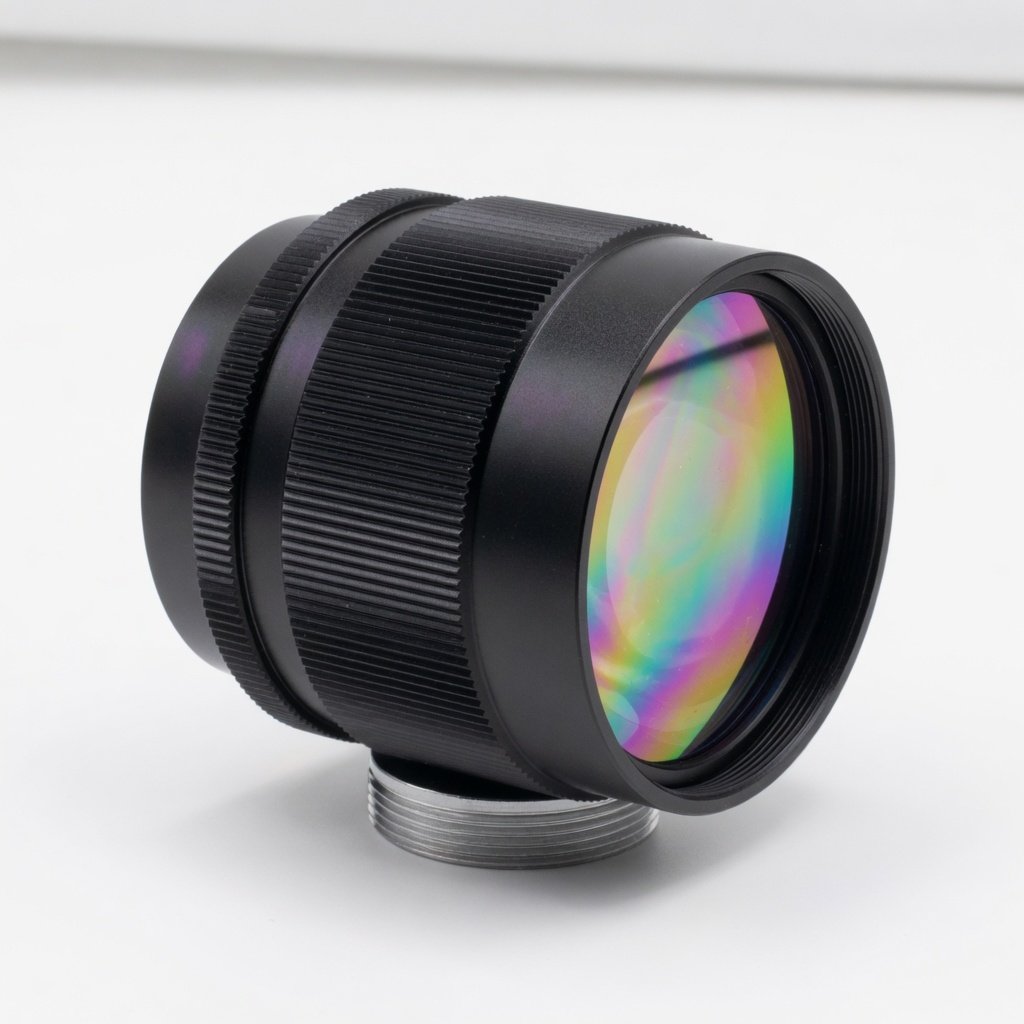
Germanium is a common LWIR lens material (the LMXHG barrels show a germanium element). It is not a drop-in for a 25 mm FA cell.
Match f-number to the detector: uncooled cameras often run near f/1. A slow visible lens starves the bolometer.
The five inputs in the machine vision lens selection guide still apply. On thermal, “format” is array × pitch, and “environment” is often outdoor or furnace-adjacent. The Lensmind family is listed as a thermal imaging line, including near-infrared thermal optics in the Product Bible — write the waveband on the RFQ so the coating is not a guess.
Pitch Times Pixels Is the Format
Thermal arrays are sold as 160, 320, 640, 1024 and similar counts. The millimetres are count × pitch. A 640×480 detector at 17 µm is 10.88 × 8.16 mm. At 12 µm the same count is 7.68 × 5.76 mm. The image circle and the focal length both move. “VGA thermal” without pitch is as empty as “5 MP C-mount.”
Waveband and Material: Why Visible Glass Fails
A microbolometer is an uncooled thermal sensor. Infrared between about 7.5 and 14 µm heats each pixel and changes its resistance. Ordinary optical glass does not transmit that band. Germanium, chalcogenide glass, and a few other IR materials do. Lensmind LMXHG barrels show a germanium front element in catalog photography. Putting a 25 mm FA lens on a bolometer camera is a mechanical experiment, not an optical one.
The Product Bible also names a near-infrared thermal family. NIR (0.7–1.4 µm class) and LWIR (8–14 µm class) are not interchangeable coatings. Write the detector waveband on the RFQ. Wrong material is the “no contrast” failure in the field.
8, 12, and 17 µm Detectors
Pixel pitch on uncooled arrays has stepped from 25 µm-class down through 17 µm and 12 µm, with 8 µm appearing on newer chips. Smaller pitch shrinks the die for the same resolution, which shrinks the lens. It also collects less energy per pixel, which is why fast f-numbers stay in the conversation. Match the lens to the pitch you actually bought, not to last year’s 17 µm demo camera.
Pitch
640×480 size (mm)
What changes
17 µm
10.88 × 8.16
Larger die, longer EFL for same FOV
12 µm
7.68 × 5.76
Smaller optics, less energy per pixel
8 µm
5.12 × 3.84
Tightest circle; confirm MTF at that pitch
F-Number, Energy, and Why Fast Optics Show Up
Uncooled cameras are energy-starved compared with a 5 MP visible global shutter under LED bars. Fast thermal lenses (near f/1) are common because the bolometer needs photons. Do not stop a thermal lens down the way you stop an FA lens for depth of field — you will watch NETD collapse on the camera’s own metric. Quote the f-number the detector was characterized at, then keep it.
Focal Length From Detector Width and FOV
Same thin-lens estimate: f ≈ (sensor width × WD) / (field width + sensor width). For a 12 µm 640-wide chip (7.68 mm) at 5 m looking at a 2 m-wide busbar: f ≈ (7.68 × 5000) / (2000 + 7.68) ≈ 19.1 mm. A 17 µm 640-wide chip at the same FOV wants ~27 mm. Pitch changed the lens. Confirm on the drawing; germanium cells have their own principal planes.
Match the lens to the bolometer pitch, not to a visible FA cell
LMXHG thermal barrels for 8, 12 and 17 µm uncooled detectors, germanium elements, Hangzhou coating and test. Send array format, pitch, waveband, and field. First-pass feasibility in 48 hours.
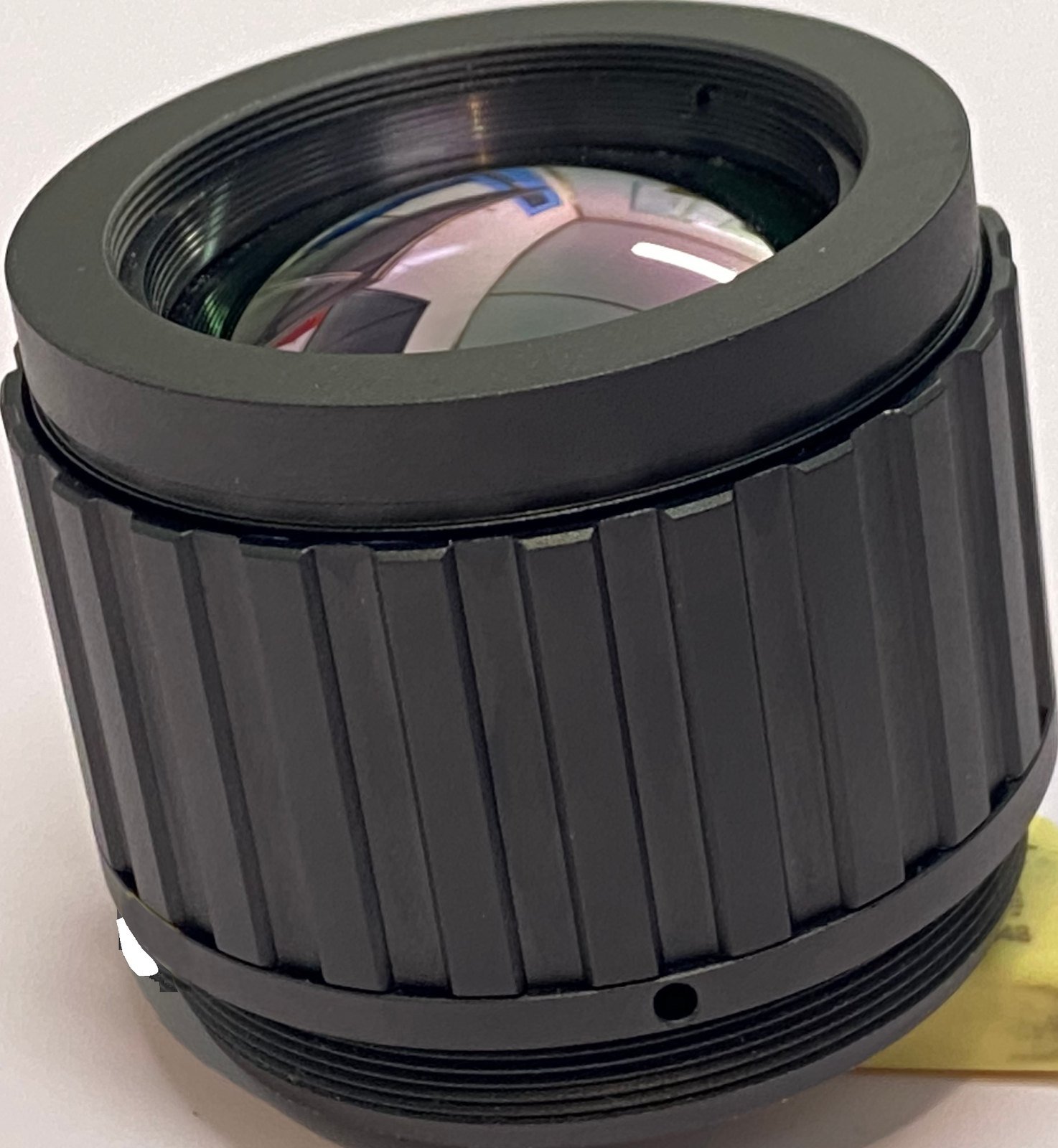
The live thermal imaging lens family is the money page for this RFQ. Compact, mid, tele, zoom, and hooded LMXHG bodies cover different fields. Do not pick by barrel length alone. Pick by detector width, EFL, and f-number. Coatings that pass 8–14 µm will not automatically pass a NIR illuminator, and the reverse is also true.
Field: object width and working distance. Same formula as visible, different glass.
Speed: f-number the camera was spec’d at.
Mount: many thermal bodies are not C-mount 17.526 mm. Send the drawing.
Process: 48-hour first pass, 60 working days prototype to mass, 30-day repeats, 50/50 payment, ISO 9001 (2024).
Worked Example: 640 × 12 µm Outdoor Gauge
Illustrative path: 640×480, 12 µm, 7.68 mm width, 8–14 µm bolometer, 8 m to a 3 m-wide kiln wall. f ≈ (7.68 × 8000) / (3000 + 7.68) ≈ 20.4 mm. Fast f-number near the camera’s characterization. Germanium cell, not FA glass. If the next camera is 17 µm 640, recompute — the EFL jumps. Contrast that dies after a coating swap to VIS is a waveband error, not a “bad lens.”
Conclusion
Thermal glass is sized by pitch × pixels and by the band the detector actually sees. 12 µm × 640 is 7.68 mm. Uncooled microbolometers live around 7.5–14 µm. Visible FA barrels do not. Write pitch, array, waveband, and field before anyone quotes an EFL.
Key takeaways
Format = array × pitch. 640 at 17 µm and 640 at 12 µm are different lenses.
Microbolometers: ~7.5–14 µm. Germanium (and similar IR materials) pass that band; crown glass does not.
Keep the f-number the detector was built for. Stopping down to “look industrial” kills signal.
If you already have the detector datasheet and the field, send those two. Hangzhou will map them onto the thermal family or tell you the waveband is NIR rather than LWIR. First-pass feasibility is 48 hours.
Written by the Lensmind Optics team — Hangzhou factory (Lin’an) and Zhongshan office, company registered 2019, ISO 9001 certified 2024. Founder on this site: Baker Zhao.
Frequently Asked Questions
Can I use a C-mount FA lens on a thermal camera?
Not if the detector is an uncooled microbolometer in the 7.5–14 µm band. Visible glass does not transmit that light. Use germanium or another IR material matched to the pitch.
What is the difference between 12 µm and 17 µm thermal lenses?
The die size changes. 640×480 at 17 µm is 10.88 × 8.16 mm; at 12 µm it is 7.68 × 5.76 mm. Focal length and circle both move.
What waveband do uncooled bolometers use?
Typically 7.5–14 µm long-wave infrared. That is not the same as a near-infrared industrial camera. Write the band on the RFQ.
Why are thermal lenses so fast?
Uncooled pixels need energy. Cameras are often characterized near f/1. Stopping down to gain depth of field will starve the detector.
Does Lensmind make germanium thermal lenses?
LMXHG catalog photography shows germanium elements for 8, 12 and 17 µm uncooled detectors. Send the detector drawing for a named match.
Is thermal the same as NIR machine vision?
No. NIR illuminators around 850 or 940 nm use glass with NIR coatings. LWIR bolometers need IR materials. Mixing them is the no-contrast failure.
Baker Zhao
Founder, Lensmind Optics
Baker Zhao is the founder of Lensmind Optics, with 26 years of experience in the optical industry — including Vice President of Sales at Sunny Optical (Zhongshan) and earlier roles at Foxconn, LG and Sintai Optical. He leads Lensmind with a mission to help customers find reliable, application-specific optical solutions from development to volume production.
A short-working-distance large-FOV feasibility input pack is the maker-ready file that states part size, stand-off, pixel budget, and which image costs the buyer will...
Turning a 50 micrometre defect at 200 millimetres into a lens commitment means locking pixel pitch, image height, and a verification target before anyone...