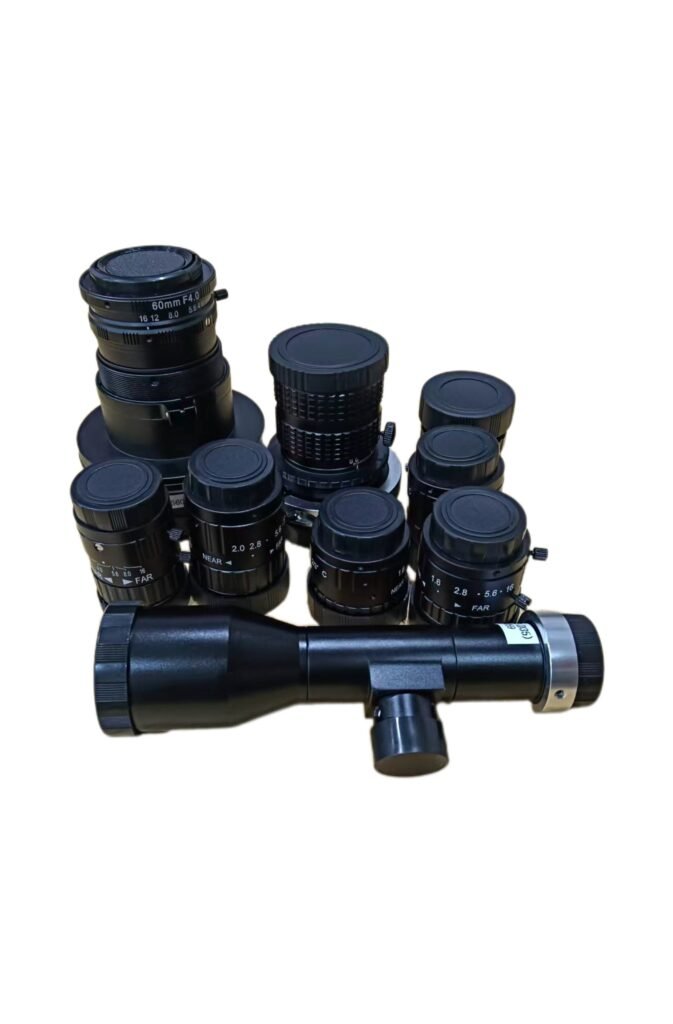
Field of view, working distance and housing length are one relationship, not three settings, so photographing them as a negotiation of three wishes will keep the argument alive. Decide by asking which of the three is fixed by the physical world and which is a preference dressed as a requirement. Working distance is usually carried by clearance for lighting, tooling, part movement and operator safety. Field of view is usually carried by the part. Envelope length is usually the elastic one, unless the machine, the housing or the device is itself the fixed space. Once you know that order, record the decision with the values you abandoned and the events that would reopen it. A trade-off that is written that way stops being relitigated at every design review.
One Relationship, Not Three Settings
The geometry is short enough to write on a whiteboard. For a given sensor width, the field of view is roughly the sensor width multiplied by the working distance and divided by the focal length. Fix any three of those four things and the fourth is determined. That is why a lens cannot honestly be selected after the sensor and the mounting geometry are already frozen, and why a supplier who is told the envelope first is answering a different question from the one you think you asked.
Because of that, a conversation about three parameters that must all hold is really a conversation about which of them carries the measurement requirement. The Machine Design column on working distance and depth of field makes the cost explicit from the imaging side: pushing the working distance out for mechanical reasons changes what the optics can deliver, because depth of field, magnification and light gathering move with it. The trade is not imaginary, and it is not symmetrical. Some of it is geometry and some of it is optical performance, and the two need to be separated before anyone gives up a parameter.
Find the Physical Requirement Before the Preference
Start with the part. What must be inside the image, including tolerance on the part’s own variation, edge margin for the measurement, and whether the whole feature must be captured in one frame or can be stitched. That gives a field of view with a number on it. Then measure the clearance. Not the drawing’s nominal distance, but the smallest usable gap left after the light arrives, the tool or the robot reaches, and the operator’s hand has room. A working distance requirement is a minimum clearance with a tolerance, and it is usually harder than people think, because half the number is taken up by hardware the drawing did not show.
Then look at the space available for the lens and its mount. This is where a real constraint can hide: threads, connectors, cable bend radius, a protective window, a lens heater, or the wall of the machine. Envelope length is a preference when the machine can be modified and a requirement when it cannot, and knowing which one you are in decides the whole rest of the exercise. Write down who owns each number, because the person who owns the clearance is often not the person who owns the image specification, and the argument is usually between them rather than between you and the lens maker.
Before You Give Anything Up, Buy It Back With Hardware
Most trade-offs are presented as three-way when they are not, because hardware can move one of the constraints without touching the lens. Changing the sensor size changes the field of view at a given focal length and working distance, which can recover the framing you thought you had lost. Adding a spacer or an extension changes the relationship between the lens and the image plane and therefore the working distance at which the system focuses, which is the practical way to fine tune an exact field of view without ordering a bespoke focal length. Spacer rings, varifocal and custom focal length sets out how those three routes compare when what you actually need is an exact field of view.
The mount is the other lever. C mount with its 17.526 mm flange distance and CS mount at 12.5 mm are not interchangeable without thought, and the 5 mm adapter ring that bridges them changes the envelope as well as the optical spacing. A different mount family may cost less than a different lens, and it changes which lenses are available to you at all. Before accepting a compromise on field of view, check whether the compromise is really about the optics or about a mechanical decision that was made three drawings ago.
The Trade-Off Record: Columns That Make It Survive
Every source agrees the decision should be written down. Almost none of them say what the page should contain, and the missing columns are the ones that matter later. Build one page per project with these rows: the parameter, the requirement value and its tolerance, the driver that produced it and the person who owns that driver, the value you actually chose, the value you abandoned, what the abandonment costs in performance, the data you requested from the maker to confirm the cost, the event that would force the decision to be reopened, and the signature and revision that makes it a record rather than a note.
The two columns people leave out are the abandoned value and the re-open trigger, and they are the two that do the work. Without the abandoned value, the next engineer cannot tell whether you considered 300 mm of working distance and rejected it or never thought about it, so the compromise gets relitigated from zero. Without the trigger, nobody notices when the constraint that justified the compromise stops being true. A record with those two columns is what turns a meeting into a decision.
Request Data at the Values You Chose, Not at Nominal
A quotation that names a focal length and an image circle without saying what the performance is at your working distance will not support the decision you just made. Ask for the numbers at the condition you will actually run. For working distance, that means performance at both ends of the range you will use, because a lens that is strong at the nominal distance can be noticeably weaker at the near limit of the cell. For field of view, that means the image height at which the figures are quoted, because a lens specified at the centre of the image and a lens specified at the edge are two different products when you are placing a feature at the corner of the frame. Numbers at named image heights explains why a quotation without them cannot be compared with another quotation, and the same demand applies when you are checking whether the compromise you accepted is affordable.
Ask as well what happens across the range, not only at the two ends. The interesting number is often the slope: how much field of view or contrast is lost for each additional millimetre of working distance, or how much performance is given up by closing the aperture to recover depth of field. A slope lets you re-price the compromise in the change meeting rather than starting a new study. This is where a supplier with real metrology can help, and where a supplier without it will answer with a datasheet range instead of a measurement. Lensmind’s FA family is specified with distortion held below 0.05% across a 10K+ batch consistency claim, which is the kind of figure that is only useful if you also know the image height and the working distance it was measured at, so ask for the conditions as part of the same answer.
Hook the Decision to Change Control
A trade-off record that lives in a project folder is a diary. A trade-off record that is referenced by the drawing revision is a control. Put the record’s revision on the optical drawing or the assembly drawing, and put the abandoned parameter in the change control system as an open assumption with an owner. Then define what reopens it. Typical triggers are a new gripper or fixture that changes clearance, a new enclosure that changes the available length, a camera change that changes the sensor size or the pixel pitch, a change in the inspection requirement such as a tightened tolerance or a new defect class, and any request from production for more depth of field or more light.
This is the same discipline that keeps a lens program stable when someone wants a late improvement. Where the freeze line sits is the sibling record, and the two belong in the same folder: one says what was frozen, the other says what was given up to freeze it. When a change request arrives, the first question is which record it touches.
When the Envelope Is the Hard Constraint
There are projects where the space is genuinely fixed, and the answer changes shape rather than merely direction. A sub 2 mm endoscope objective, a lens inside an existing camera body, or an imaging head that has to fit a hole already cut in a machine cannot buy length with a spacer. In that situation the envelope is the requirement, and the variables that move are field of view, working distance and sensor choice. The trade then usually lands on the sensor: a smaller sensor with a shorter focal length fits the length, and the cost shows up in resolution, light and depth of field rather than in the drawing envelope.
Recognising this case early saves the most money, because it changes which supplier question you ask. Instead of asking whether the lens can be made shorter, you ask what the shortest available design delivers at the sensor you can fit, and what the image quality is at the working distance the machine allows. That is a design question, not a catalogue question, and it should be quoted as one.
What the Record Looks Like in One Page
Fill the page in the order the decisions actually happen. The requirement block carries the part, the field of view with tolerance, the minimum usable clearance, the available length and the sensor. The drivers block names the owner of each number. The decision block carries the chosen values, the abandoned value, and the performance cost expressed as the data you asked for. The control block names the drawing revision, the change control reference, the re-open triggers and the approver.
Then send the relevant part of it with the request for quotation, because the supplier needs the working distance, the field of view, the sensor and the space, and those four are exactly the contents of the record. A quotation requested from that page comes back comparable to the next one, and a compromise accepted on that page is a compromise you can explain to the customer, the auditor or the engineer who joins the project in two years and asks why the station runs at the working distance it does.
The trade-off lands on a real catalogue once the numbers are fixed: the machine vision lens families cover the entocentric options, while telecentric lenses are the answer when measurement must not change with depth.