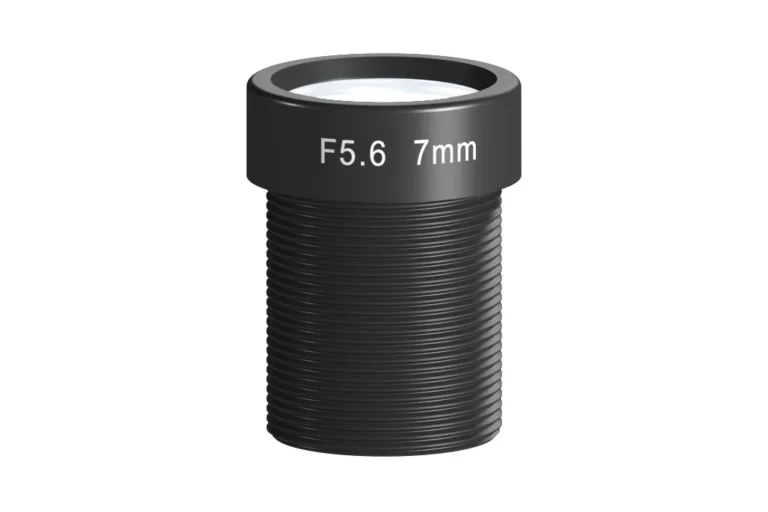
C-Mount or S-Mount for Eight Cameras: Decide Before the Drawing Locks
Settle one question before you touch the CAD template: who moves focus, the camera or the lens. If each of the eight positions must...
read more…
Answer the field of view question with the error budget, not with whichever option is easiest to buy. If a catalog lens already produces the required field at your working distance and the only real problem is focus at that fixed distance, a locked spacer stack is the correct choice, and the document that settles it is a measurement of the assembled stack at the true conjugate, not a calculation. If the field must change during setup or across product variants, a varifocal is the honest tool, and it has to ship with a locked setting plus a written setting and verification procedure. Go to a custom focal length when no catalog lens with a reasonable spacer closes the field of view tolerance, or when distortion, edge resolution, back focal distance or packaging cannot be met. Each route carries a different document package, and the acceptance clause belongs in the purchase specification.
If this is close to your build but not exact, custom optics design at Lensmind is how we turn a spec sheet into a production design.
Three numbers decide the route: working distance, field of view, and the active area of the sensor. Write the working distance with its datum spelled out, because a distance measured from the front mechanical surface, from the first optical surface and from a principal plane are three different specifications, and a supplier who assumes the wrong one will deliver a lens that is nominally correct and practically out of tolerance. Write the field of view in object space as width by height, not as a diagonal alone, and check that its aspect ratio is compatible with the sensor before anyone quotes a lens.
The selection method this site already teaches uses five inputs: sensor format, working distance, field of view, resolution target and environment. Convert the first three into a starting focal length with the standard far-conjugate approximation, focal length roughly equal to working distance multiplied by sensor dimension and divided by field dimension, then run the same arithmetic for the vertical direction, and check the image circle before anything else. A machine vision lens calculator handles that first pass. Treat the result as a starting point rather than proof: at short working distances the approximation drifts, so the maker’s data at the real conjugate, or measured data, is what belongs in the decision.
Then answer one question in writing, because it eliminates a route immediately: must the field of view be exact at one distance, or must it stay controlled across a range? A single fixed distance points at a fixed solution. A range points at adjustability, and the rest of the decision follows from there. That is the selection question behind machine vision lens spacer rings vs varifocal vs custom focal length, and it is a question about working distance, field of view and tolerance rather than about budget alone.
A spacer does not change the optical prescription of the lens. It moves the lens relative to the sensor, and at a finite working distance that change in image distance trades working distance against magnification and field of view along the imaging curve the lens already has. That makes it a trim tool. It cannot turn a catalog lens into a different design, and it cannot create a field of view that the lens and sensor combination does not already reach within tolerance.
The optical cost is real and it is lens specific. Pushing a lens away from the conjugate it was corrected at can raise aberrations and distortion, reduce illumination at the edges of the sensor, and change how the aperture behaves in practice. None of those effects can be predicted from the spacer thickness alone, which is why the maker has to supply data for the assembled stack, and why field of view and magnification have to be measured at the actual conjugate instead of calculated from nominal numbers.
The mechanical cost is where spacer plans fail quietly. A spacer consumes back focal distance and therefore eats into the margin the mount allows above its flange focal distance. With a C-mount camera that reference is 17.526 mm, on CS-mount it is 12.5 mm, and a 5 mm adapter ring is already part of the stack on many benches. The number to write down is the margin remaining after the spacer, the mount, any adapter, the sensor cover glass and any filter are all counted. A stack that leaves no margin will focus on the bench and drift in the field.
Locking is the second half of the same problem. A spacer that sits between a lens and a camera has to be located against a defined datum, tightened to a stated torque and locked, and the focus ring has to retain travel after the stack is assembled. Ask what the spacer changes, focus, magnification or back focal distance, and record the answer in the file. Using spacer rings on camera lenses for a fixed field of view is a sound choice when the catalog lens already meets the field within tolerance, when the working distance is fixed, when the adjustment is small, and when the maker will verify the assembled stack rather than only the catalog lens.
A varifocal lens changes focal length, and on most designs the focus plane moves when the focal length changes, so the operator has to refocus after every adjustment. That is the difference between a varifocal and a true parfocal zoom, and the difference matters more than any label on the barrel. A varifocal belongs in development and commissioning, where it lets an integrator find the right field on a bench, cover several product sizes with one camera, or absorb an installation tolerance that is still being measured.
It is a weak answer when the requirement says exact field of view at a fixed working distance, because the setting becomes a state rather than a specification. A setting can be disturbed. Markings on the barrel may not correspond to a calibrated field. Repeatability between units is not guaranteed by the part number. Temperature, vibration and adjustment torque all enter the error budget. Weigh the advantages and disadvantages of varifocal lenses in machine vision against a single question: who is allowed to change the field after the line is qualified? If the answer is nobody, the varifocal is a setup aid.
A simple bench test tells you what you own. Set focus at the working distance, change the field, and watch the sharpness of a resolution target. If the image goes soft, the lens behaves as a varifocal regardless of what the datasheet implies, and it needs a refocus step in the procedure. If a varifocal does stay in production, specify the calibrated field or the setting value rather than a dial position, the refocus procedure, the locking method and torque, the acceptance limits, and whether every unit must be calibrated individually.
A custom focal length is justified when the combined requirements cannot be met by a catalog lens plus a spacer: field of view tolerance, distortion budget, resolution at the edges of the image, aperture, spectral band, image circle, packaging, focus range, production repeatability or environmental durability. The point is not that custom is better. The point is that a catalog lens has to be exhausted first, including the families a maker already runs, because those carry proven test data and short lead times. That sequence is the subject of the catalog versus custom decision, and it belongs before an RFQ rather than after one.
Custom does not automatically mean a new optical design from scratch. It can be a modified catalog design, a focal length variant inside an existing family, a selected lens with a custom barrel or mount, a spacer designed into the lens body, or a complete optical and mechanical design. Decide which one you are asking for before the request goes out. A custom focal length lens vs a standard lens is not a quality argument; it is an argument about who can guarantee the field, and at what documentation cost.
Use the custom route when the field must be guaranteed across production tolerances rather than adjusted once on a bench. That is where process capability becomes the product. On an FA camera lens line, distortion held below 0.05 percent with 10K+ batch consistency is the kind of number that replaces a bench adjustment, and closed-loop 1 micron class active alignment on units that demand it is what keeps a specified field stable from unit to unit. The metrology behind those claims is the same list a buyer should be shown: Trioptics centration and OptiSurf, a laser Fizeau interferometer, reflective centering instruments, a precision air-bearing stage, a UV spectrophotometer and collimation systems. Catalog families such as the 2/3 inch to 1.1 inch C-mount FA line with models like FA3505W, FA5005W, FA2520W, FA3520W, FA5020W and FA7520W, the LMHS-MH series, and M12 S-mount lenses with FT and HT focus lock are the baseline to test before tooling anything.
Start with what should be common to all three routes, because it is the part buyers most often forget to make contractual. A production lens should ship with a report that names the part number and revision, the batch number, the test conditions, the inspection coverage and an explicit pass or fail judgment, covering the agreed parameters, typically MTF, distortion, back focal distance and depth of field. Reports should be the default rather than a special request, and the report has to state the sensor and the working-distance datum it was taken at, or it cannot be compared with anything you measure later. Documentation for machine vision lenses is only useful when it can be matched to an installed unit.

For a spacer route, the package is short and specific. Spacer thickness with its tolerance and part number. A drawing of the complete lens, spacer and camera stack. The datum scheme with axial runout and tilt limits. Assembly torque and the locking method. A stack-up calculation that includes the mount, any adapter, the sensor cover glass and any filter, expressed as remaining flange distance margin. Field of view and magnification measured on the assembled stack at the real conjugate, from more than one assembly rather than from a single prototype. If the ring ships as part of the product, retention, vibration and thermal drift results belong in the file as well. The documentation required for spacer rings is mostly measurement of the assembled configuration, because the catalog datasheet describes a lens that no longer exists as built.
For a varifocal route, the package has to describe a state. Field of view against setting at the specified working distance. A focus against setting curve, and an explicit statement of whether the lens is varifocal or parfocal. Repeatability after adjustment. Scale accuracy if the barrel is engraved. Drift data after vibration, thermal cycling and handling. The controlling document is a setting and verification work instruction, because the part number alone does not define the field. Documentation for varifocal lenses in machine vision applications has to include the procedure that returns a unit to the approved setting after any disturbance, plus the acceptance limits at that setting.
For a custom focal length, the package is the design. A controlled optical specification with guaranteed focal length and field of view tolerances. The performance budget and the tolerance analysis behind those numbers. Predicted and measured MTF, distortion, relative illumination and chromatic performance at the specified conjugate, aperture and wavelength. Field of view tolerance at the exact working distance. Back focal and flange dimensions. Coating and spectral band information. First-article measurements compared against the design targets. The production test method and sampling plan, the end-of-line inspection requirement, and a change control and obsolescence clause. Tooling ownership, minimum order quantities, lead times and lifecycle terms belong in the same document rather than in a cover email, and the documentation for custom focal length lenses in machine vision becomes the controlling document for every future sourcing decision on that part.
The clause that ends most disagreements is one sentence built from your own numbers. At working distance value plus or minus tolerance, with the named camera and sensor, at the stated aperture and illumination, the assembled system shall produce an object-space field of view of width by height plus or minus tolerance, magnification plus or minus tolerance, distortion no greater than the stated limit, and resolution or MTF no worse than the stated value at the defined field points. Name the working-distance datum in the same sentence. A supplier who signs that sentence has accepted the geometry you will measure at incoming inspection, and a supplier who rewrites it into a nominal field of view has told you what the delivery will contain.
Sequence the program the same way. Use a catalog lens or a varifocal during proof of concept, measure the field at the real working distance with the real sensor, cover glass, mounts and lighting, and then decide whether a locked spacer holds the tolerance. Escalate to a custom focal length when the spacer route cannot hold it, or when the performance budget has no room left. Keep a varifocal only if adjustability is genuinely required and can be locked and calibrated. A custom request normally gets a feasibility answer within 48 hours, an NDA comes before drawings move, prototype to mass production is a 60 working day commitment, repeat orders run at 30 days, and custom tooling is stored free for five years. Those numbers matter to the document package because they set how much of the design you can freeze early.
Put one question to the vision partner before any route is chosen: can you guarantee the required object-space field of view, at the defined working-distance datum, across lens, spacer, camera, temperature and assembly tolerances, and provide a repeatable inspection method? If the answer is yes, pick the cheapest route that satisfies it, which is often a locked spacer on a catalog lens. If the answer is no, the spacer is a setup aid, and the honest next step is a fixed focal length that the maker will guarantee. Lensmind Optics answers both kinds of request from one quality system: in-house machining, coating, cementing, cleanroom assembly in Class 10,000 cells at the Hangzhou factory, and final metrology, with ISO 9001 certification since 2024. The right route is the one whose documents survive an audit, not the one that was easiest to order.

Settle one question before you touch the CAD template: who moves focus, the camera or the lens. If each of the eight positions must...
read more…
C-mount is 17.526 mm. CS-mount is 12.526 mm. Same 1-32 UN thread. The 5 mm ring is one-way.
read more…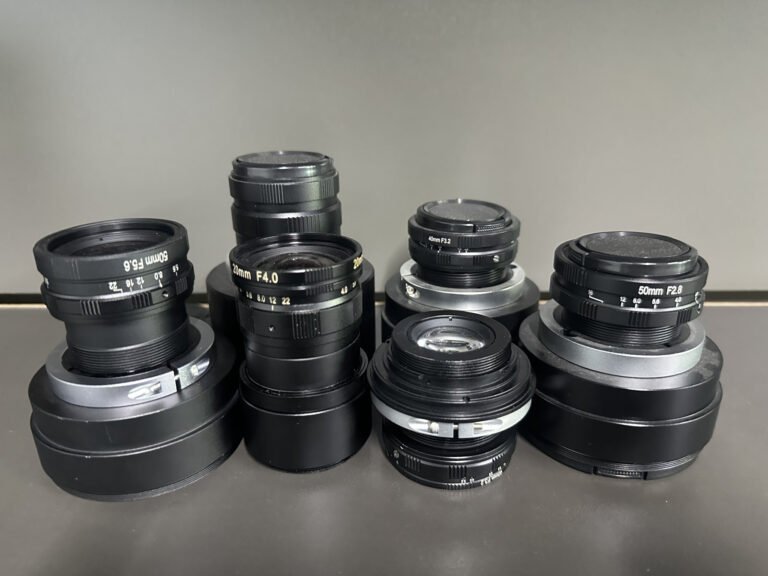
M12 is M12x0.5 with no flange standard. C-mount is 1-32 UN at 17.526 mm. Match the camera body first.
read more…