Spacer Rings, Varifocal or Custom Focal Length: Choosing and Documenting an Exact FOV
Answer the field of view question with the error budget, not with whichever option is easiest to buy. If a catalog lens already produces...
read more…
The line scan vs area scan choice is visible on the floor before anyone opens a datasheet. A foil web never stops. A connector sits still under a C-mount camera. One station needs a single pixel row and an encoder. The other needs a frame trigger and a 2/3″ FA lens. Mixing those architectures is how a 16K camera gets a C-mount barrel that covers half the line.
Key Takeaways
Machine vision cameras split on how they sample the world. An area-scan sensor is a grid. One trigger, one rectangle. A line-scan sensor is a single row. The object, or the camera, must move so successive rows become a 2D image. That is why a web of film can be inspected at full width without stitching six area-scan heads.
The scene on a foil line is motion plus a bright line of light. The scene on a connector gauge is a part in a nest. If you force area scan onto a continuous web, you fight overlap, lighting falloff, and missed strips. If you force line scan onto a part that stops, you have no rows to assemble.
Pick the architecture from the motion. Then size the lens to the sensor length, not to a C-mount habit.
The table is the decision. Everything after it is how you keep the lens from clipping the line.
| Parameter | Line scan | Area scan |
|---|---|---|
| Capture | One pixel row, then motion | Full frame, one exposure |
| Motion | Required; encoder-matched | Static or moderate |
| Typical sensor | 4K / 8K / 16K line | 2/3″ to 1.1″ area |
| Lighting | Line illumination | Area / ring / dome |
| Best object | Web, cylinder, wide sheet | Discrete nested part |
Verdict — line scan: Use it when the part does not fit one frame at the resolution you need, or when it never stops. Budget encoder, line light, and a lens whose circle covers the full line.
Verdict — area scan: Use it for connectors, labels, and assembly checks. A C-mount FA lens with distortion below 0.05% is enough for many gauges. Do not buy 16K because the brochure looks serious.

Line length is arithmetic. Pixel count times pixel pitch. A 16K line at 3.5 μm is 16,384 × 0.0035 mm = 57.344 mm. An 8K line at 5 μm is 40.96 mm. A 4K line at 7 μm is 28.672 mm. The lens image circle must cover that length at the magnification you actually run. A 2/3″ C-mount circle is about 11 mm on the diagonal. It cannot cover a 57 mm line.
Edmund Optics notes that roll-off is especially relevant for large or line-scan sensors. Even when the circle “covers” the line, illumination can fall toward the ends. Relative illumination belongs on the RFQ next to image circle, not as an afterthought when the web shows dark stripes.
| Line | Pitch example | Line length | FA C-mount? |
|---|---|---|---|
| 4K (4096) | 7 μm | 28.672 mm | No |
| 8K (8192) | 5 μm | 40.96 mm | No |
| 16K (16384) | 3.5 μm | 57.344 mm | No |
| 2/3″ area | diagonal ~11 mm | Area rectangle | Yes, FA line |
Those millimetres are pixel count × pitch, not catalog poetry. If your camera is 16K at 5 μm, the line is 81.92 mm and you need a still larger circle. Send the exact pixel count and pitch with the RFQ. Lensmind’s factory line includes a 40 mm 16K-class lens; image-circle matching for 4K / 8K / 16K is the selection topic, not a footnote.

The machine vision lens selection guide still starts from sensor format, working distance, FOV, resolution and environment. For line scan, “format” is the line length, not a 2/3″ label. For area scan, format is the rectangle. After that split, magnification and working distance behave the same way.
| Best for | Not ideal for |
|---|---|
| Line scan on film, foil, textile, electrode web | A part that stops in a nest |
| Line scan unwrapping a can or roller | A 16K camera with a 2/3″ FA lens |
| Area scan for connectors, labels, assembly | A two-metre web at 50 μm defects |
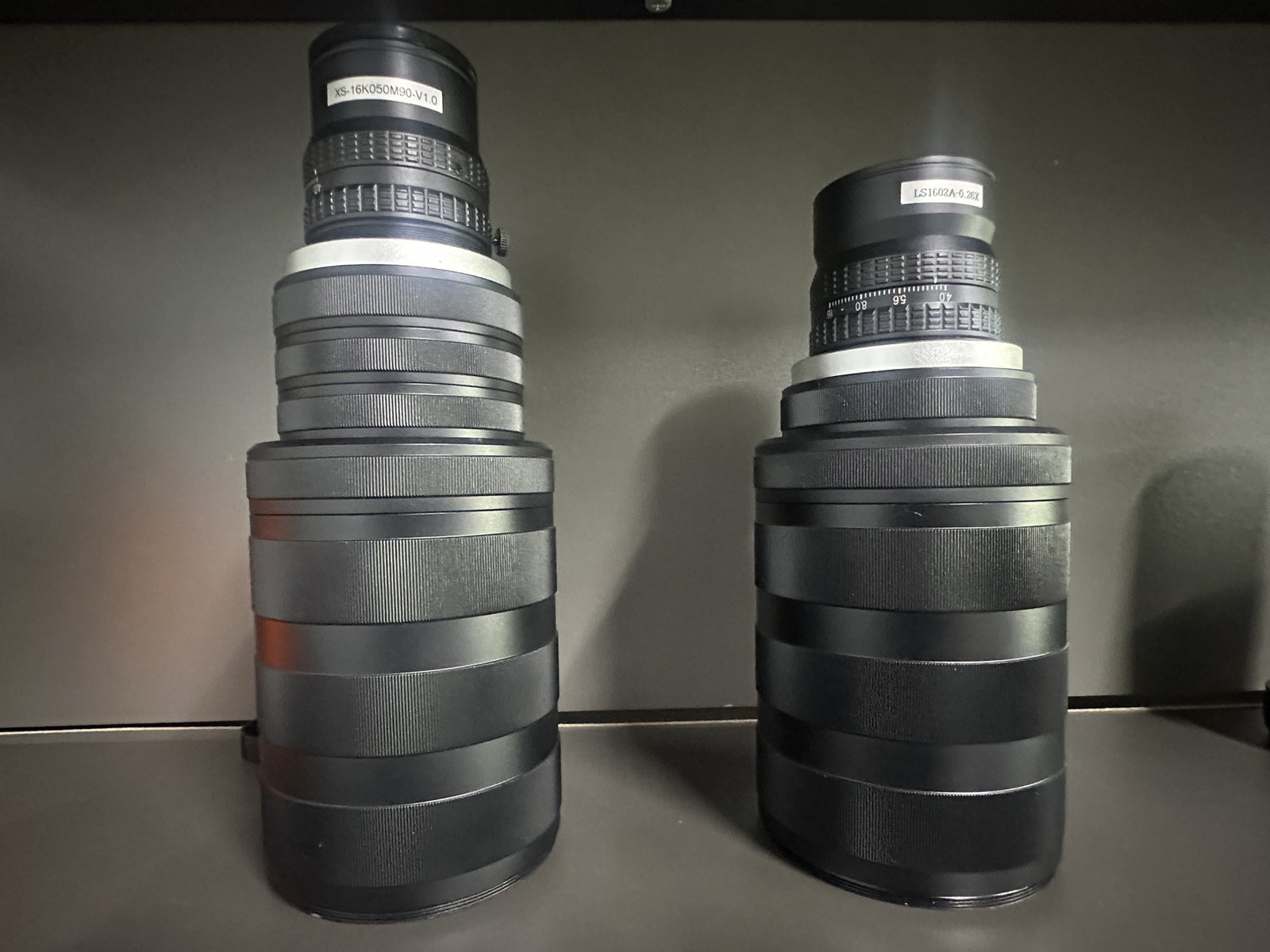
If the object is a web, start from line scan lenses and send line length. Catalog units on the floor include LS8040A-class barrels and 16K cells such as LS1602A. If the object is a discrete part on a 2/3″ to 1.1″ camera, stay on FA C-mount.
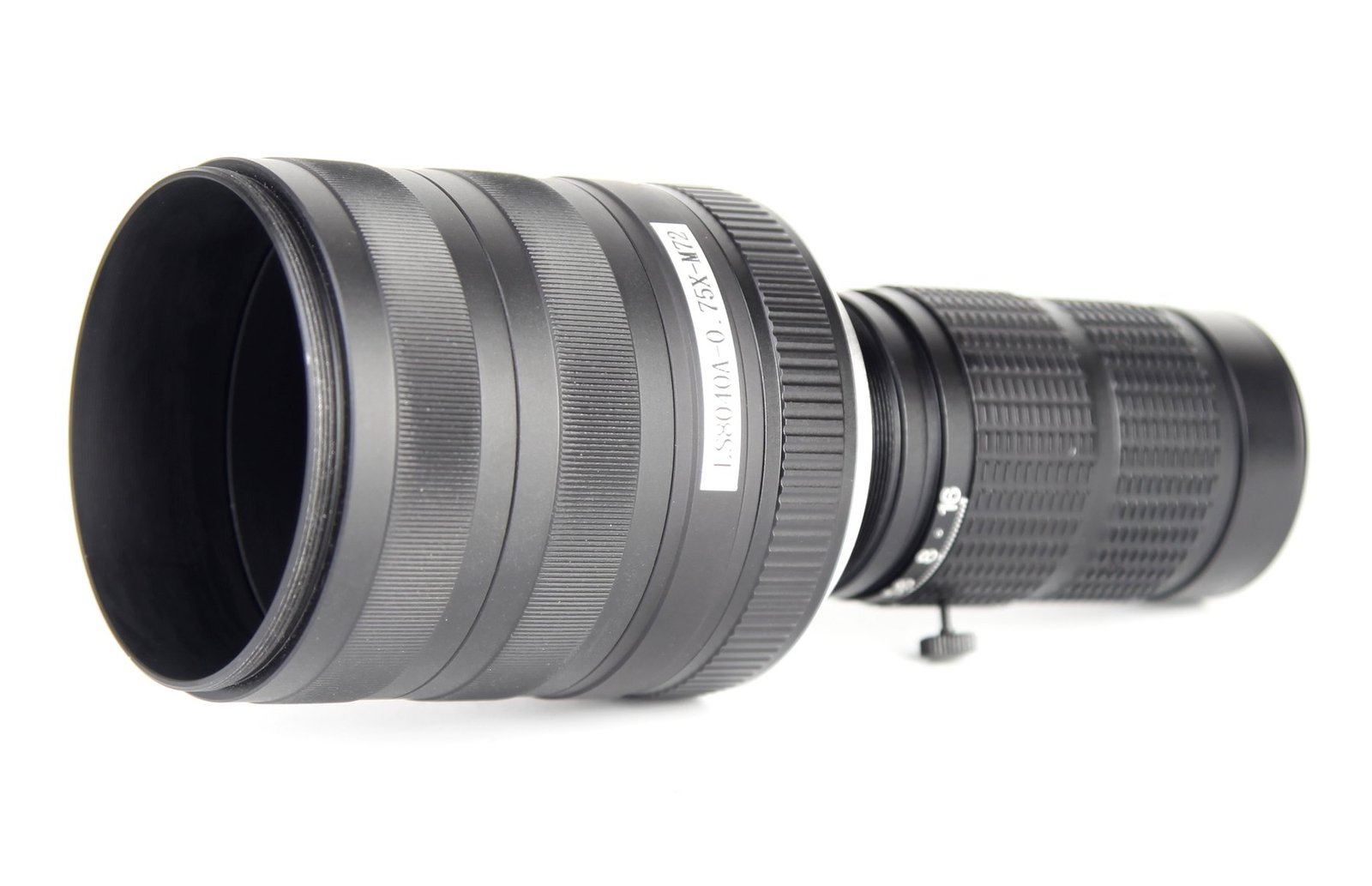
Hangzhou machines, coats, cements and assembles in house. Class 10,000 cells. 1 μm-class active alignment when the unit needs it. ISO 9001 certified 2024. The line-scan-specific checks sit on top of that.
FA distortion below 0.05% is the area-scan number. Quote the line-scan distortion from that drawing, not from the FA brochure. Custom feasibility still returns within 48 hours after NDA if the circle is not a catalog match.
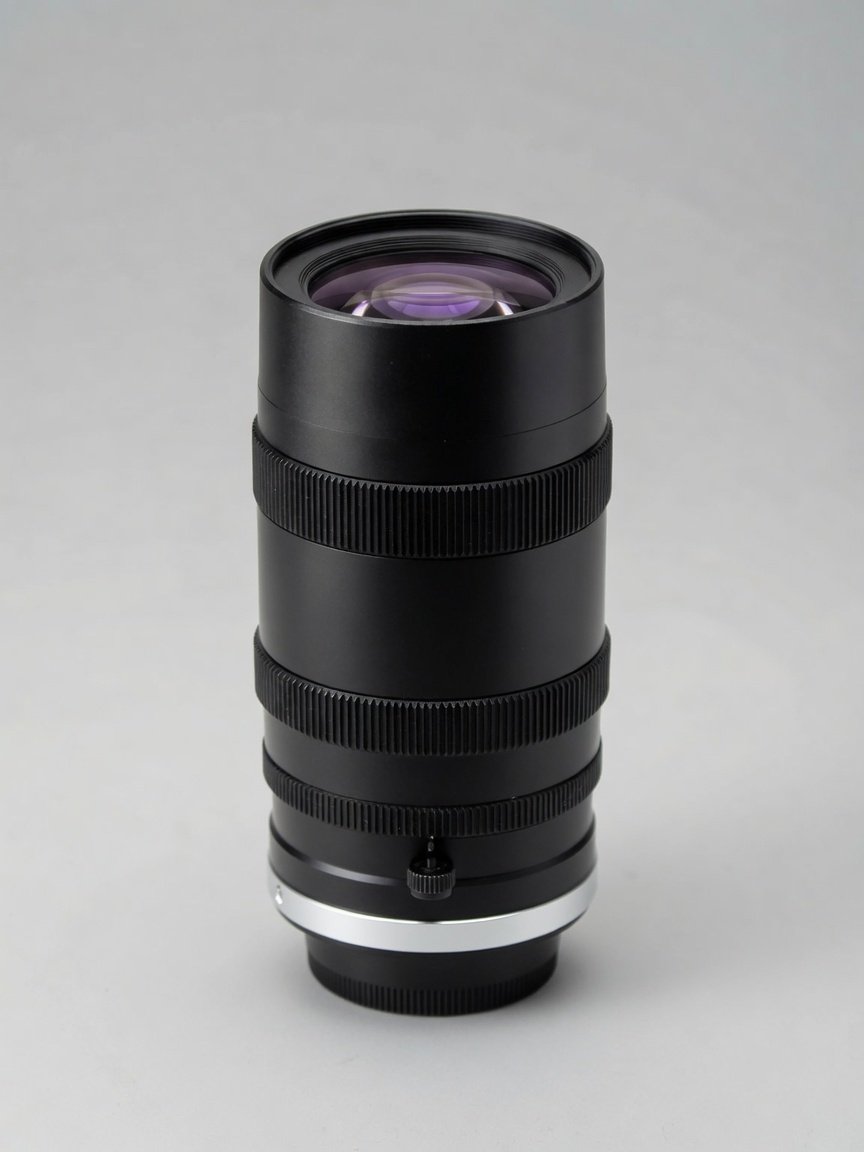
Illustrative pair. Station A: electrode coating on a moving web, 16K at 3.5 μm, defects specified across the full width. The lens must cover 57.344 mm and hold illumination at the edges. An encoder ticks the line rate. Station B: a 2/3″ C-mount camera over a connector nest. One frame, distortion below 0.05%, no encoder. Those two RFQs should not share a lens SKU.
The failed mix looks like this: purchasing copies the 16K camera into an FA C-mount line because “we already buy C-mount.” The centre of the web is sharp. The last two thousand pixels are dark or vignetted. False “coating skip” alarms fire at the edges. The fix is a line-scan lens, not a brighter bar light.
Line scan and area scan are two ways to sample a surface. Motion and width decide the camera. Image circle decides the lens. A 16K line at 3.5 μm is 57.344 mm. A 2/3″ FA cell does not cover it.
Key Takeaways
If the part is a web or an unwrapped cylinder, send the line length and stay on the line-scan family. First-pass feasibility still returns within 48 hours. If the part sits still in a nest, do not buy a 16K camera to look serious.
Written by Baker Zhao, Founder at Lensmind Optics. Hangzhou factory in the Lin’an optics cluster; ISO 9001 certified 2024. Company registered 2019.
Use line scan for continuous webs, unwrapped cylinders, or widths that will not fit one area-scan frame at the resolution you need.
Multiply pixel count by pixel pitch. A 16K sensor at 3.5 μm is 57.344 mm. The lens image circle must cover that length.
No, not at 57 mm class. FA C-mount circles are sized for 2/3″ to 1.1″ area sensors, not 16K lines.
Yes. Line rate must match object speed so rows do not stretch or compress. Area scan uses a frame trigger instead.
Pixel count, pitch, magnification, web width, working distance, and a relative-illumination target at the line ends.

Answer the field of view question with the error budget, not with whichever option is easiest to buy. If a catalog lens already produces...
read more…
Settle one question before you touch the CAD template: who moves focus, the camera or the lens. If each of the eight positions must...
read more…
C-mount is 17.526 mm. CS-mount is 12.526 mm. Same 1-32 UN thread. The 5 mm ring is one-way.
read more…